
Music Theory and Composition

Ryan Leach is an Award Winning Composer for film and tv. His music has been heard on Every major Network. His clients includes Disney, Mtv and Netflix.
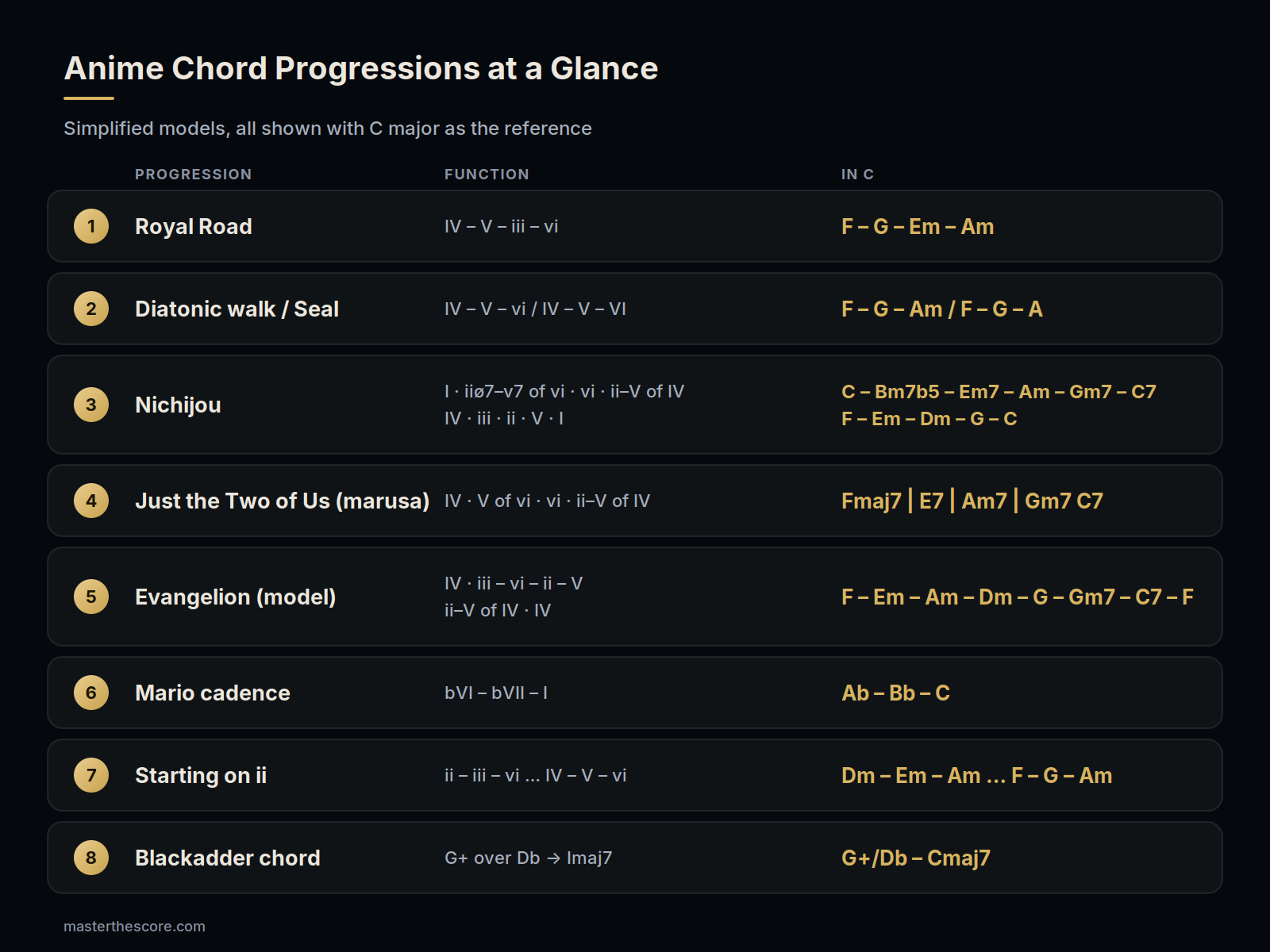
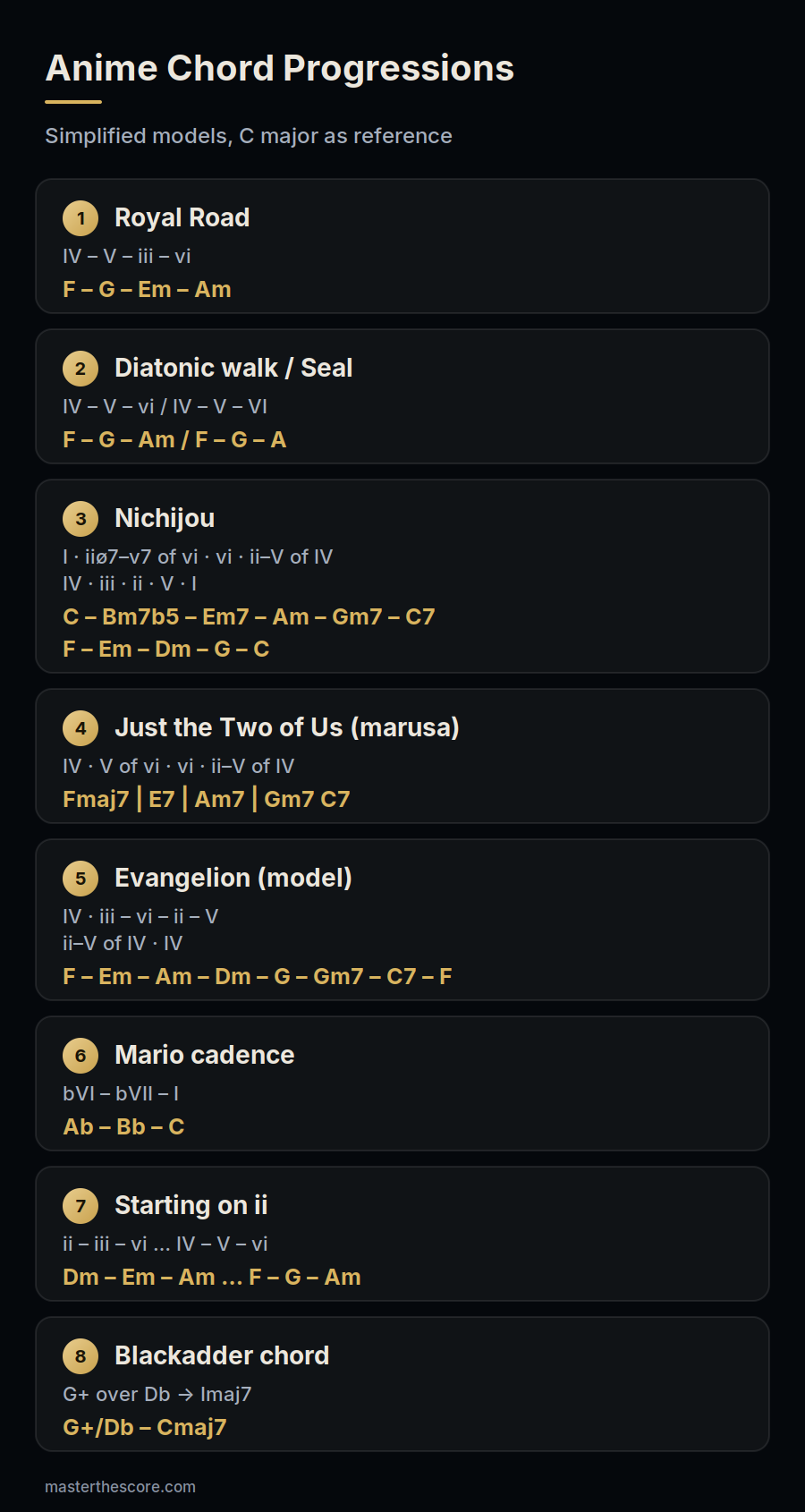
Anime and Japanese game music has a harmonic sound you can recognize within a few bars: warm, a little nostalgic, often jazzy, and very good at making a chorus feel like it is lifting off. A large part of that sound comes from a handful of chord progressions that Japanese composers and songwriters return to again and again. This guide collects eight of the most useful ones, with what each one sounds like and where it tends to appear. It is based on the harmony curriculum of our anime and JRPG composition courses, The Legend of Otoe.
Unless stated otherwise, the examples use C major as a reference for comparison. The perceived tonal center can vary with the musical context. The examples are simplified models that show the shape of each progression, not full transcriptions of the songs they are associated with. Real pieces use other keys, voicings and small variations.
There is no single rule, but a few habits show up across anime openings, Studio Ghibli scores and JRPG soundtracks:
Almost every progression below is a combination of these four ideas.
In C: F – G – Em – Am
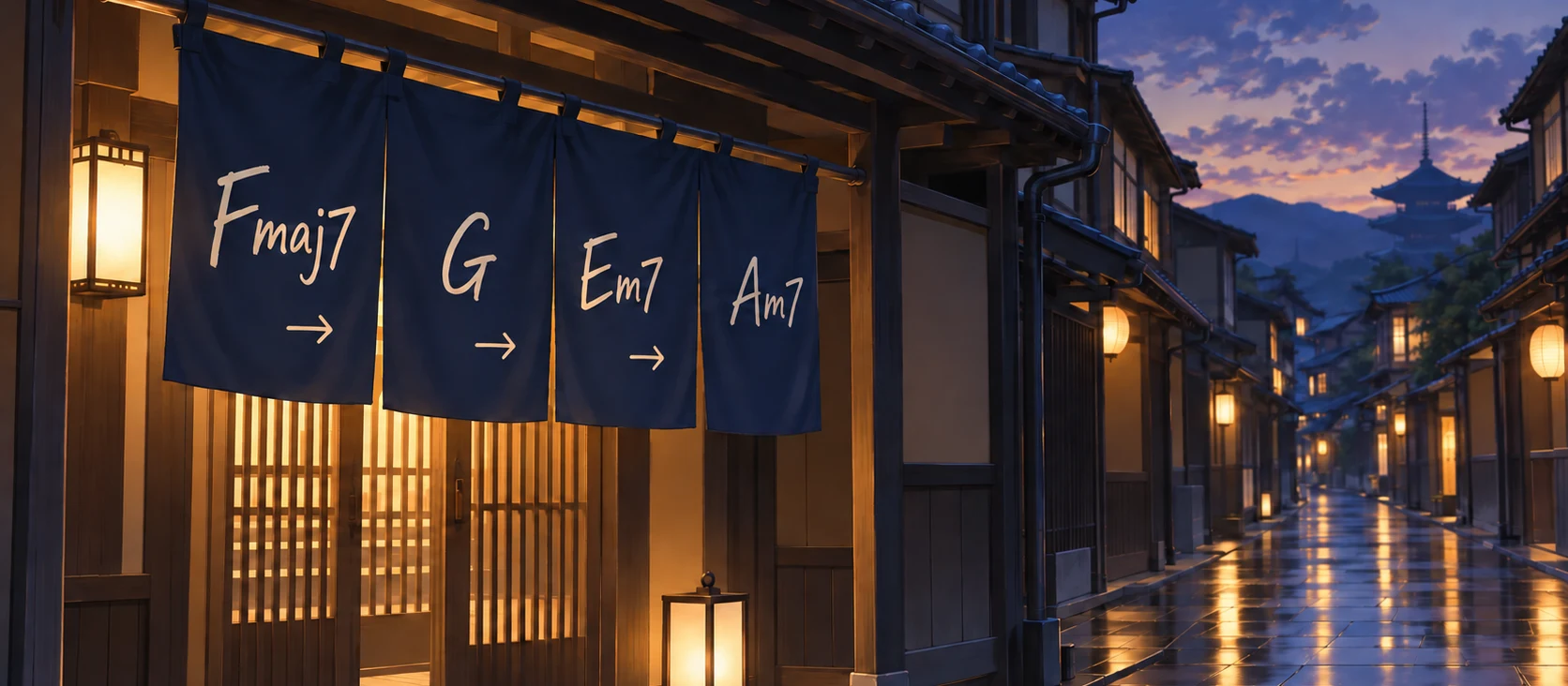
If you learn only one Japanese progression, this is the one. It is so common that Japanese musicians have a name for it: ōdō shinkō, the Royal Road progression, a well-traveled road that countless J-pop songs, anime openings and game themes have walked. Instead of resolving from V to I, it steps sideways to iii and settles on vi, which gives it that bittersweet, hopeful quality.
The Royal Road has enough history and variations to fill its own article, so we wrote one: The Royal Road Progression.
A diatonic walk is exactly what it sounds like: a progression that walks up or down through the chords of the key, one step at a time. A few examples:
Diatonic walks are very hard to get wrong. The smooth, stepwise bass line does most of the work, which is why they are a good starting point for village themes and calm, pastoral music.
A popular variation changes the last chord of the climb. Instead of IV – V – vi, the walk lands on a major VI: F – G – A. That A major chord is not in the key of C, so this is a chromatic variation of the diatonic walk rather than a purely diatonic one. The unexpected brightness of that chromatic chord is what gives it its lift. You can stretch the moment with a suspension first (F – G – Asus4 – A): will it resolve to minor or major? It resolves to major.
In our courses we call this the Seal progression, after the three-chord climb in Seal's "Kiss from a Rose." Keep in mind that in the song itself, the last chord of that climb is heard as home. There the same shape works as a cadence, which brings us straight to the Mario cadence in section 6.
In C: C – Bm7b5 – Em7 – Am – Gm7 – C7 – F – Em – Dm – G – C
This is the most involved progression in this guide, and it is especially common in J-pop. We call it the Nichijou progression, after the opening music of the slice-of-life anime Nichijou.
It combines descending-fifth motion, a secondary ii–V, and a diatonic walk:
Written out like this it looks complicated, but the logic is simple: visit vi, visit IV, walk home.
The Legend of Otoe: Composing Music for Anime and JRPGs Level 1 takes you from harmonic functions and secondary dominants to your first complete piece in the style, a hometown village theme for piano and string quartet. Explore the course
In C: | Fmaj7 | E7 | Am7 | Gm7 C7 |
This progression takes its name from Grover Washington Jr. and Bill Withers' "Just the Two of Us." In Japan it is so widespread that it has its own nickname: marusa shinkō (丸サ進行), after Shiina Ringo's song "Marunouchi Sadistic." Online it is also sometimes called the "anime canon." Treat these names as labels for a family of closely related versions rather than one fixed eight-bar pattern.
The core is a four-bar loop, with Gm7 and C7 sharing the last bar. Its structure is surprisingly simple: there are only two real destinations, the IV chord and the vi chord, and each one is approached by its own dominant.
The progression swings back and forth between those two targets. One common eight-bar version plays the loop once and then holds Am7 instead of the ii–V at the end:
| Fmaj7 | E7 | Am7 | Gm7 C7 | Fmaj7 | E7 | Am7 | Am7 |
The held vi gives the phrase a place to rest. Because the progression never lands on C major, it has a floating, late-night feel that works beautifully under a relaxed groove.
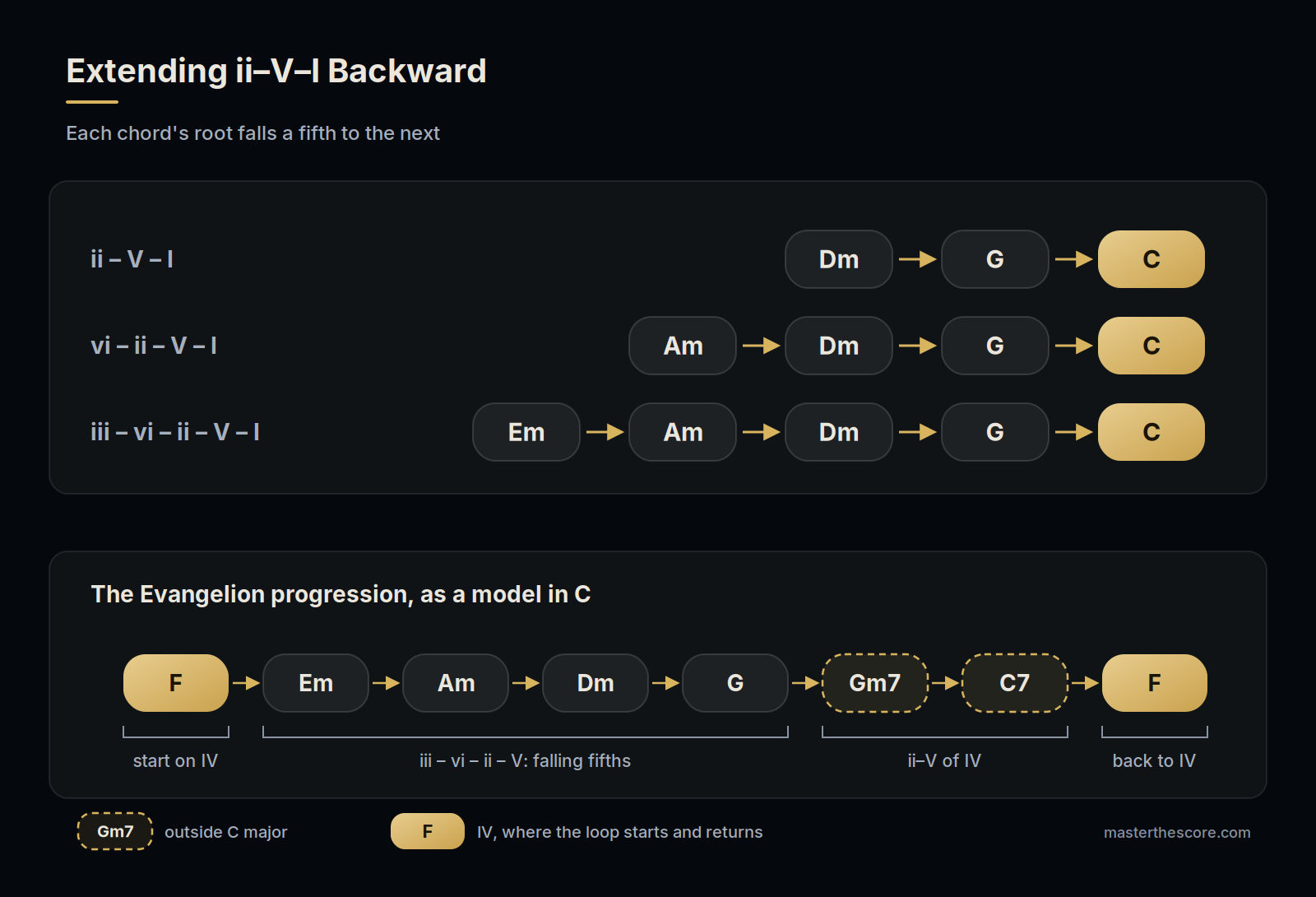
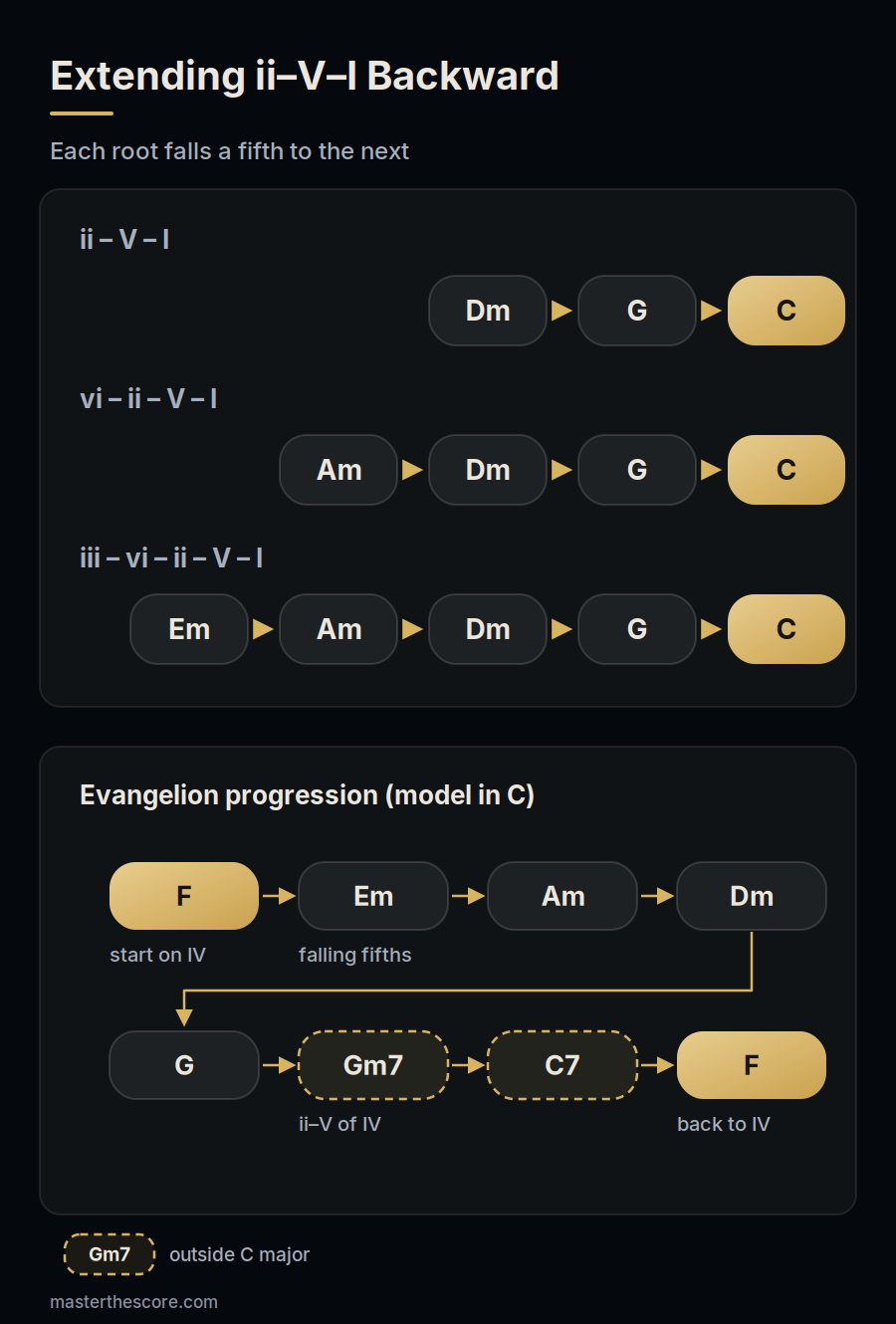
To understand this one, it helps to look at one of the oldest principles of tonal harmony: root motion by falling fifths. A ii–V–I moves down in fifths, from D to G to C. You can keep extending the chain backward with chords from the same key. A minor is a fifth above D minor, so ii–V–I can become vi–ii–V–I. Go one step further and you get the rarer iii–vi–ii–V–I, and so on. Each new chord leans naturally into the next. The principle is centuries old, but bebop jazz musicians used these chains so heavily that they have become part of the modern jazz vocabulary, and Japanese pop inherited them from there.
In The Legend of Otoe we call one version of this idea the Evangelion progression, because of its association with the opening of Neon Genesis Evangelion. Its shape: start on IV, drop into a iii–vi–ii–V chain, and then use a small ii–V to return to IV instead of going home to I.
A model in C: F – Em – Am – Dm – G – Gm7 – C7 – F
The result is a loop that keeps rolling forward and never quite settles. Once you know the principle, you can build your own chains of any length.
In C: Ab – Bb – C
A cadence is musical punctuation, the moment where a phrase comes to rest. The Mario cadence gets there in a more dramatic way than the usual V–I. It is named after the level-clear fanfare in Super Mario Bros., and it is also known as the Aeolian cadence.
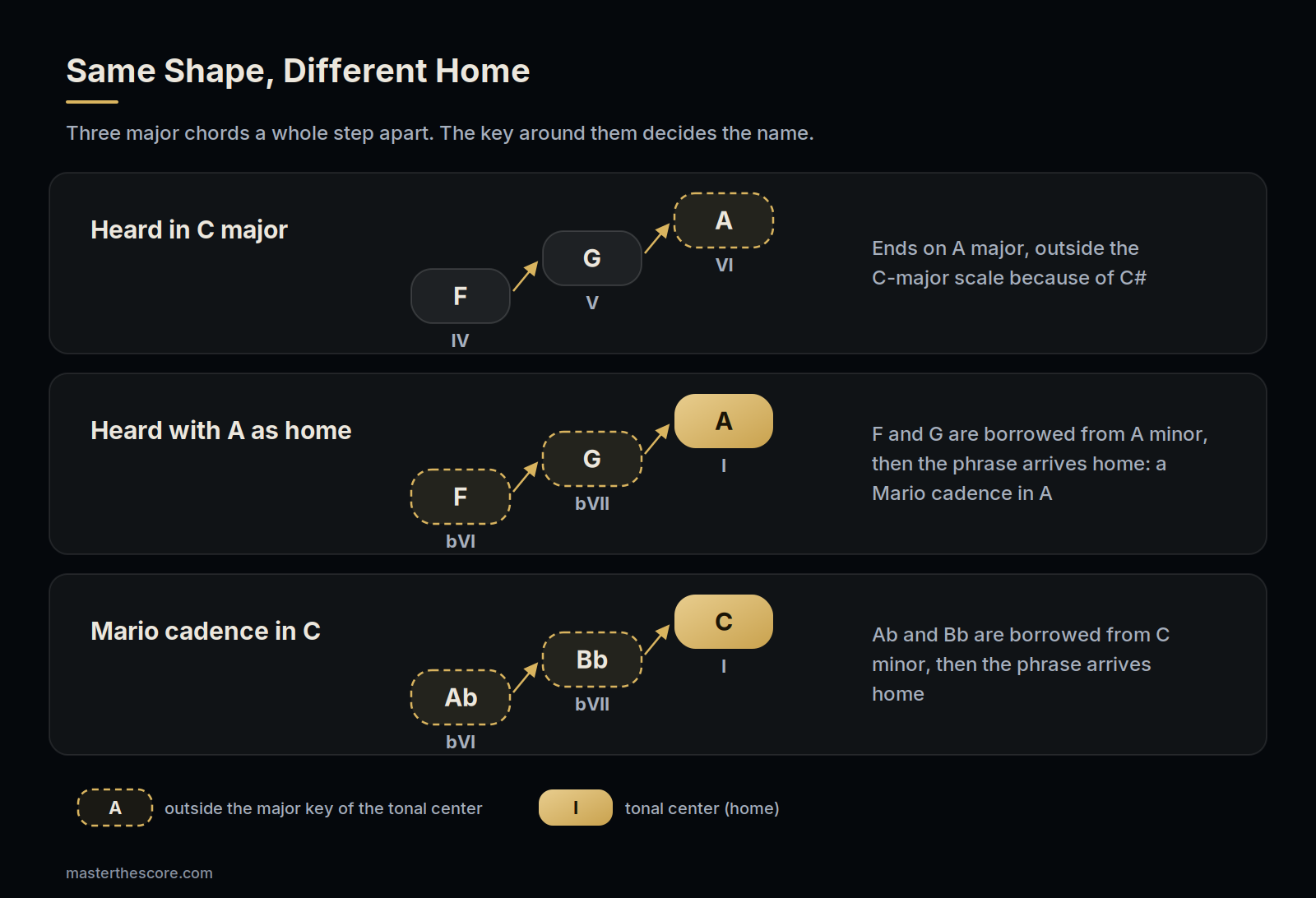
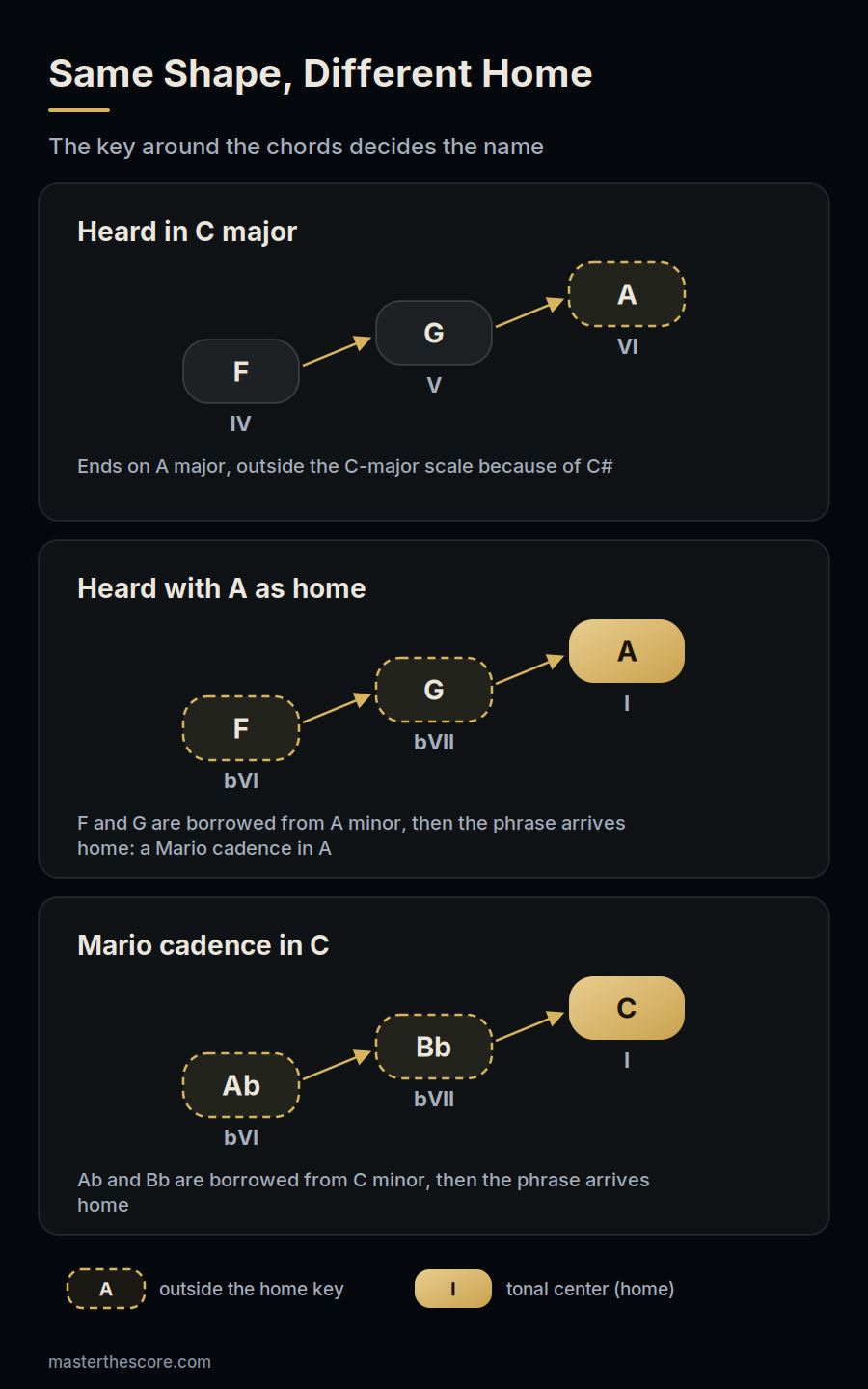
It borrows two chords from the parallel minor: the major chords built on the flat sixth and flat seventh degrees of the scale (Ab and Bb in C). Neither contains the leading tone B, so the arrival sounds broad and triumphant rather than tidy. It is a great ending for a hero theme or a victory moment.
You may notice that this is the same shape as the major-VI climb from section 2: three major chords, each a whole step apart. What decides the name is context, meaning which chord the ear hears as home. Heard in C, F – G – A is IV – V – VI and ends away from home on a chromatic major chord. Heard with A as the center, the very same chords are bVI – bVII – I, a Mario cadence in A. The chords do not change; the key around them does.
A close relative is the backdoor ii–V: Fm – Bb7 – C. Both chords come from C minor, and the Bb7 would normally resolve to Eb, but instead it steps up to C. Compared with the Mario cadence, two things change: Fm takes the place of Ab (both are subdominant chords), and Bb becomes a dominant seventh chord.
If you want to go deeper into borrowed chords like these, see our guide to modal interchange.
Most of the progressions above begin on IV, but IV is not the only subdominant chord in the key. The ii chord does the same job with a softer, minor color. A good example is the chorus of "Butterfly Effect" by the Japanese jazz trio Fox Capture Plan. It opens with a short diatonic walk from ii that jumps ahead to vi, and then closes with a Royal Road–style climb.
A model in C: Dm – Em – Am … F – G – Am
It is a small change, but starting on ii makes a familiar progression sound fresh.
Resolving to C: G+/Db – Cmaj7
Strictly speaking, this is a chord rather than a progression, but it appears so often in anime and J-pop that it belongs here. The Blackadder chord is an augmented triad over a bass note a tritone below its root. In C, that is G augmented (G – B – D#) over a D-flat.
Read from the Db in the bass, the notes spell (enharmonically) the root, the #11 (G), the minor seventh (B = Cb) and the ninth (D# = Eb). The third and the fifth are missing, so you could write it as Db9(#11, no3, no5). That hollow middle, with the bass and the upper notes far apart, is a big part of its shimmering sound.
When it resolves to Cmaj7, the voice leading is very smooth: Db falls a half step to C, D# rises a half step to E, and G and B can simply stay where they are. In this context the chord works like a tritone substitute for the dominant, although it does not contain the full F–Cb tritone of a Db7 chord, and in other contexts it can function differently. Its Japanese popularizer, Hidekazu Tanaka, called it the augmented slash chord, and it has also been described as the Japanese augmented sixth chord.
For a closer look at how it works, see our articles on the tritone and augmented chords.
The Legend of Otoe: Levels 2 and 3 Borrowed chords, tritone substitution, altered dominants and the variations that turn these progressions into your own music, practiced in hands-on workshops and applied to a full adventure theme. Explore the course
The same chords can sound like a church hymn or like an anime opening. Melody, rhythm, instrumentation and arrangement all play a big part in that. On the harmonic side, voicing makes a large difference:
Learning the names is the easy part. Hearing how far each progression can be stretched, and how to move between them in a finished piece, takes practice. That is what the workshops in The Legend of Otoe are for.
Our Music Composition & Orchestration Courses
Our Music Production Courses
Our Music Trailer Courses
See All CoursesWhat is the most common anime chord progression? The Royal Road progression (IV – V – iii – vi, or F – G – Em – Am in C) is probably the most widely used. It appears in countless anime openings, J-pop songs and game soundtracks, often with small variations.
What is a Japanese chord progression? There is no official definition, but the term usually refers to progressions that are especially common in Japanese pop, anime and game music, such as the Royal Road, Just the Two of Us (marusa) and Nichijou progressions. They often start on the IV chord and use secondary dominants, borrowed chords and jazz extensions.
What is the Just the Two of Us progression? In C major, its core is a four-bar loop: Fmaj7 – E7 – Am7 – Gm7 C7, with Gm7 and C7 sharing the last bar. It alternates between the IV chord and the vi chord, approaching each with its own dominant. It is named after the song by Grover Washington Jr. and Bill Withers, and in Japan it is also known as the marusa progression (丸サ進行), after Shiina Ringo's "Marunouchi Sadistic."
What is the Mario cadence? It is the progression bVI – bVII – I (Ab – Bb – C in C major), named after the level-clear fanfare in Super Mario Bros. It borrows two major chords from the parallel minor key and arrives at the tonic with a broad, triumphant sound. It is also known as the Aeolian cadence.
What is the Blackadder chord? It is an augmented triad over a bass note a tritone below its root, for example G+/Db. Read from the bass, it contains the root, #11, minor seventh and ninth, with no third or fifth. Resolving to Cmaj7, the Db falls to C, the D# rises to E, and G and B can stay in place, so in that context it works much like a tritone-substituted dominant.
Why do so many anime progressions start on the IV chord? Starting on IV creates a sense of motion right away, because the ear does not hear the first chord as home. It lets the progression build toward a resolution instead of beginning with one, which suits the energy of opening themes and choruses.
Do I need jazz theory to write anime chord progressions? No. Many of these progressions use only the chords of one key. Jazz ideas like seventh chords and ii–V movements add color and are worth learning step by step, but a simple diatonic walk with good voicings already sounds convincingly in the style.
Learn with Master The Score
Courses on composition, orchestration, music production, trailer music and sound design, from composers writing for film, games and media. Students also get exclusive discounts on leading sample libraries and plugins.
Discover all courses →


Online education for media composers — orchestral writing, trailer music, mixing and more, taught by working professionals.