
Music Theory and Composition

Ryan Leach is an Award Winning Composer for film and tv. His music has been heard on Every major Network. His clients includes Disney, Mtv and Netflix.
If you have ever wondered why so many anime openings, J-pop songs and JRPG themes share a certain bittersweet, forward-leaning sound, a large part of the answer is one four-chord progression: IV–V–iii–vi, known in Japan as the Royal Road progression. This guide explains what the Royal Road progression is, why it sounds the way it does, how Japanese composers modify it, and how to use it in your own music. The material is drawn from The Legend of Otoe, the Master The Score course series on composing music for anime and JRPGs. For the full picture of the style beyond harmony — melody, instruments and structure — see our guide on how to write anime music.
The Royal Road progression is a four-chord sequence built on the fourth, fifth, third and sixth degrees of a major key: IV – V – iii – vi. In C major that is F – G – Em – Am. In practice it is usually played with seventh chords, which gives it its characteristic warmth: Fmaj7 – G7 – Em7 – Am7.
Japanese musicians call it the ōdō shinkō (王道進行), which translates directly as "royal road progression". The image is of a broad, paved imperial road: a path that has been travelled so often that it has become the standard route. That is exactly the role the progression plays in modern Japanese music. It is central to J-pop, city pop and J-rock, and it is one of the first things a composer needs to know when writing in the style of anime or JRPG soundtracks.
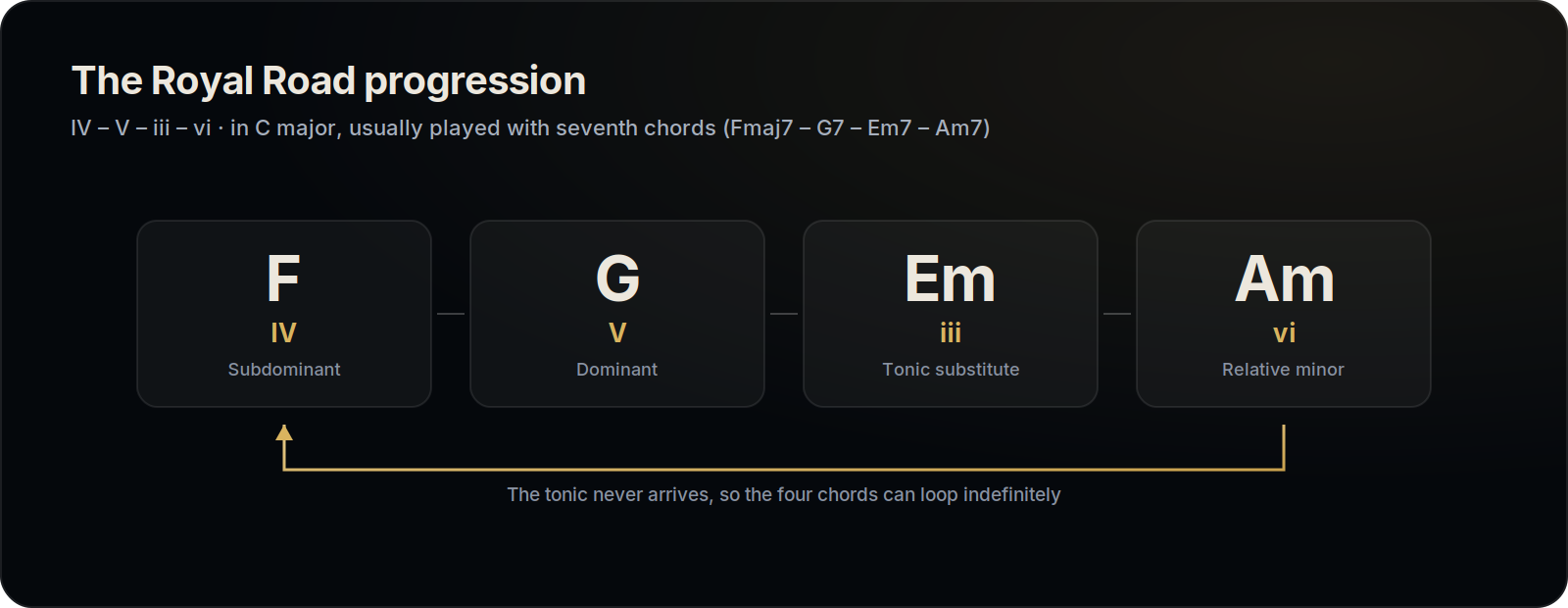
A quick way to hear it: play the four chords as a loop on the piano. The progression never lands on the tonic chord, so it feels as if it is always about to arrive somewhere without quite settling. That quality is the point.
Nothing about the individual chords is unusual. IV, V, iii and vi are all diatonic, and Western pop uses all four constantly. What makes the Royal Road distinctive is the order.
This combination of brightness, deferred resolution and a minor landing is a large part of why the progression reads as emotional and slightly melancholic even at fast tempos. With seventh chords on every step, the jazz influence that runs through so much Japanese popular music becomes audible as well.
Three other progressions sit alongside the Royal Road in defining the modern Japanese sound: the Seal progression, diatonic walks and the Nichijou progression. Of the four, the Royal Road is probably the most commonly used. Seal and Nichijou are the names we use in our courses for these patterns; the progressions themselves are heard all over the genre.
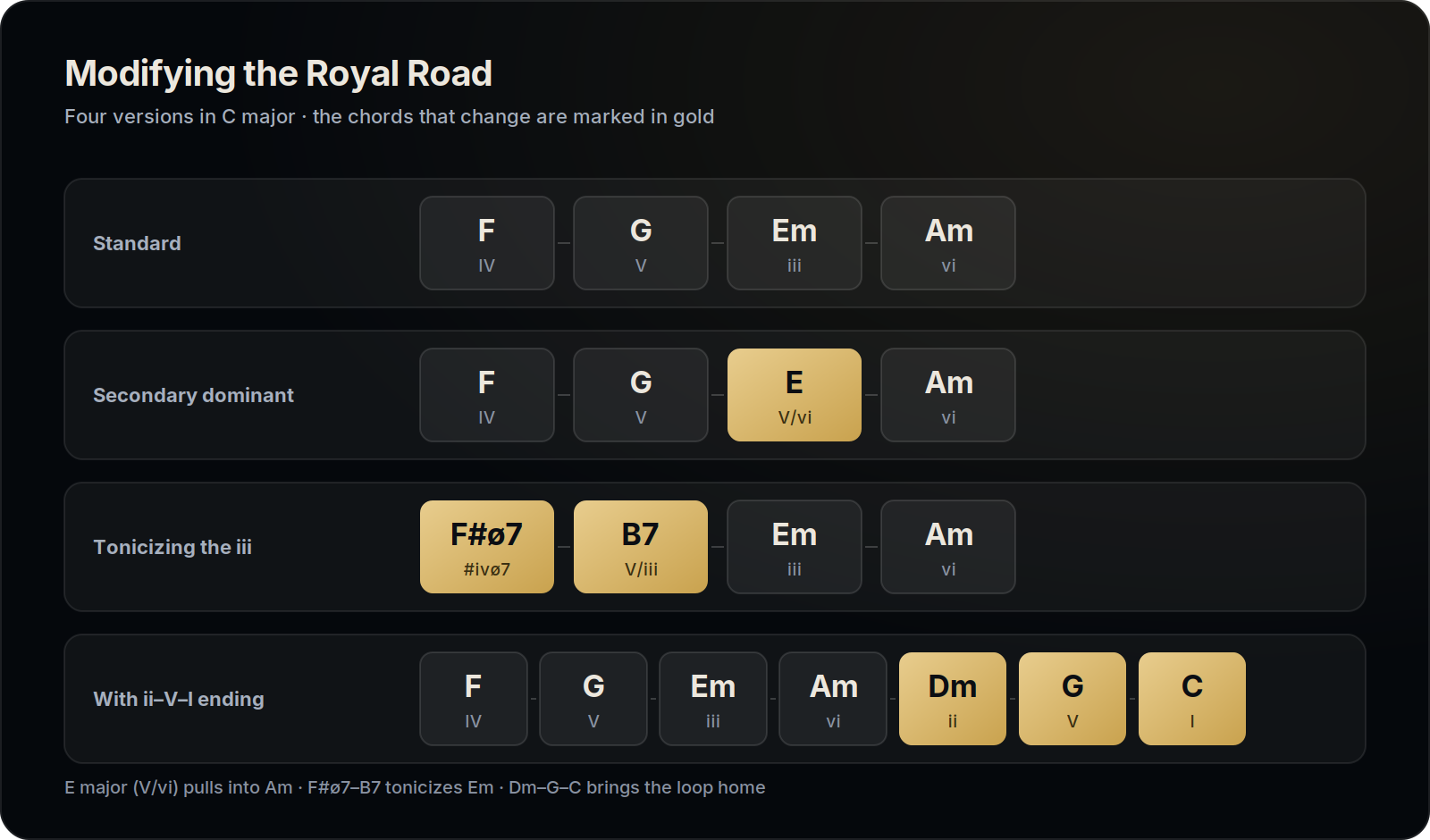
A useful reference version adds a ii–V–I cadence at the end. In C major:
F – G – Em – Am – Dm – G – C (IV – V – iii – vi – ii – V – I)
The ii–V–I tail gives the loop a proper landing point when you want one, and Royal Road straight into a ii–V–I is very typical of the genre. Many Japanese songs use exactly this shape: four chords of Royal Road, then a cadence home.
The Legend of Otoe: Composing Music for Anime and JRPGs Royal Road, Seal and Nichijou progressions, taught through an original story and finished with your own score in the style. Explore the course
Here is where the progression becomes interesting. There are enough variations available that you never really need to play the plain version again, and we recommend that you don't.
The modifications fall into a few families.
The simplest changes keep the harmony but alter the bass line or swap a chord for one with the same function. Inversions give the progression a smoother, more melodic bass, and functional substitution replaces a chord with another that does the same job, such as exchanging the iii for another tonic-function chord.
A very common change is to turn the iii chord into a major chord. In C major, Em becomes E major, which is the dominant of vi (V/vi). The result is F – G – E – Am: the E pulls hard into the A minor that follows. Strictly speaking this is no longer the standard Royal Road, since the third chord is usually minor, but it is one of the most common ways to play it.
The same principle can be applied elsewhere. At the end of the ii–V–I version, the C major tonic can be turned into a C7, which is V/IV, so that the progression loops back to F with extra pull.
A more advanced option comes from the Lydian mode. The raised fourth degree of the key can support a half-diminished chord, #iv ø7, which in C major is F#m7♭5. In the context of a Royal Road progression, this chord can replace the IV and act as the ii of E minor, so that F#m7♭5 – (B7) – Em tonicizes the iii chord instead of simply arriving at it. The progression gains a small internal cadence and a much more sophisticated colour.
Once you know borrowed chords, any step of the progression can take colour from the parallel minor or from another mode. In practice the plain triads get replaced by altered dominants, sevenths with extensions and chords borrowed from outside the key, while the underlying shape of the Royal Road stays recognisable.
The dominant chords in the progression, the V and any secondary dominants, can be replaced by their tritone substitutes or sharpened with alterations. Once the basic version is solid, tritone substitution and altered dominants are standard tools.
A related sound uses a fully diminished seventh chord in place of a dominant to increase tension. This variant is familiar from Zelda's Lullaby, which uses it in the key of G. The choice here is less about the Roman numeral than about the voice leading.
The Legend of Otoe: Levels 2 & 3 Borrowed chords, modal writing and a full lesson on Royal Road modifications, continuing into non-functional harmony in Level 3. Explore the course
Anime opening themes are a special case, and they explain why the modifications matter. An opening is short, fast and has to hold attention for ninety seconds. A faster tempo does not require more chords: tempo and harmonic rhythm are separate decisions. Modified Royal Road progressions are one way to add variety; rhythm, melody, register and instrumentation can also keep a short opening engaging.
Three habits are worth knowing:
This is a useful way to think about the Royal Road in general. It is so well known that using it unaltered can sound generic. Using it as a destination, a closing gesture or a heavily decorated version of itself keeps the recognisable sound while giving the song its own identity.
The Royal Road is one of a family of progressions that together define the modern Japanese sound. Four are worth knowing from the start, and three more once borrowed chords are part of your vocabulary:
Most of these, plus the Just the Two of Us progression and the Blackadder chord, are explained with their chords in C in our guide to anime chord progressions. For the Royal Road inside a complete loopable piece, see the JRPG town-theme walkthrough in our guide to how to make video game music.
A broader introduction to how these progressions fit alongside Western harmony, including the Royal Road in context, is in our complete guide to chord progressions for composers.
Our Music Composition & Orchestration Courses
Our Music Production Courses
Our Music Trailer Courses
See All CoursesWhat is the Royal Road progression? The Royal Road progression is the chord sequence IV – V – iii – vi in a major key, usually played with seventh chords (for example Fmaj7 – G7 – Em7 – Am7 in C major). It is one of the most common progressions in Japanese popular music and anime soundtracks.
Why is it called the Royal Road? The name is a direct translation of the Japanese term ōdō shinkō (王道進行). Ōdō means a royal or kingly road, the well-travelled main route, which describes how standard the progression has become in Japanese music.
Is the Royal Road the same as the "anime chord progression"? Largely, yes. When people talk about the anime chord progression they usually mean the Royal Road or one of its modifications, since it appears in a very large number of anime openings and endings. The closely related Seal progression (IV – V – VI) — our course name for the shape — is often meant as well.
What is the difference between the Royal Road and I – V – vi – IV? Three of the chords overlap (IV, V and vi), but the Royal Road swaps the tonic for iii and changes the order. I – V – vi – IV, the most common progression in Western pop, starts on the tonic and ends on the subdominant. The Royal Road starts on the subdominant, never states the tonic, and ends on the relative minor, which gives it a more suspended, melancholic quality.
Can you use the Royal Road progression in a minor key? The progression is defined relative to a major key, but because it ends on vi, the relative minor, it often feels minor already. Many songs treat the vi as the effective home and use the Royal Road as a loop within a minor-feeling piece.
Do I need seventh chords to play it? No, the plain triads work. Seventh chords are what most Japanese songs use, though, and they are a large part of the characteristic sound.
Learn with Master The Score
Courses on composition, orchestration, music production, trailer music and sound design, from composers writing for film, games and media. Students also get exclusive discounts on leading sample libraries and plugins.
Discover all courses →


Online education for media composers — orchestral writing, trailer music, mixing and more, taught by working professionals.