
Music Theory and Composition

David McCaulley is a pianist and composer known for his YouTube channel Film Score Analysis, home to more than 150 score reductions of iconic film scores. He studied composition and piano at the University of North Texas and teaches The Piano Composer at Master The Score.
The Dorian mode is a natural minor scale with a raised sixth degree. That single note is enough to give Dorian a character of its own, serious like minor, but brighter, prouder, and less heavy. It's the mode composers often reach for when a scene needs weight without sadness.
This guide covers the Dorian scale formula, how to build it in every key, how it differs from natural minor, which chords bring out its color, and how it's used in film, game, folk, and jazz. It's part of our series on the modes; for the big picture of all seven, start with our guide to modes in music.
The Dorian mode is the second mode of the major scale. Seen from its own root, it's a natural minor scale with a raised sixth degree, and that one raised note gives it its character.
Play the white keys of a piano from D to the next D and you get D Dorian: D, E, F, G, A, B, C. Those are the same seven notes as C major, but with D treated as home the scale takes on a completely different sound.
That last part matters. Starting a scale on D doesn't make music Dorian. The ear has to hear D as the tonal center: D in the bass, phrases that begin and end on D, harmony built around a D minor chord. Without that context, the same white keys drift back toward C major. The mode lives in the relationship between the notes and the tonic.
Because its third is minor, Dorian belongs to the minor family, alongside Aeolian (the natural minor scale), Phrygian, and Locrian. Of those four, it's the brightest, and that brightness comes from one specific note.
Compared to the major scale on the same root, Dorian lowers two degrees, the third and the seventh:
1 – 2 – ♭3 – 4 – 5 – 6 – ♭7
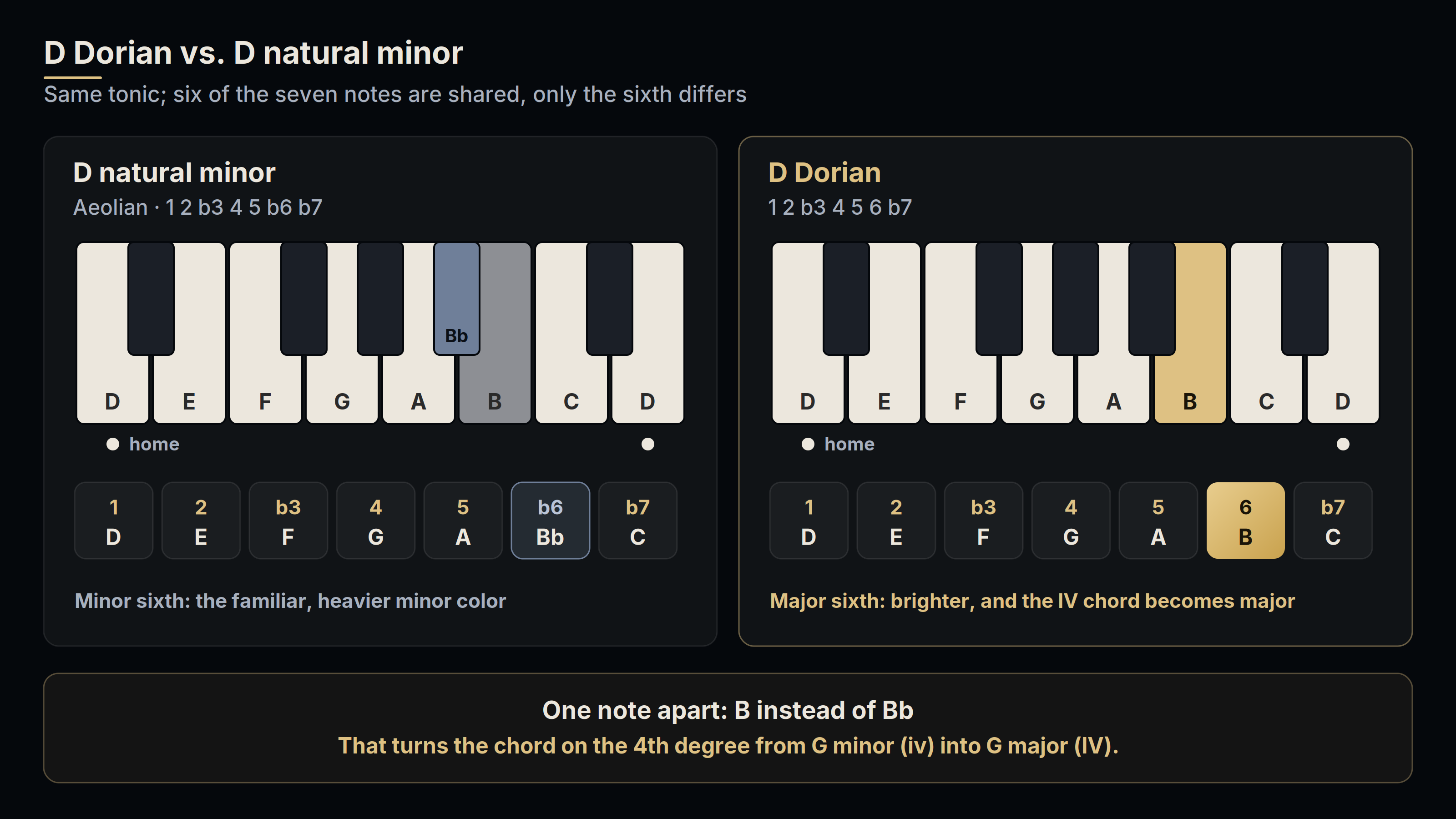
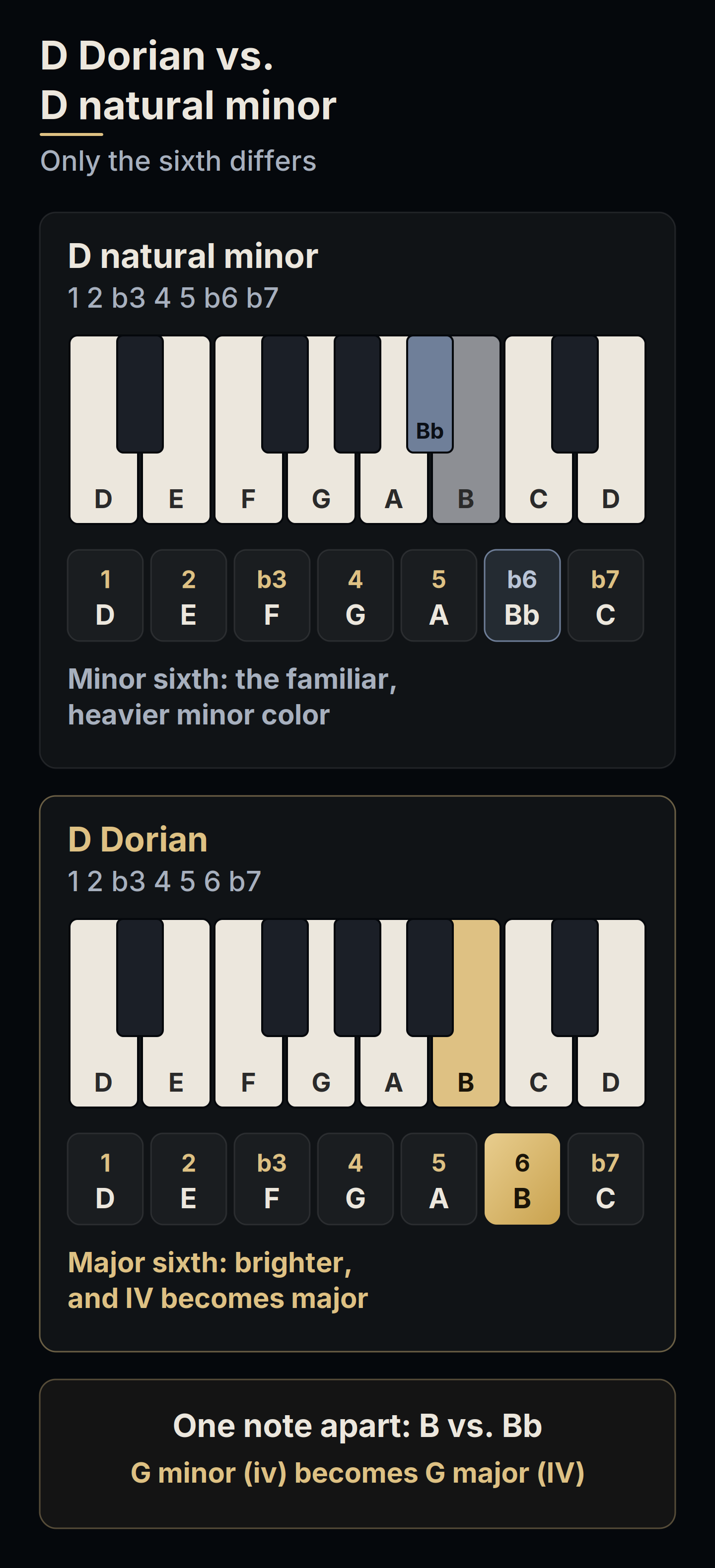
Compared to the natural minor scale, the difference is even smaller. Natural minor is 1 – 2 – ♭3 – 4 – 5 – ♭6 – ♭7. Dorian keeps everything except the sixth, which it raises back to a major sixth. That raised sixth is Dorian's color note: the one degree that separates it from ordinary minor and gives it its sound.
As an interval pattern, Dorian runs whole step, half step, whole step, whole step, whole step, half step, whole step. That pattern reads the same forward and backward, which makes Dorian the only one of the seven modes whose step pattern is symmetrical. It's a nice detail to know, and a quick way to check that you've built it correctly.
There are two ways to find the notes, and both are worth knowing.
Method 1: Start on the second degree of a major scale. Every Dorian scale shares its notes with the major scale a whole step below its root. D Dorian uses the notes of C major, G Dorian the notes of F major, A Dorian the notes of G major. This is the fastest way to find the notes, especially if you already know your key signatures.
Method 2: Take a minor scale and raise the sixth. Any natural minor scale becomes Dorian when you raise its sixth degree by a half step. G minor has E♭; G Dorian has E natural. C minor has A♭; C Dorian has A natural. This is the more useful way to think about Dorian while composing, because it tells you exactly what makes the mode sound the way it does, and it works from any root without having to work out which major scale is involved.
Here is every Dorian scale, with the major scale it shares its notes with:
In each one, the sixth degree is the note to watch: A in C Dorian, B in D Dorian, E in G Dorian.
Since Dorian and natural minor differ by only one note, the best way to understand Dorian is to hear that note in context. Play Dm – G – Dm, then Dm – Gm – Dm. The G major chord contains B, the major sixth above D, and gives the progression a Dorian color. The G minor chord contains B♭, the minor sixth, and sounds like ordinary D minor. Two short progressions don't establish a whole mode, but that difference between the two sixths is the difference between the two colors.
That's also why the major IV is the chord most often used to bring out Dorian. In natural minor, the chord on the fourth degree is minor (iv). In Dorian, the raised sixth turns it into a major chord (IV), and the result is a minor key with a major side to its personality.
Two related scales are worth separating from Dorian:
Because Dorian has no leading tone, it doesn't produce a major V chord. Its v chord is minor. That's a large part of its modal feel: the music can move and return home without the tension-and-release of a functional V–i cadence.
Dorian is often described as a brighter version of minor. It keeps the seriousness of a minor key, but the raised sixth takes the edge off the sadness. Words that come up again and again when composers describe it: stoic, proud, adventurous, earthy, wistful rather than tragic.
In film and game scoring, Dorian has also picked up strong cultural associations, especially with Celtic and folk-flavored music, and with fantasy settings: taverns, bards, sea voyages, northern landscapes. These are conventions of scoring traditions rather than properties of the scale itself. Tempo, orchestration, and rhythm can push Dorian in very different directions, and in jazz, the same mode reads as cool and open rather than folk-like.
On the brightness spectrum of the seven modes, Dorian sits in the middle: darker than the major modes (Lydian, Ionian, Mixolydian), brighter than the other minor modes (Aeolian, Phrygian, Locrian). That middle position is exactly what makes it useful: it's the natural choice when major feels too light and minor feels too heavy.
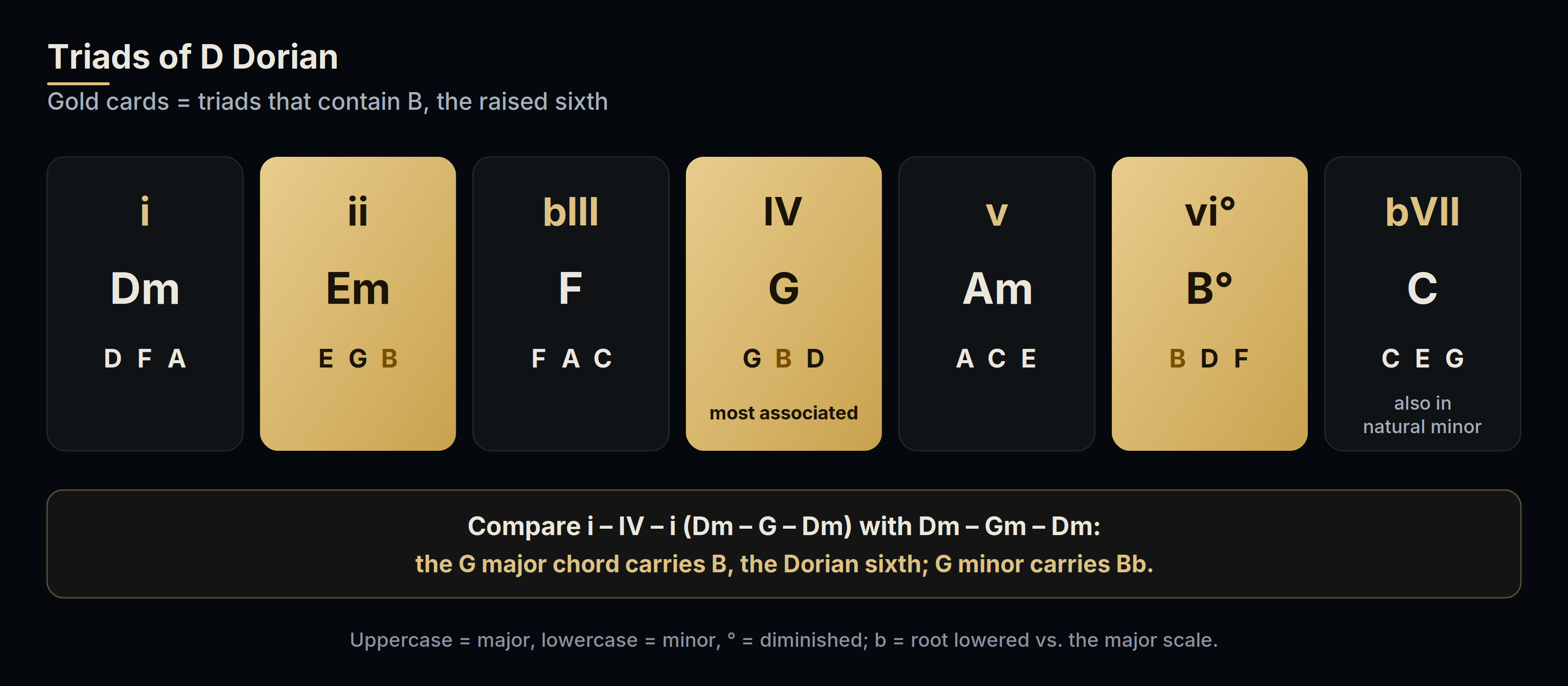
Build a triad on each degree of D Dorian and you get:
As seventh chords: Dm7, Em7, Fmaj7, G7, Am7, Bm7♭5, Cmaj7. (Roman numerals follow the usual convention: uppercase for major, lowercase for minor, ° for diminished, and a flat before the numeral means the root is lowered compared to the major scale.)
Not every chord in the mode brings out its color equally. Among the triads, three contain the raised sixth, B in D Dorian, and those are the ones that make the mode audible:
The ♭VII (C major) is also common in Dorian writing and works well as a modal cadence (♭VII–i), but as a triad it's shared with natural minor, so on its own it doesn't distinguish Dorian from Aeolian. (Extended to Cmaj7, it does pick up B, the Dorian sixth.) Similarly, the v (A minor) gives Dorian a gentle, non-functional way to lean away from the tonic and come back.
One thing to listen for with seventh chords: the IV7 (G7 in D Dorian) is a dominant-seventh chord. It contains a tritone, and if it moves to the ♭VII (C major), the ear can hear V7–I in C major. That can briefly tonicize C or weaken the sense of D as home, without necessarily turning the passage into a modulation. When the goal is to hear Dorian as clearly as possible, as in a practice exercise, moving from IV7 back to the tonic keeps the center unambiguous.
The Piano Composer Chapter 3 takes Dorian to the keyboard: how to remember it as minor with a raised sixth, which of its chords carry the color note, and a progression-and-scale exercise with voice leading written out, so the sound gets into your ears and your fingers. Explore the course
A few progressions that show the mode clearly, all in D Dorian. Hold D in the bass under the i chord to keep the tonal center unmistakable.
In the progressions that include the IV chord, swap G major for G minor and you'll hear the Dorian color come and go.
Knowing the notes is the easy part. Two things decide whether the music actually sounds Dorian.
Establish the tonic. Because Dorian shares its notes with a major scale, it can easily be heard as that major scale instead. C Dorian uses the notes of B♭ major; if your bass and your phrases keep landing on B♭, the listener hears B♭ major. Put the tonic in the bass, start and end phrases on it, and build your harmony around the i chord. A pedal tone is the bluntest way to do this, but not the only one.
The same risk runs in the other direction. G Dorian shares its notes with D natural minor, so a passage that lingers on A minor or D-centered harmony can start to sound like D minor. Returning to the IV chord (C major) and then to G minor is a reliable way to pull the ear back to the Dorian home.
Let the color note be heard. If neither the melody nor the harmony makes the raised sixth audible, the distinction between Dorian and natural minor stays open. Aim melodic lines at the sixth, place it on strong beats now and then, and use the chords that contain it, especially the IV. You don't need to hammer it; a well-placed E natural in G Dorian can color an entire phrase.
It also helps to know what the major V does. It lies outside the Dorian scale, and bringing it in adds a leading tone that pulls toward functional minor. A single borrowed V doesn't automatically cancel the Dorian character of a passage, but the more the music leans on it, the more the modal color gives way to a conventional minor-key cadence.
There's a second, complementary way Dorian shows up: as a chord scale. In a major key, Dorian is the scale that fits the ii chord. Over Dm7 in C major, D Dorian contains exactly the notes of the key, which is why it's the standard scale for ii chords in jazz education.
Over a functional ii chord, the major sixth deserves attention rather than an automatic ban. B over Dm7 forms a tritone with F, so some chord-scale approaches treat it cautiously when preserving the ii chord's predominant character. It can also work as a sustained 13th; voicing, melody, and context determine the effect. Over a D-minor modal tonic, that same B is the characteristic Dorian color.
That's where minor 6 and minor 13 chords (Dm6, Dm13) come in: they put the major sixth right into the tonic sound, and they're common in modal jazz and in many soundtracks. One caution: a minor 6 chord on its own doesn't prove Dorian, because it fits melodic minor just as well. The lowered seventh, heard somewhere in the melody or harmony, is what completes the Dorian picture.
Dorian runs through several very different traditions, which makes it easy to hear in context.
Folk music. Many traditional English, Irish, and Scottish melodies use Dorian. The best-known melodic versions of "Scarborough Fair" and "Drunken Sailor" are two of the most frequently cited examples, and both show how naturally the mode sits in a sung melody.
Modal jazz. The form of Miles Davis's "So What" is built on D Dorian, moving up a half step to E♭ Dorian for the bridge. It's one of the clearest demonstrations of Dorian as a home rather than a passing color. A subtler use shows up in harmony: in The Legend of Otoe: Levels 2 & 3, a passage from Oliver Nelson's "Stolen Moments" is reduced to C minor and D minor chords over a held C in the bass to demonstrate the effect. The D minor chord brings in A natural, the major sixth above C.
Latin and rock. The two-chord vamp of Santana's recording of Tito Puente's "Oye Como Va" (Am7 to D9) is a textbook i–IV in A Dorian: the D chord contains F♯, the raised sixth.
Film scoring. John Powell's opening music for How to Train Your Dragon offers a specific example of Dorian color in film scoring. As the opening titles give way to Berk, repeated moves from a minor tonic to a major IV bring the raised sixth into focus. The passage shows how Dorian-inflected harmony can help introduce a fantasy world, as Morgan Patrick's analysis of the film's harmonic language describes in detail.
Game and library music. In media scoring more broadly, Dorian tends to appear where a minor key needs dignity rather than grief: fantasy adventure, seafaring themes, Celtic-flavored settings, heroic-but-weathered characters. It's common enough that production music briefs sometimes specify it directly, asking for a track in Dorian or Phrygian alongside tempo and instrumentation.
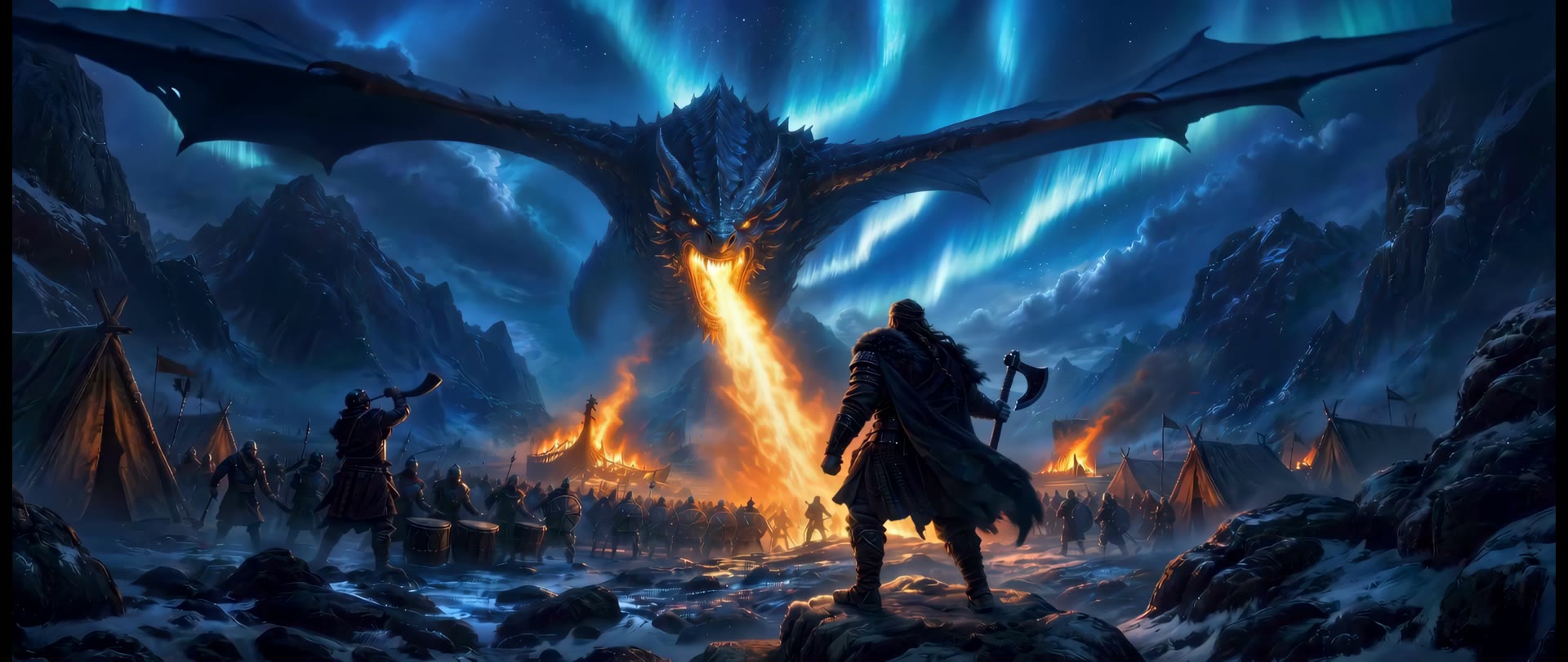
A useful way to see Dorian in action is to look at how the choice of mode shapes a theme before a single note is written. Take a theme for a band of cartoon Vikings, meant to sound tough, proud, and serious rather than tragic, with a vague northern-European flavor.
Dorian fits that brief on two levels. Emotionally, its minor color with a raised sixth is meant here to sound stern and proud rather than grieving, which matches the characters. Culturally, its long association with Celtic and folk music suggests the right part of the world without pointing to any specific tradition.
From there, a few further choices build on the mode:
None of these decisions requires a melody yet. Together they narrow the possibilities so much that the theme almost suggests itself, which is one of the most practical things a mode can do for a composer.
Composing Worlds: Vikings and Dragons The Vikings theme is built from the ground up in G Dorian: why the mode fits, how the minor pentatonic and the major IV share the work, and how melody, harmony, and orchestration come together into a finished theme, contrasted with the far darker scales of the dragons. Explore the course
Once Dorian is in your ears, it becomes one of the most flexible tools in the minor palette. For how it relates to the other six modes, and how to borrow single Dorian chords into other keys, see our guides to modes in music and modal interchange.
Our Music Composition & Orchestration Courses
Our Music Production Courses
Our Music Trailer Courses
See All CoursesWhat is the Dorian mode? The Dorian mode is the second mode of the major scale: a natural minor scale with a raised sixth degree. D Dorian uses the white keys from D to D: D, E, F, G, A, B, C.
What is the Dorian scale formula? 1 – 2 – ♭3 – 4 – 5 – 6 – ♭7. Compared to the major scale it lowers the third and seventh; compared to natural minor it raises the sixth.
Is Dorian major or minor? Minor. Its third is a minor third, so its tonic chord is minor. The raised sixth gives it a brighter character than natural minor, but it belongs to the minor family.
What is the difference between Dorian and natural minor? One note: the sixth. Natural minor has a minor sixth, Dorian a major sixth. That changes the chord on the fourth degree from minor (iv) to major (IV), which is the most recognizable Dorian sound.
What are the chords in D Dorian? Dm, Em, F, G, Am, B°, and C. The G major chord (IV) carries the Dorian color most clearly because it contains the raised sixth, B.
What does the Dorian mode sound like? Dorian often sounds brighter than natural minor because of its raised sixth, and it's frequently described as proud or wistful rather than tragic. The actual mood depends on tempo, rhythm, and instrumentation. In film and game music, it's often associated with Celtic, folk, and fantasy settings.
What songs use the Dorian mode? Frequently cited examples include the best-known melodic versions of the traditional "Scarborough Fair" and "Drunken Sailor," Miles Davis's "So What," and the i–IV vamp of Santana's recording of Tito Puente's "Oye Como Va." In film scoring, the opening music of How to Train Your Dragon uses Dorian-colored i–IV moves.
What is the difference between Dorian and melodic minor? Ascending melodic minor raises both the sixth and the seventh. Dorian raises only the sixth and keeps the lowered seventh, so it has no leading tone and no major V chord.
Learn with Master The Score
Courses on composition, orchestration, music production, trailer music and sound design, from composers writing for film, games and media. Students also get exclusive discounts on leading sample libraries and plugins.
Discover all courses →


Online education for media composers — orchestral writing, trailer music, mixing and more, taught by working professionals.