

Music Theory and Composition

David McCaulley is a pianist and composer known for his YouTube channel Film Score Analysis, home to more than 150 score reductions of iconic film scores. He studied composition and piano at the University of North Texas and teaches The Piano Composer at Master The Score.
Modes sound intimidating and turn out to be surprisingly simple. All seven are derived from the major scale, and the modes that come from one and the same major scale even share its notes. What makes each mode its own thing is the note you treat as home, and that one decision changes the color of everything: the chords, the melody, the mood.
This guide explains what modes are, how to build all seven, what each one sounds like, and how composers actually use them in film, game, and orchestral music. It draws on the harmony curriculum of our courses, especially The Piano Composer and Pillars of Composition, where the modes are taught as a working palette rather than a list to memorize.
A mode is a scale defined by two things: its interval pattern, and the note that serves as its tonic, the note that feels like home. The seven modes most composers work with are the modes of the major scale: Ionian, Dorian, Phrygian, Lydian, Mixolydian, Aeolian, and Locrian. You'll often see them called the church modes. The names are borrowed from the medieval system, but the modern seven modes are a simplified, different thing, so it's best not to treat the two as identical.
The easiest way to see the modes is on the white keys of a piano. Play from C to C and you get the C major scale. Now play from D to the next D, all white keys. Same seven notes, but the half steps fall in different places, so the scale has a different interval pattern. That shape is D Dorian.
Here is the part that matters, and that most explanations skip: starting on D is not enough. For the music to sound Dorian, D has to be heard as the tonal center. Put D in the bass, begin and end your phrases on D, build your harmony around a D minor chord. Do that, and the same white keys stop sounding like C major and start sounding like something else. Skip it, and the listener simply hears C major with a melody that happens to begin on D. A mode lives in the relationship between the notes and the tonic, not in the notes alone.
Think of a mode as a flavor of a scale. The major scale and the natural minor scale are themselves modes (Ionian and Aeolian); the other five sit between and beyond them, some brighter than major, some darker than natural minor. That range is what makes modes useful.
The terms overlap, so a quick sorting. A scale is any ordered collection of pitches. A mode is a scale defined by its interval pattern together with its tonic. A key is the broader tonal world built around a tonic, which in practice usually includes chromatic notes, borrowed chords, and secondary dominants.
C Ionian and the C major scale are identical: the same seven notes with the same tonic. "C major" can additionally name a key, the whole tonal world built around C. Whether a passage sounds functional or modal is not decided by the label, and not by chromatic notes either. It comes from how the music is organized: whether a dominant pulls to the tonic, whether the leading tone leads, whether cadences behave like cadences. G7 to C uses only white keys and sounds unmistakably functional; a chromatic passing tone doesn't destroy a modal passage. The same holds for A Aeolian and the A natural minor scale, which are identical, while "A minor" as a key typically brings in the raised leading tone at cadences that Aeolian keeps lowered.
If you want the fundamentals first, our guide to music scales covers the major and minor scales in detail.
There are two ways to derive a mode, and each is useful in a different situation.
Method 1: Rotate the major scale. Take a major scale and start on a different degree. C major starting on its second note gives you D Dorian; starting on its fifth note gives you G Mixolydian. This is the relative view: it tells you which major scale a mode shares its notes with. It's the fastest way to find the notes.
Method 2: Alter the major scale from the same root. Describe each mode as the major scale with certain degrees raised or lowered. C Mixolydian is C major with a lowered seventh. C Dorian is C major with a lowered third and lowered seventh. This is the parallel view, and it's the one most composers end up preferring, because it tells you what makes each mode sound the way it does, and it transposes instantly: any Dorian scale is a natural minor scale with a raised sixth, whether the root is D, G, or F-sharp.
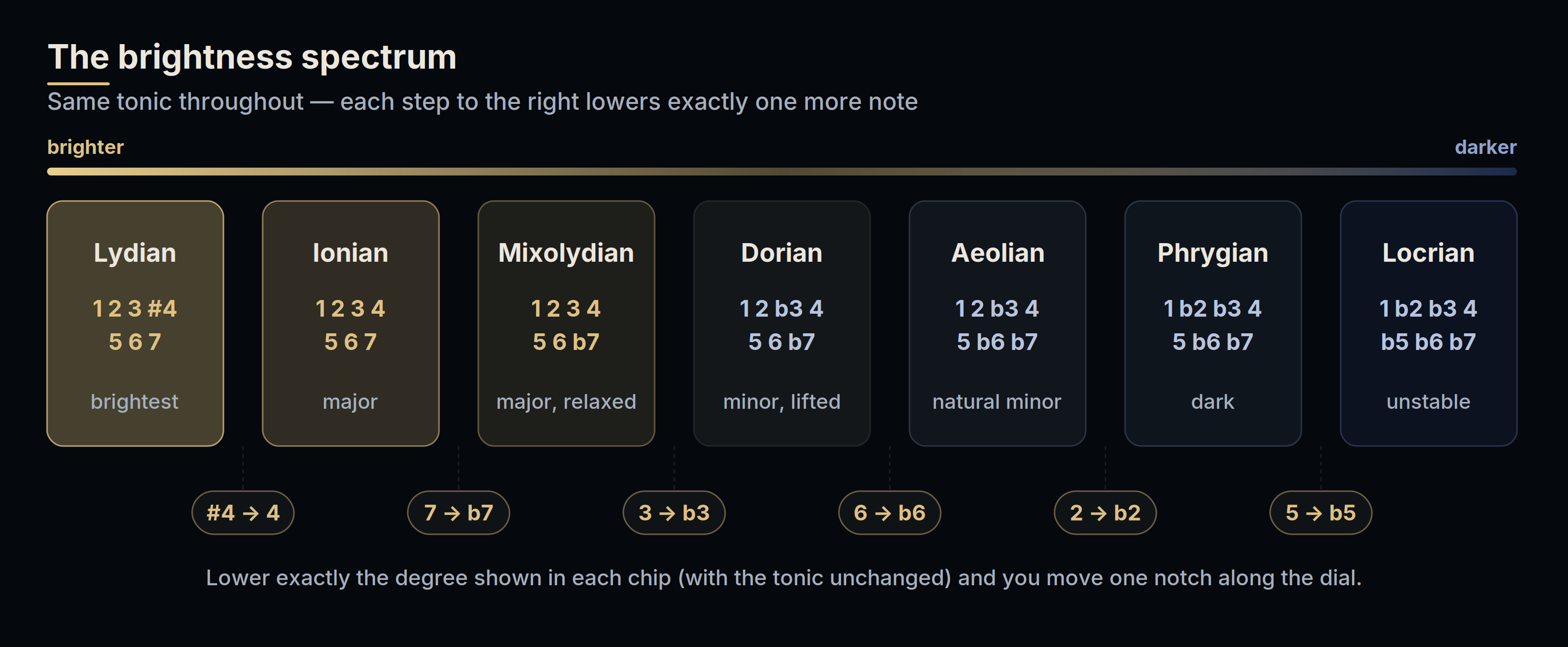
Here are all seven modes as alterations of the major scale (♭ means lowered a half step, ♯ raised):
Lydian is the only mode that raises a note. Ionian alters nothing. The other five each lower one or more.
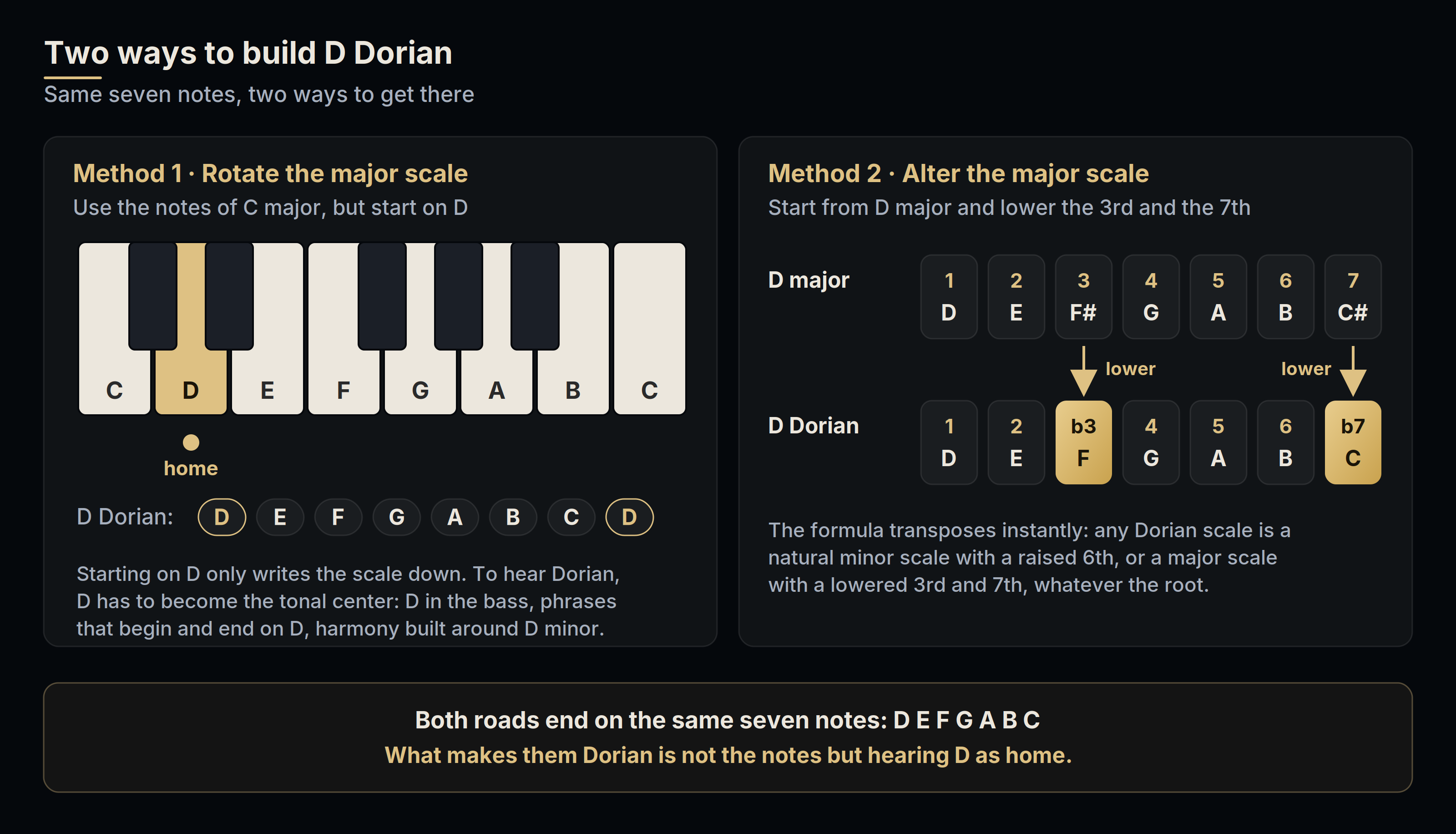
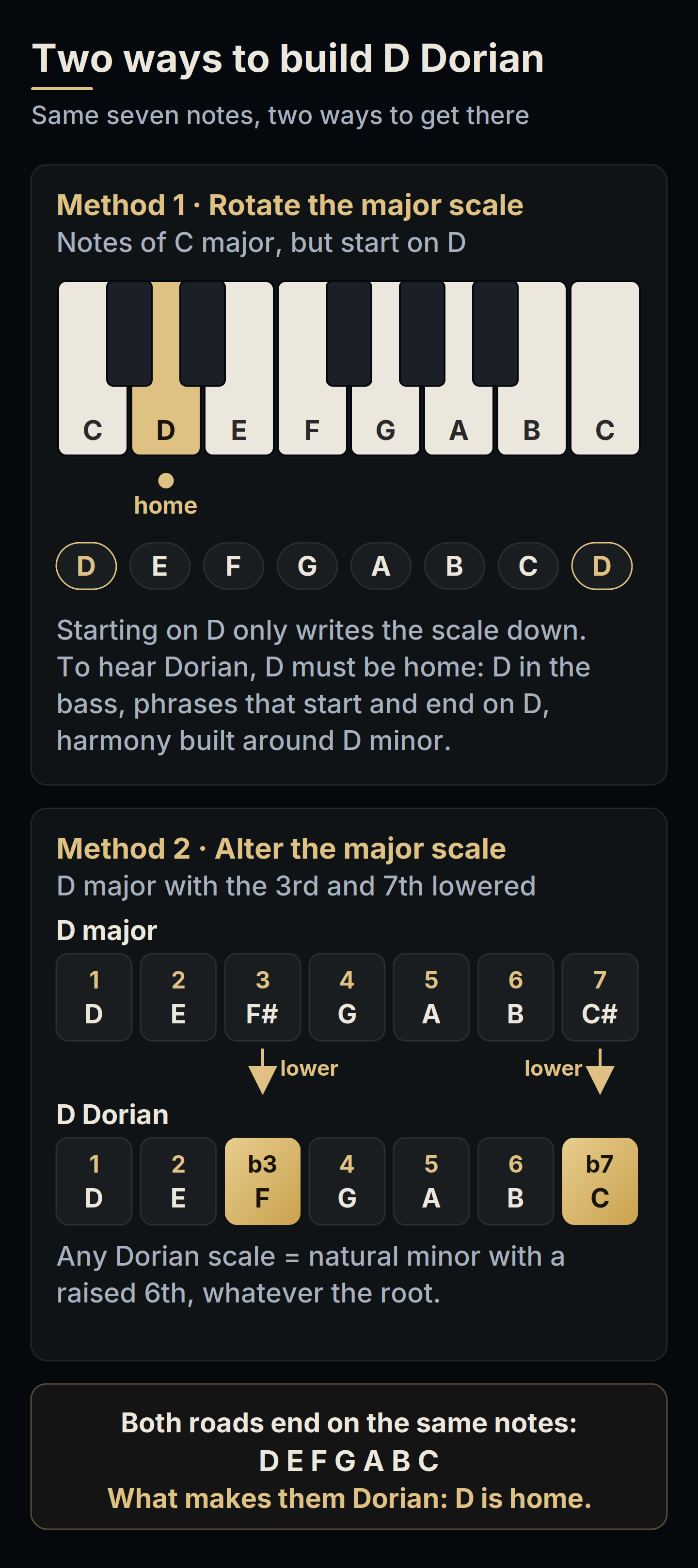
Because the word "parallel" trips up many musicians, especially those coming from other languages: in English, parallel modes share the same tonic (C Ionian, C Dorian, C Lydian) and therefore do not share the same notes. Relative modes share the same notes but have different tonics (C Ionian, D Dorian, F Lydian all live on the white keys). Relative thinking finds the notes; parallel thinking is how you hear and use the color. When composers shift a theme's mood or borrow chords, they're almost always working with parallel modes, because keeping the tonic keeps the sense of home intact.
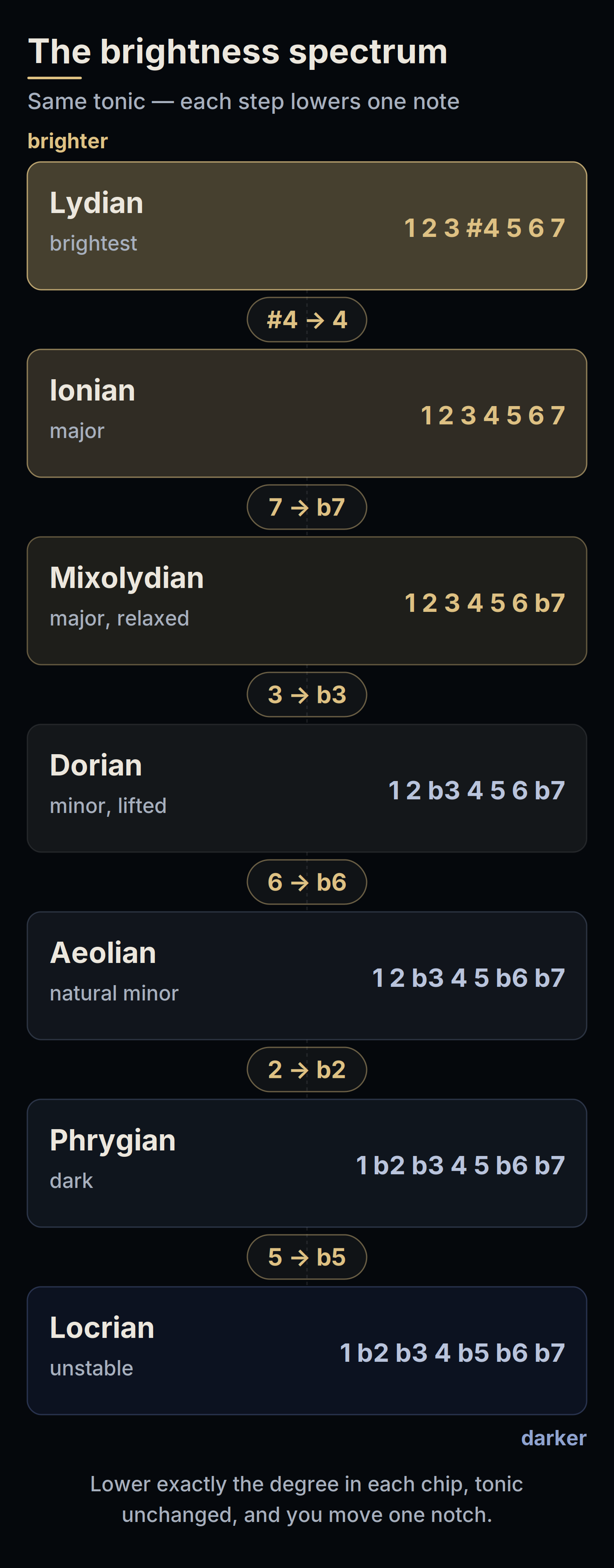
The most useful way to hear the modes is not in white-key order but in order of brightness. Arrange them so that each mode lowers exactly one more note than the one before it:
Lydian → Ionian → Mixolydian → Dorian → Aeolian → Phrygian → Locrian
Lydian is the brightest, with its raised fourth. Lower that fourth and you have Ionian. Lower the seventh: Mixolydian. Lower the third and you cross into minor territory: Dorian. Lower the sixth: Aeolian. Lower the second: Phrygian. Lower the fifth: Locrian, the darkest and least stable of the seven.
This gives you a dial: brighten a plain major theme toward Lydian or relax it toward Mixolydian; lift a heavy minor theme with Dorian or darken it with Phrygian.
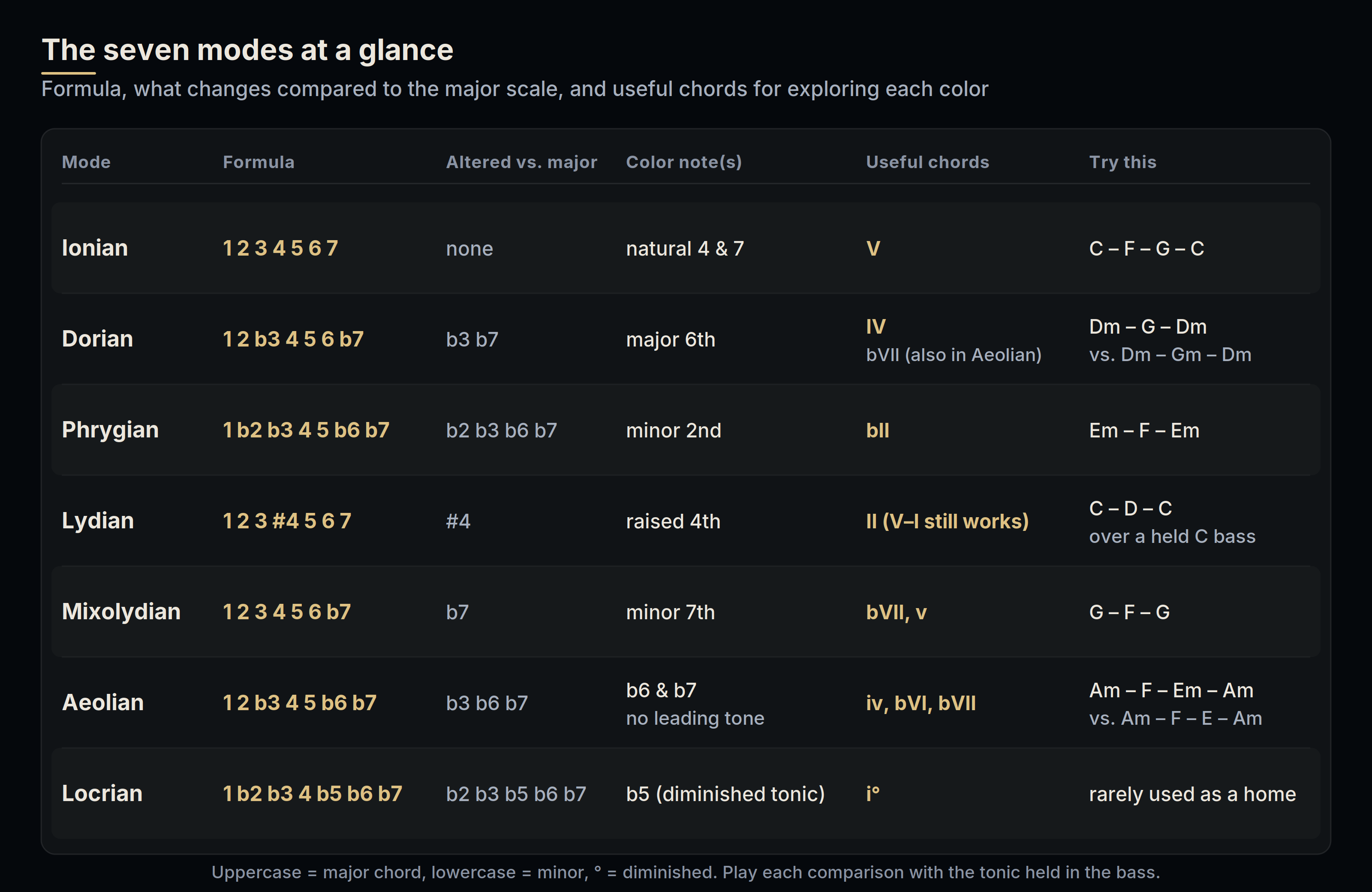
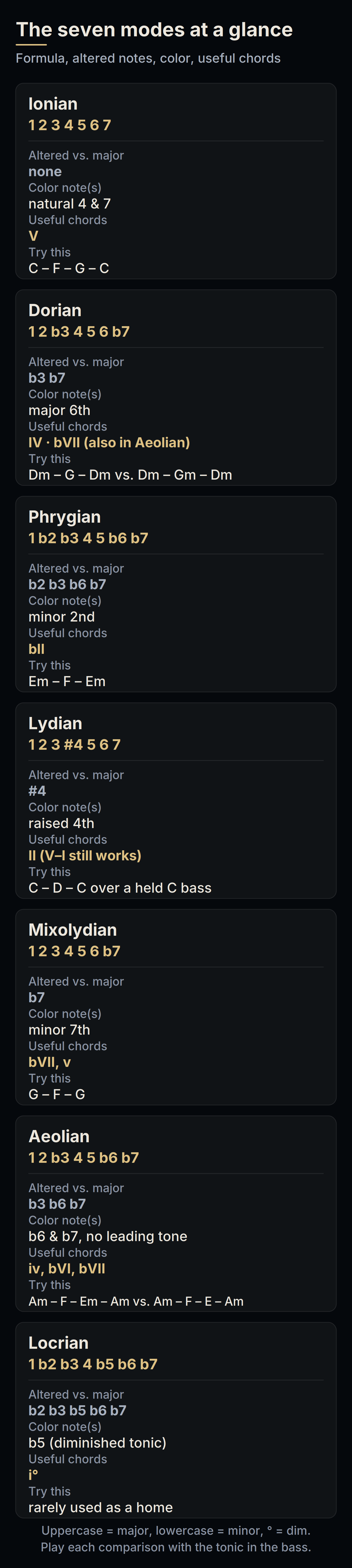
Each mode has one or two characteristic degrees, the notes that distinguish the modes from one another. A mode becomes audible when those characteristic notes are heard, in the melody, in the harmony, or both. For each mode below you'll find the formula and the color note, and for several of them a short chord comparison you can play at the keyboard to hear the difference immediately.
Formula 1 2 3 4 5 6 7. No altered notes; its identity comes from the natural fourth and the leading tone. Clean, open, wholesome. Simple triads over a drone in Ionian tend to read as pastoral or Americana, and plain diatonic major is often the right choice for characters and places that are innocent, warm, and safe.
Formula 1 2 ♭3 4 5 6 ♭7. Color note: the major sixth. That one note turns the iv chord of natural minor into a major IV, and the whole mode takes on a brighter, more resolute cast. Play Dm – G – Dm and then Dm – Gm – Dm: the G major chord carries the major sixth and gives the progression a Dorian color, the G minor chord carries the minor sixth and sounds like natural minor. Two short progressions don't establish a whole mode, but the difference between those two sixths is the difference between the two colors. Dorian is a common choice for stoic, proud, or adventurous minor-key material, and in film scoring it carries strong associations with Celtic and folk-flavored music. Its major IV and major ♭VII chords are the ones that show its color, though note that ♭VII is shared with Aeolian; i–IV–i is the more unmistakably Dorian move.
Formula 1 ♭2 ♭3 4 5 ♭6 ♭7. Color note: the lowered second, a half step above the tonic. Play Em – F – Em: that F major chord, a half step above home, is the Phrygian signature, and it resolves back down into the tonic with a great deal of pull. The mode sounds dark, tense, and often sinister, and it also carries a Spanish or flamenco flavor that scoring traditions have used for a century. It suits dark fantasy, crime, and anything that needs to feel unsettled. Nobuo Uematsu's score for Final Fantasy VI uses Phrygian frequently; the opening cue "Omen" is a clear example. A close relative, Phrygian dominant, raises the third and adds an exotic, more Middle-Eastern color.
Formula 1 2 3 ♯4 5 6 7. Color note: the raised fourth. Play C – D – C and then C – Dm – C, holding a C in the bass throughout so that C stays home (otherwise the ear can hear the first as IV–V–IV in G major): the major II chord is the Lydian signature, and it gives a lift and brightness that plain major doesn't have. Lydian colors are among the most widely used sounds in film music for flight, wonder, childhood, and heroism; John Williams reaches for them in flying music. Because the V chord stays major, a normal V–I still works inside Lydian, and II–I is the characteristic modal alternative. One caution: a major II doesn't automatically mean Lydian. In a functional context the same chord can act as a secondary dominant (V of V). Context decides.
Formula 1 2 3 4 5 6 ♭7. Color note: the lowered seventh. Play G – F – G: the major ♭VII chord is the Mixolydian signature. The mode keeps the warmth of major but loses the sharp leading tone, which makes it smoother and often bluesy. Its tonic seventh chord is a dominant-seventh type (G7), which is why Mixolydian sits at the heart of blues and rock harmony; the chord has dominant quality without necessarily having dominant function. The minor v is its other characteristic chord. Mixolydian colors also appear as local inflections inside major-key themes: John Williams' main theme for Jurassic Park uses the lowered seventh as a prominent color within an otherwise major-key melody, and the note sounds intended rather than wrong.
Formula 1 2 ♭3 4 5 ♭6 ♭7. Color notes: the lowered sixth and seventh, with no raised leading tone. Play Am – F – Em – Am and then Am – F – E – Am: the F major chord carries the lowered sixth, and the Em versus E shows the difference between the natural and the raised seventh. The first is Aeolian; the second uses the major V of harmonic minor, and it immediately sounds more "classical." Aeolian is the smoother, more open form of minor, and it's usually the right choice when you want a minor sound without the traditional leading-tone pull.
Formula 1 ♭2 ♭3 4 ♭5 ♭6 ♭7. On paper Locrian should be the darkest mode of all, and people meeting it for the first time often expect it to be the ultimate tool for menace. In practice it rarely works that way. The lowered fifth makes the tonic chord diminished, and without a perfect fifth to anchor it, the tonic struggles to feel like home; the music tends to drift toward another tonal center. Locrian is by far the least used of the seven. Its unstable color can be effective in short doses, but it isn't a practical home for most music.
The Piano Composer Chapter 3 works through the modes at the keyboard: how to build each one, which chords it contains, and progression exercises so the sound gets into your ears and your fingers. Explore the course
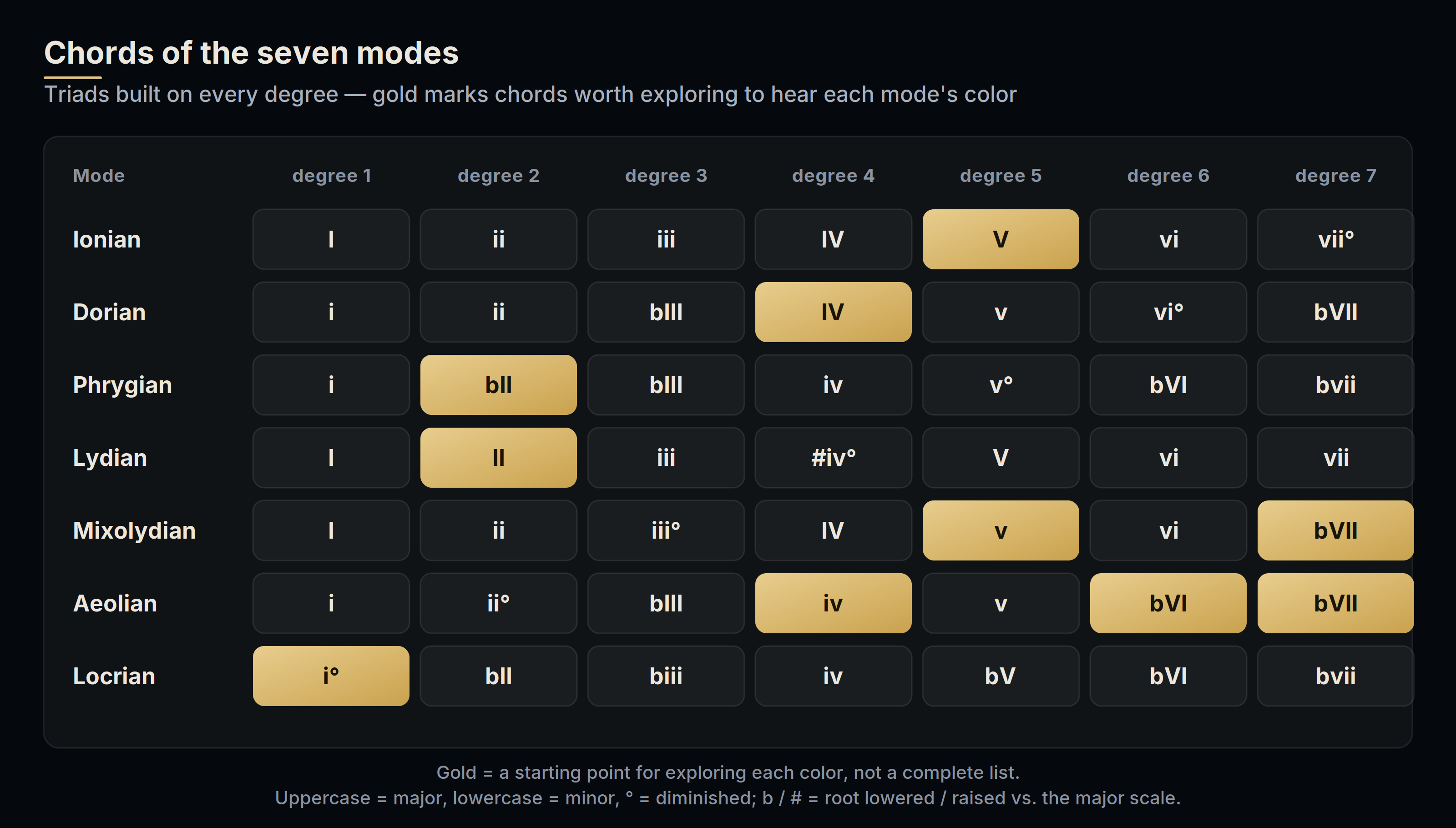
Because each mode rearranges the half steps, each mode also produces its own set of diatonic chords. Build a triad on every degree and you get:
(Uppercase numerals are major chords, lowercase minor, ° diminished. A flat or sharp before a numeral means the chord's root is lowered or raised compared to the major scale.)
Every mode has chords that contain its color note, and those chords are the fastest way to make the mode audible: the major IV in Dorian, the ♭II in Phrygian, the major II in Lydian, the ♭VII in Mixolydian. Once a minor tonic is established, a major IV can bring out a Dorian color.
There is no single "cadence chord" per mode; there are characteristic ways of returning home. In Ionian, V–I does the job. In Dorian, i–IV–i shows the mode directly, and ♭VII–i is a common modal close. In Phrygian, ♭II–i. In Lydian, II–I alongside the still-available V–I. In Mixolydian, ♭VII–I. Treat these as options that reveal the mode, not as rules.
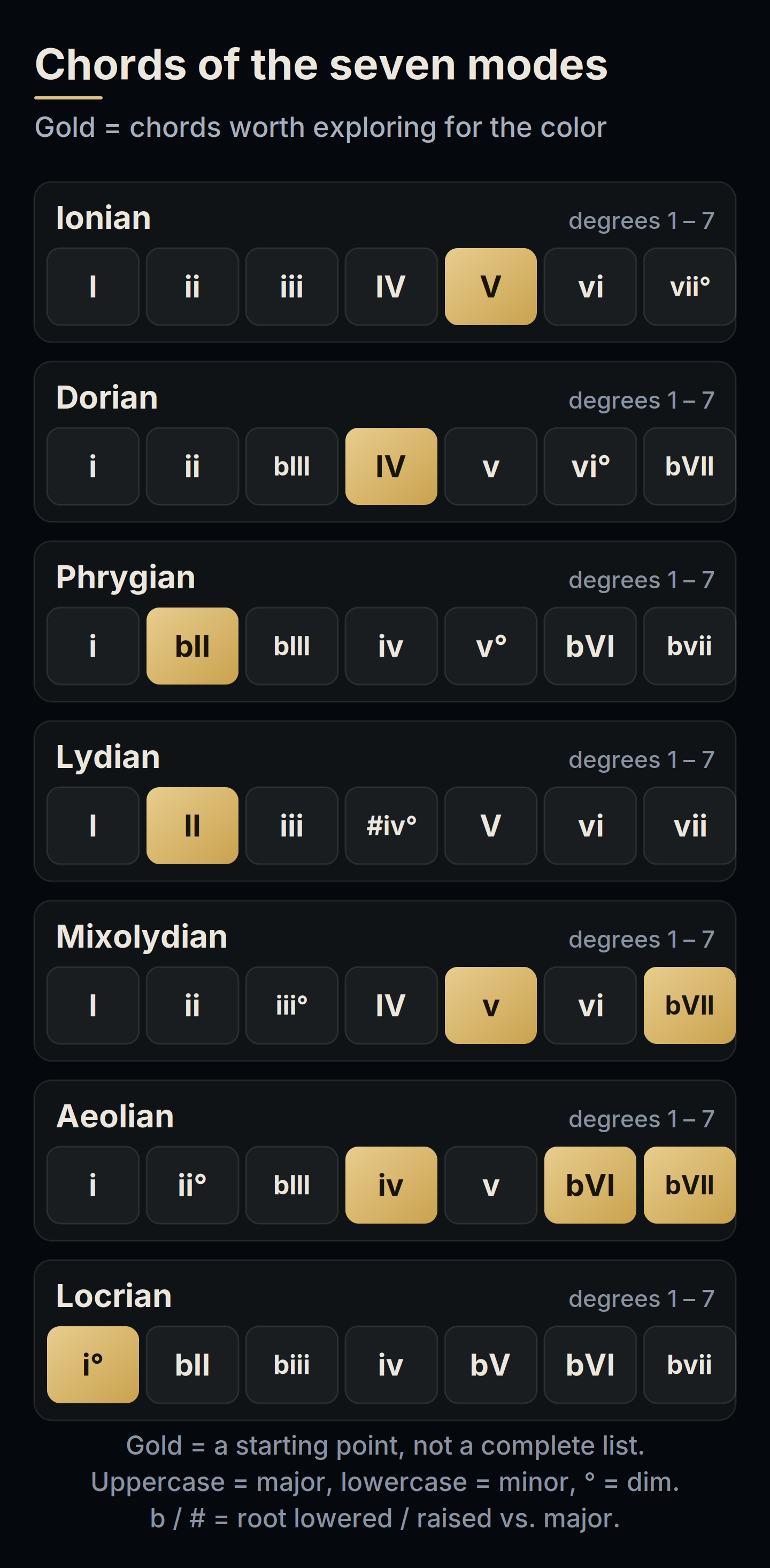
This chord-per-mode view is also the doorway to modal interchange: borrowing a chord from a parallel mode. A ♭VI in a major key, a iv from Aeolian, a ♭II from Phrygian all "belong" to some mode built on your tonic, which is exactly why they sound colorful rather than random.
Knowing the seven modes is the easy part. Making them sound like anything comes down to a few habits.
Make the tonic feel like home. If the notes are C Dorian but your bass and phrases keep gravitating toward B-flat, the listener hears B-flat major. Root in the bass, phrases that start and end on the tonic, harmony built around the tonic chord.
Let the color note be heard. Every mode has characteristic degrees that distinguish it. If neither the melody nor the harmony makes them audible, the mode's identity stays unclear: a Lydian melody that avoids the raised fourth over harmony that avoids it too just sounds like major. The reverse also holds: a single raised or lowered note doesn't turn a passage into another mode. Identity comes from emphasis and context, not from one accidental.
Start strictly diatonic. As an exercise, writing with only the seven notes of the mode is the fastest way to learn its sound. It's a learning constraint, not a law of modal music; real scores add chromatic detail all the time without losing their modal identity.
Change the mode of an existing idea. Keep a melody and change its mode. A hero theme in Ionian can be shifted into Lydian by raising every fourth, into Aeolian by lowering the third, sixth, and seventh, or into Dorian for something in between. The melody stays recognizable, the mood changes completely. It's a standard variation technique in scoring and a fast way to generate a villain version, a sad version, or a triumphant version of the same motif.
Mix modes within a phrase. A single raised fourth for a moment of brightness, or one lowered sixth for a shadow, can be more effective than a wholesale change. The same applies to harmony, which is where borrowed chords come in.
Let the mode carry associations. Modes are shortcuts to moods, and in film and game scoring they've accumulated cultural associations too: Dorian with Celtic and folk material, Phrygian with Spanish color or danger, Lydian with wonder. These are conventions of scoring traditions rather than properties of the scales, but they're conventions audiences recognize. In Composing Worlds: Vikings and Dragons, the Vikings theme is built on Dorian with a minor-pentatonic skeleton precisely because those choices, made before a note is written, already place the music culturally and emotionally.
Pillars of Composition The harmony modules introduce the modes, the chords each one produces, and modal interchange, then have you write a complete piece in a mode other than Ionian. Explore the course
There's a second, complementary way to use modes, common in jazz education and useful for anyone writing melodies over a chord progression. Instead of asking "what mode is this piece in?", you ask "what scale fits this chord?" For the diatonic chords of a major key, the answer is the mode built on each chord's root: Ionian over I, Dorian over ii, Phrygian over iii, Lydian over IV, Mixolydian over V, Aeolian over vi, Locrian over vii°.
An important clarification: playing D Dorian over the ii chord in C major does not move the tonal center to D. The key is still C. The chord scale is simply the set of notes that sit well on that chord for as long as it lasts.
What this gives you is a guide to extensions and melody notes. Over the IV chord, Lydian applies, so the raised fourth (the ♯11 of the chord) is not only available but characteristic; an Fmaj7♯11 in C major sounds natural, while a Cmaj7 with an added 11 over the I chord tends to clash, because the fourth sits a half step above the chord's third. That's why some notes are called avoid tones: not forbidden, but likely to blur the chord's quality if you lean on them. Our guide to chord progressions covers the functional side of that picture.
The same idea, take a parent scale and start it on different degrees, applies to other scales too. Melodic minor, harmonic minor, and harmonic major all have their own modes, and a few are common enough in film and game music to know by name.
The most useful is Lydian dominant, sometimes written Lydian ♭7: a major scale with a raised fourth and a lowered seventh. It combines the brightness of Lydian with the bluesy edge of Mixolydian, and the result reads as quirky, mysterious, or comedic depending on context. Danny Elfman's theme for The Simpsons is the classic example, and it's worth being precise about it: the theme has the raised fourth people describe as "Lydian," but it also has the lowered seventh, which makes it Lydian dominant rather than plain Lydian. Technically the scale is the fourth mode of melodic minor. Phrygian dominant, mentioned above, is the fifth mode of harmonic minor.
Once the seven core modes are in your ears, these relatives are a small step away.
If modes are new to you, a simple path:
The goal is to reach the point where a scene, a character, or a feeling suggests a mode before you've written a note.
Our Music Composition & Orchestration Courses
Our Music Production Courses
Our Music Trailer Courses
See All CoursesWhat are modes in music? Modes are scales defined by their interval pattern and by the note treated as the tonic. The seven modes of the major scale are Ionian, Dorian, Phrygian, Lydian, Mixolydian, Aeolian, and Locrian, each with its own characteristic color.
How many modes are there? The standard set is seven, the modes of the major scale. Other scales such as melodic minor and harmonic minor also have modes, which is where names like Lydian dominant and Phrygian dominant come from.
What is the difference between a mode and a scale? A scale is any ordered set of pitches. A mode is a scale defined by its interval pattern and its tonic. Every mode is a scale; "mode" usually implies one member of a related family such as the seven derived from the major scale.
Are major and minor scales modes? Yes. The major scale is the Ionian mode and the natural minor scale is the Aeolian mode. The other five modes are further variations of the same seven-note pattern.
Which mode is the brightest and which is the darkest? Lydian is the brightest. Locrian is the darkest on paper, but its diminished tonic chord makes it unstable, so in practice Phrygian is the darkest of the commonly used modes.
How do I remember the modes? A common mnemonic for the order is "I Don't Particularly Like Modes A Lot." A more musical approach is to remember each mode as an alteration: Lydian is major with a raised fourth, Mixolydian is major with a lowered seventh, Dorian is natural minor with a raised sixth, Phrygian is natural minor with a lowered second.
Why is the Locrian mode rarely used? Its lowered fifth makes the tonic chord diminished. Without a perfect fifth anchoring the tonic, the ear tends to hear another note as home, so the mode is hard to sustain as a key center.
Can I use more than one mode in a piece? Yes, and most composers do, either by shifting a theme into another mode for a variation or by borrowing single chords from a parallel mode, which is called modal interchange.
Learn with Master The Score
Courses on composition, orchestration, music production, trailer music and sound design, from composers writing for film, games and media. Students also get exclusive discounts on leading sample libraries and plugins.
Discover all courses →

Online education for media composers — orchestral writing, trailer music, mixing and more, taught by working professionals.