
Music Theory and Composition

Ryan Leach is an Award Winning Composer for film and tv. His music has been heard on Every major Network. His clients includes Disney, Mtv and Netflix.
Search for Japanese instruments and you'll run into a naming problem immediately: the "Japanese zither," the "Japanese banjo," the "Japanese flute," the "Japanese drums." Every one of those has a real name, a real repertoire, and real playing techniques that decide whether your track sounds like the instrument or like a keyboard preset of it. This guide covers the traditional Japanese instruments composers reach for most — koto, shakuhachi, shamisen, biwa, and the taiko family — what each one actually is, how it's played, what its strengths are, and how to write for it convincingly, whether you're hiring a player or working with virtual instruments in your DAW.
If you've heard an instrument in an anime score or a game soundtrack and you're trying to put a name to it, start here. Each of these gets its own section below.
| You might search for… | Commonly refers to… | What it is |
|---|---|---|
| Japanese zither, Japanese harp | Koto | A long zither with 13 strings on movable bridges, plucked with picks worn on the fingers |
| Japanese flute, Japanese bamboo flute | Shakuhachi | An end-blown bamboo flute with five finger holes and a famously breathy, vocal sound (Japan also has transverse flutes — see below) |
| Japanese banjo, Japanese guitar | Shamisen | A three-string, long-necked lute played with a large plectrum, combining plucked strings with percussive attacks |
| Japanese lute | Biwa | A pear-shaped, fretted lute used for centuries to accompany sung storytelling |
| Japanese drums | Taiko | A family of Japanese drums, from the small shime-daiko to the huge ō-daiko |
Two notes on the naming. The koto sometimes gets called a harp because of its sweeping glissandos, but structurally it's a zither: the strings run parallel over a long resonating body rather than rising away from it. And "taiko" simply means "drum" in Japanese — the ensemble drumming style Western listeners usually picture is called kumi-daiko, and it's a much younger tradition than the drums themselves.
The koto is a long wooden zither — its standard form has 13 strings, each running over its own movable bridge, plucked with tsume, picks worn on the thumb, index, and middle finger of the right hand. Variants extend the family downward and upward: there's a 17-string bass koto, and modern instruments with 25 and 30 strings; an 80-string experiment exists mostly in museums now. Koto builders traditionally describe the instrument as a dragon, and the parts are named accordingly — the end near the player is the dragon's head, the far end its tail.
The koto came to Japan from China during the Nara period (from 710 onward), where it was first an instrument of gagaku, the court music, played by nobles and monks. An older native zither, the wagon, preceded it. For centuries the koto belonged to the upper classes; it was in the long peace of the Edo period (from 1603) that it spread to ordinary people, and most of its classical repertoire dates from that era. After Japan reopened to the West in the Meiji era, koto composers began absorbing Western ideas — which is one reason the instrument moves so naturally between traditional music and modern media scores today.
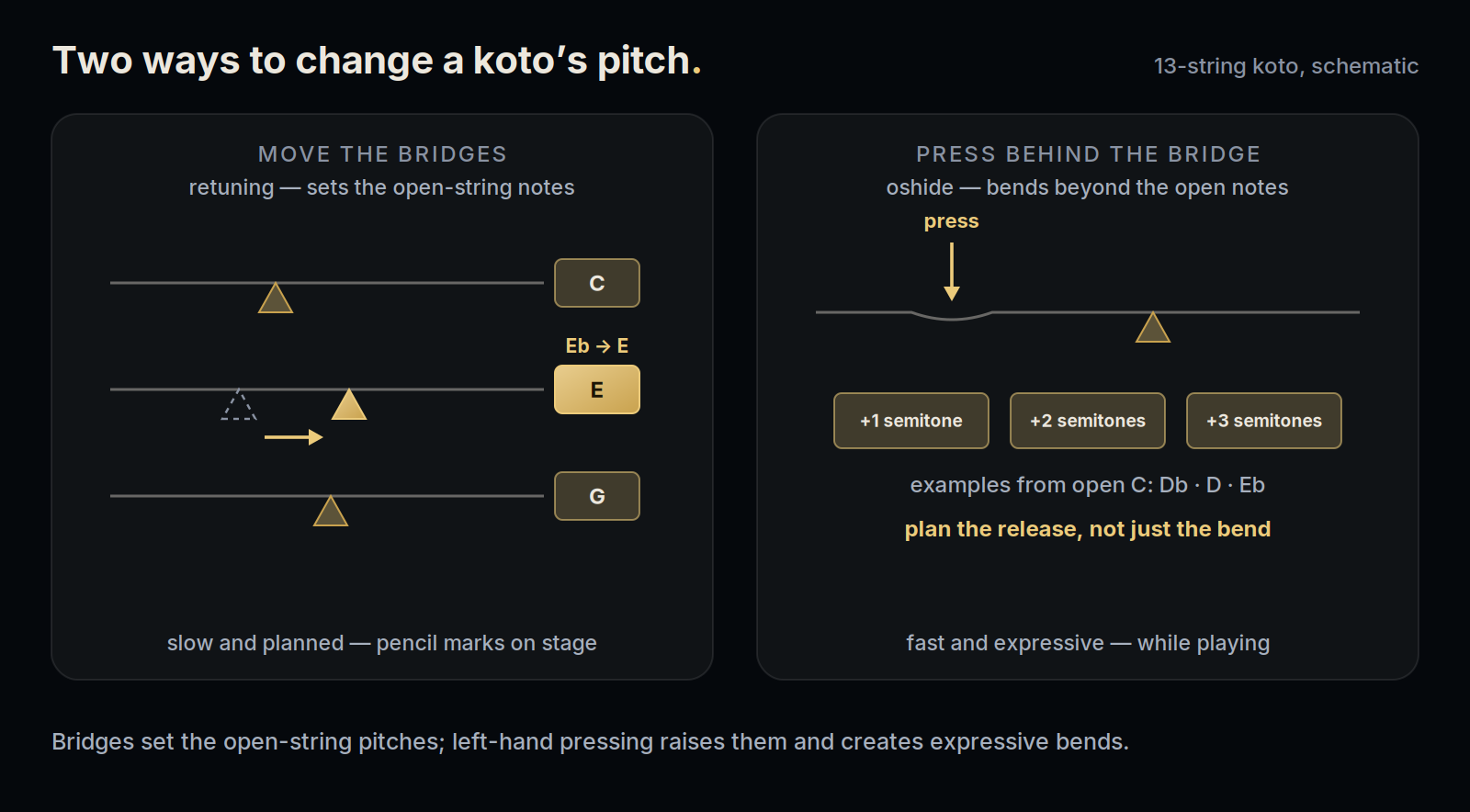
Here's the single most important thing to understand before writing for koto: the instrument is tuned by physically placing the bridges, and the chosen tuning defines which notes sit on the open strings under the player's hands. Left-hand pressing techniques can raise these open-string pitches and create expressive bends. Classic tunings like hirajōshi and kumoijōshi are pentatonic — our guide to Japanese scales covers the scales behind them — and there are many variants; players can also set Western tunings, and can even move bridges mid-piece.
That mid-piece retuning is possible but costly. In her guest lecture for The Legend of Otoe, koto master Yoko Reikano Kimura describes marking bridge positions in pencil for concerts — and warns that every retuning a piece demands chips away at the concentration the player has left for the music itself. Her example: the Genshin Impact scores she has performed are beautifully written, but push a 13-string koto hard. For recording sessions this matters far less, since sessions can be punched in around retunings; for live performance it can decide whether your piece is playable at all. Her advice is simple — when in doubt, ask a player where the comfortable zone is.
A few practical constraints from her lecture worth keeping in mind: the koto covers far fewer octaves than a piano, and notes forced too high start to sound pinched and noisy, because the string speaks best with room to vibrate between the bridges. The right hand plucks mostly with three fingers, and the left hand is busy with pitch work — so for chords, she suggests keeping voicings modest (she names about six notes as a sensible ceiling) or breaking them into arpeggios, and setting the tuning so the right hand can play the essential material on open strings.
The koto's expressive power was built on timbre and pitch inflection more than on chord progressions — Kimura encourages composers to start simple and idiomatic rather than from Western chord stacks, and to treat harmony as one available color rather than the natural first move on this instrument. The core techniques:
For deeper study, Kimura recommends Composing for Japanese Instruments by composer Minoru Miki, available in an English translation by Marty Regan — a standard reference for exactly this subject.
The shakuhachi is an end-blown bamboo flute with five finger holes — four on the front, one on the back. The name is a measurement: shaku is an old unit of about a foot, hachi means eight, and the standard instrument is 1.8 shaku long. What gives it its unusual flexibility is the blowing end: the player shapes the tone against an angled, notched blowing edge, so pitch and color respond to breath, embouchure, and head angle as much as to the fingers.
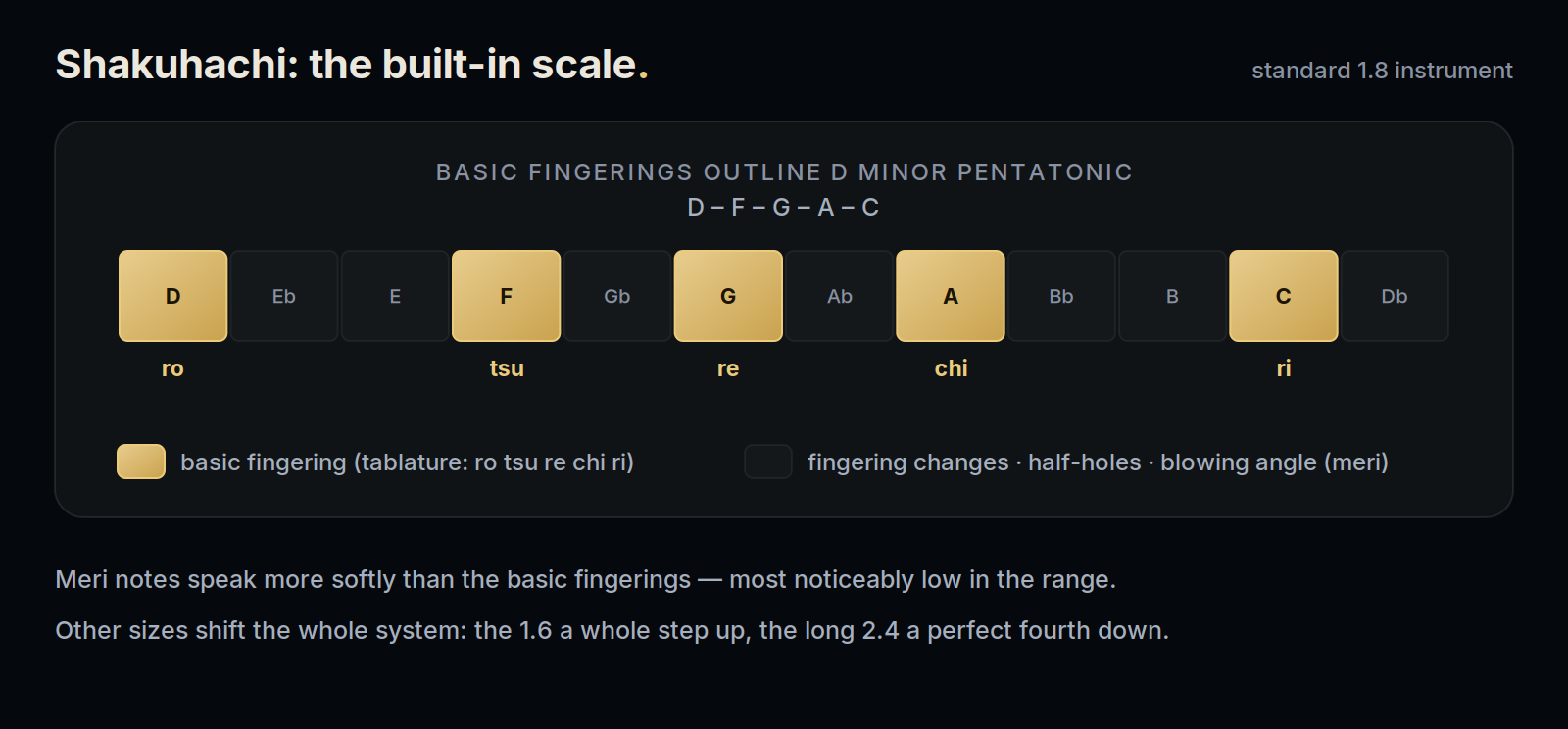
On a standard 1.8 shakuhachi, the basic fingerings outline D minor pentatonic: D–F–G–A–C — ro, tsu, re, chi, ri in the traditional tablature. Additional pitches use combinations of fingering changes, partial hole coverage, and adjustments to the blowing angle. Lowering the head to pull a pitch down is called meri, and it's central to how the instrument reaches notes outside the basic set; in his guest lecture, Zac Zinger points out that meri notes speak more softly than the basic fingerings — most noticeably in the low register — which matters when you write exposed lines. Other sizes shift the whole system: the 1.6 sits a whole step above the standard instrument, and the long 2.4 a perfect fourth below it.
The shakuhachi's history explains its sound ideal. It arrived from China by way of gagaku, then largely disappeared before re-emerging in the Edo period as the meditation instrument of the Fuke sect — monks, many of them former samurai, who played solo pieces called honkyoku as suizen, "blowing Zen," often wearing basket hats that hid their faces. From the Meiji era onward, playing together with koto and shamisen became widespread, and new schools and repertoire followed. But the honkyoku tradition — centuries of solo playing in quiet rooms — shaped an aesthetic of breath, shading, and long decays that the instrument still carries into modern scores.
Zac Zinger's advice from the course, condensed:
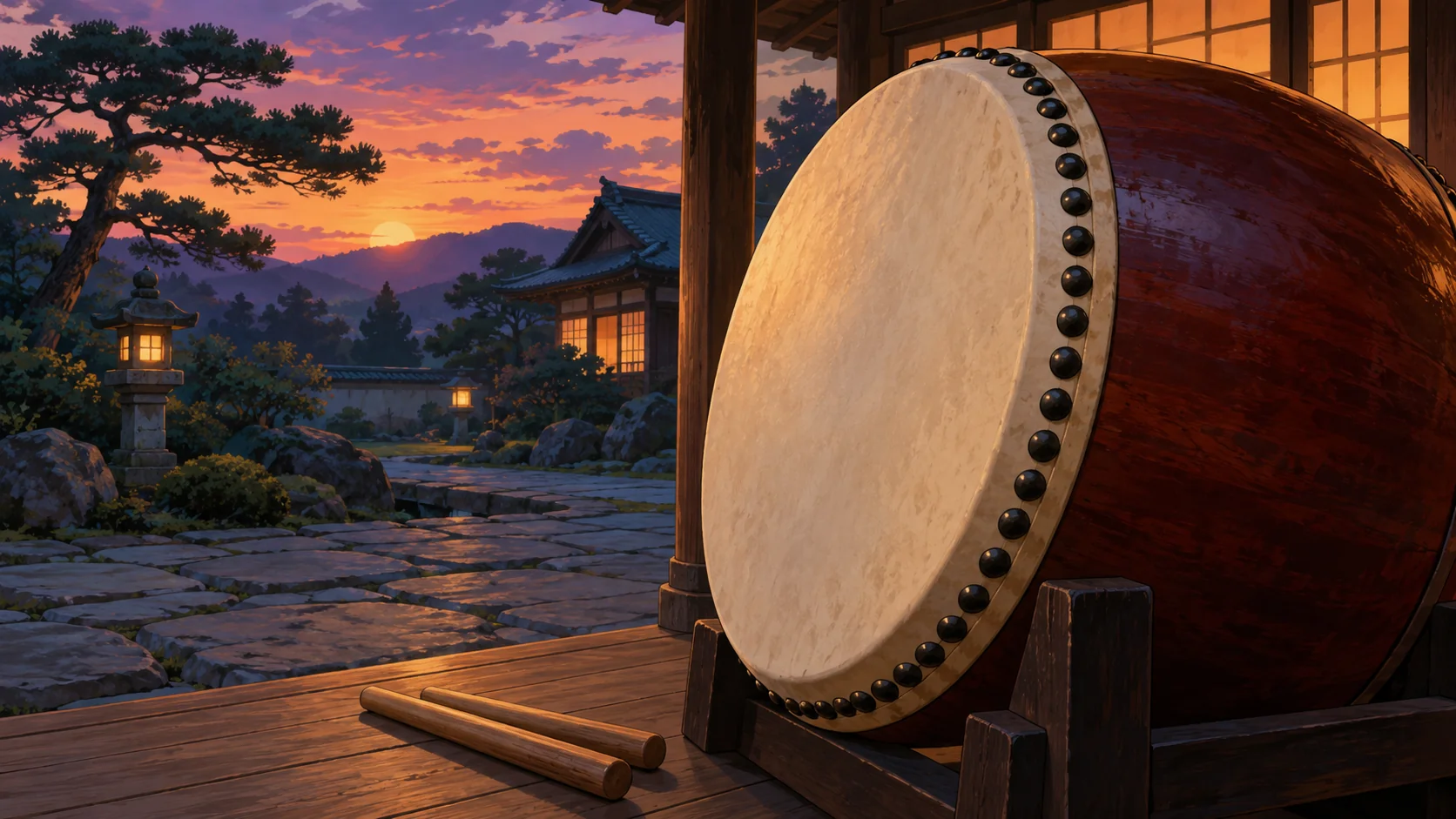
"Taiko" is the umbrella word for Japanese drums; what most people picture — a coordinated ensemble hammering out interlocking rhythms — is kumi-daiko, a modern style whose pioneer, the jazz drummer Daihachi Oguchi, assembled the first ensemble of this kind in 1951. The drums themselves are ancient and originally came to Japan from the Asian mainland. That's worth knowing as a composer, because the "taiko sound" in trailers and games draws on both: ceremonial weight and modern ensemble energy.
The core drums, roughly from small to large:
These roles come from how the course demo arranges the drums — useful defaults, not fixed rules of the tradition. Strokes have names — don for the full center hit, ka for the rim — and traditional patterns alternate and combine them. Two details from the demo worth stealing: the oroshi, an accelerating roll that gathers from slow single strokes into a rumble, is a ready-made tension device; and — drawing on the instructor's own kumi-daiko ensemble experience — a clave pattern runs on top of the drums, because its crack carries over everything, the same logic as layering a bright percussive element over low percussion in a mix. Auxiliary colors like the kagura suzu, a handheld cluster of bells, sit naturally in the same world.
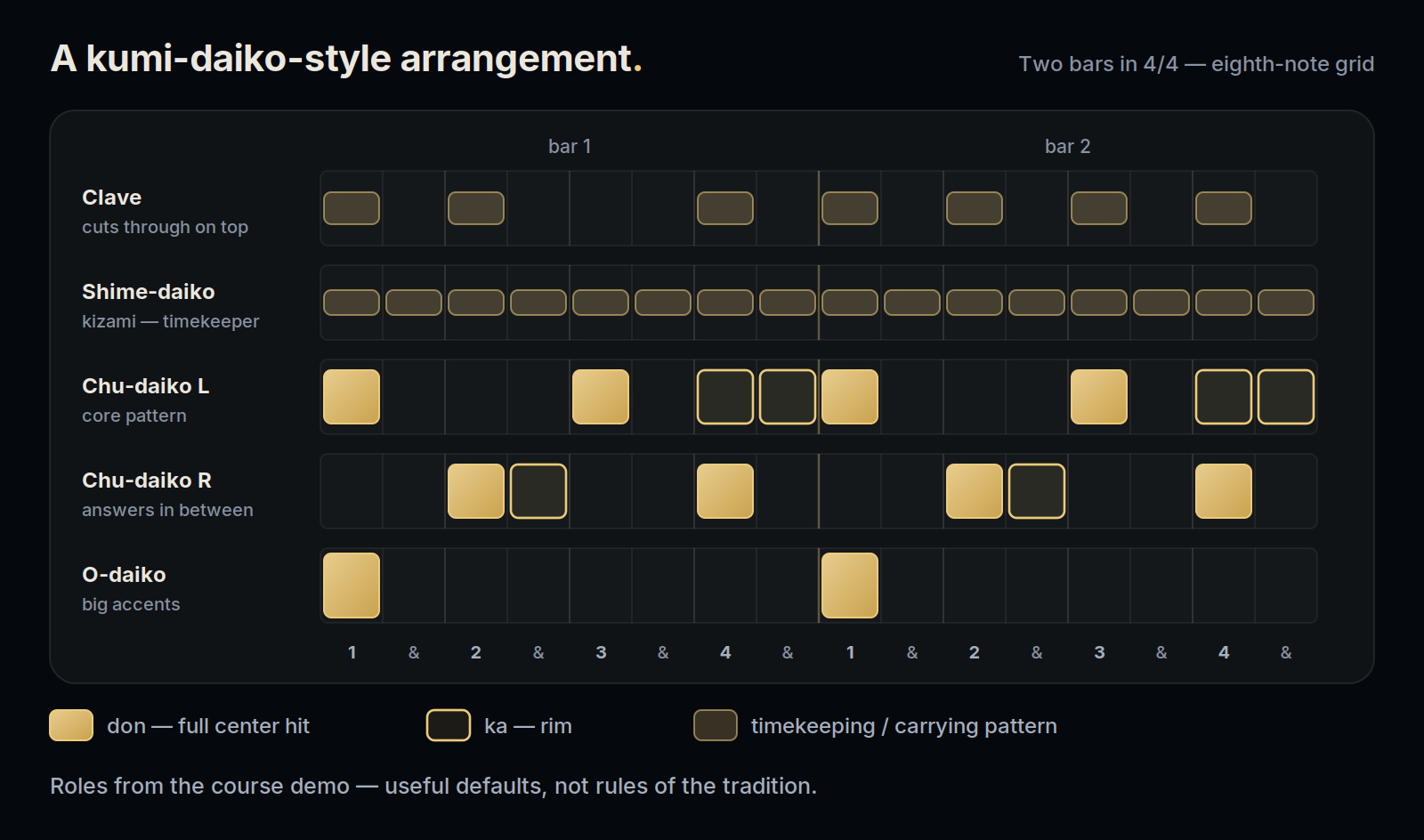
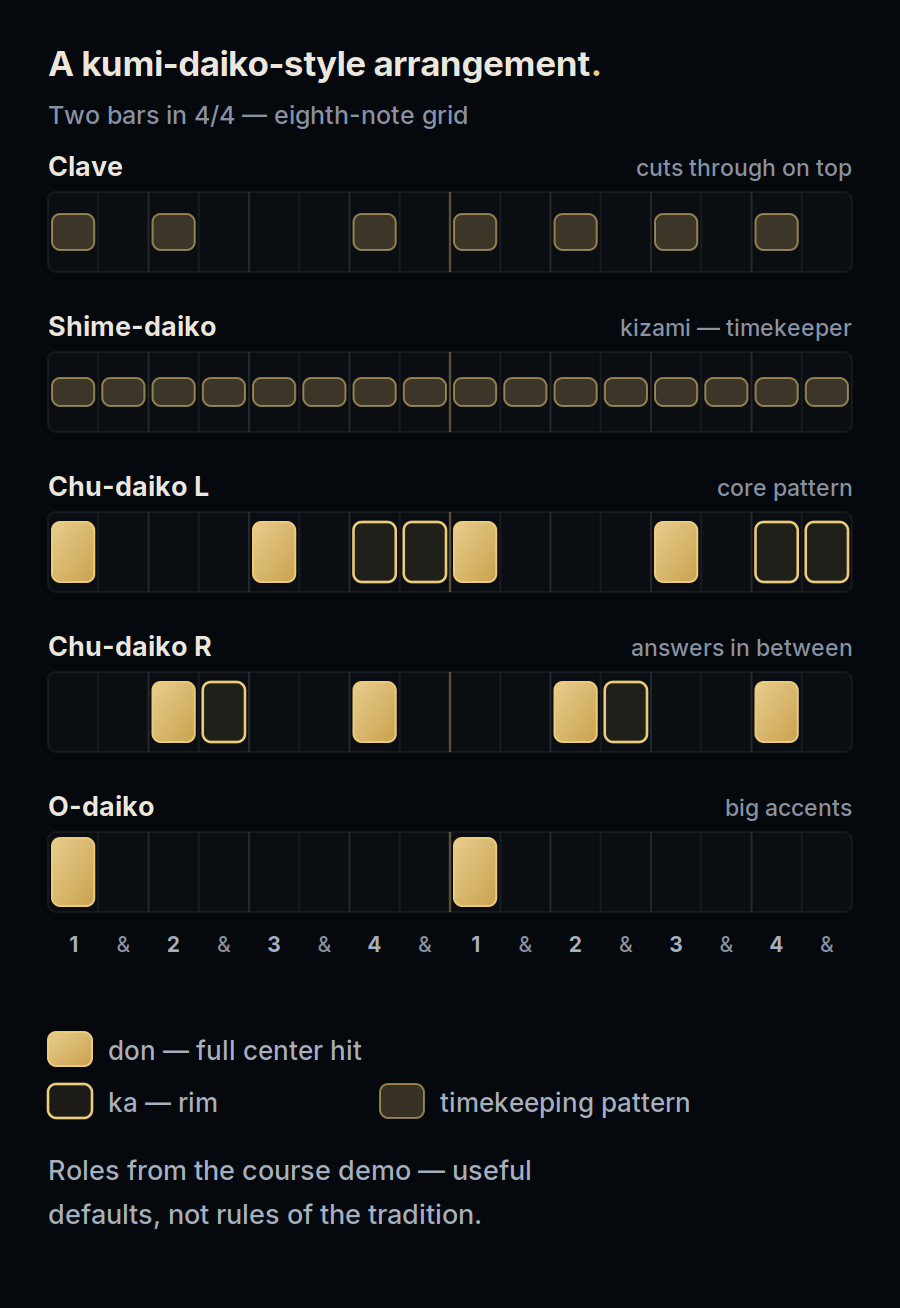
Beyond that, the demo treats taiko exactly like orchestral percussion: reinforce what the arrangement is already doing, give each drum a role, and hold back — if every downbeat gets the full ensemble, the big moments have nowhere to go.
The Otoe course focuses its deep dives on koto, shakuhachi, and taiko, and encourages students to explore the plucked lutes on their own — so here is the essential background.
The shamisen is the instrument behind the "Japanese banjo" search: a three-string, long-necked lute with a skin-covered body, played with a large plectrum called a bachi, combining plucked strings with percussive attacks — the bachi can strike the skin along with the string. The lowest string is set up to produce sawari, a deliberate buzzing halo that is part of the instrument's identity. It spans everything from kabuki theater music to the fast, virtuosic tsugaru-jamisen style that fills the "shamisen shredding" videos you may have seen. In a track, it reads instantly as rhythmic energy and grit, where the koto reads as flowing elegance.
The biwa is the "Japanese lute" in the literal sense — a pear-shaped, fretted instrument related to the Chinese pipa, played with a wide plectrum and associated for centuries with sung epic storytelling. Its dramatic strokes and buzzing sustain make it a striking color for scene-setting and tension — and its own repertoire is far richer than its sparse film-score cameos suggest.
Beyond these, a few more colors turn up in scores evoking older Japan: the shō, a mouth organ from gagaku that sustains luminous tone clusters; the transverse bamboo flutes (shinobue and the piercing nohkan); and the tsuzumi hourglass drums of noh and kabuki theater.
The Legend of Otoe: Levels 2 & 3 Level 3 teaches these instruments from the source: koto master Yoko Reikano Kimura and shakuhachi player Zac Zinger give guest lectures on writing for their instruments, taiko gets its own percussion workshop, and you finish by scoring your Caves of Despair piece with a full traditional-instrument arrangement. Explore the course
The course frames traditional instruments with three guidelines that work for any of the instruments above.
Give it a role. Treat a traditional instrument the way you'd treat an oboe or a viola: assign it to melody, counterline, ornament, harmony, resonance, or rhythm. Melody makes it the lead singer; counterline and ornament make it a featured guest; the accompaniment roles put it in the band. An instrument that just noodles "atmosphere" with no role tends to sound pasted on.
Play to its strengths. Each of these instruments carries centuries of repertoire that shaped what sounds idiomatic on it — pentatonic tunings and bends on the koto, breath shapes and decays on the shakuhachi, don-ka stroke patterns on taiko. You can absolutely write against tradition — Zinger himself plays jazz on the shakuhachi — but it works better as an informed choice than as an accident.
Make it clear. The delicate solo voices — shakuhachi and koto above all — are easily buried; give them space. When you double them, contrasting timbres help the character survive: the course points to Yu-Peng Chen's writing for Genshin Impact's Inazuma region as a model, with koto doubled by oboe and shakuhachi doubled by violin — pairs different enough that neither swallows the other. Similar-timbre pairs like koto with harp or shakuhachi with flute blend into a single color instead, which can also be exactly what you want — as long as it's a choice rather than an accident.
One more point the course makes explicitly: these instruments are not a costume. A pentatonic melody alone doesn't make music Japanese, and a taiko hit alone doesn't make it epic — the instruments work best when the writing underneath already has a reason for them.
Most of us will write for these instruments as virtual instruments first. The course demo is built on Native Instruments' East Asia library; the first point below is specific to how that library works, the rest are general habits:
The Legend of Otoe: Composing Music for Anime and JRPGs If you're starting from zero: Level 1 teaches the compositional foundation all of this rests on — melody, harmony, and arrangement for anime- and JRPG-style music. Explore the course
Our Music Composition & Orchestration Courses
Our Music Production Courses
Our Music Trailer Courses
See All CoursesWhat are the main traditional Japanese instruments? The ones composers use most are the koto (13-string zither), shakuhachi (end-blown bamboo flute), shamisen (three-string lute), biwa (pear-shaped lute), and the taiko drum family. Court and theater traditions add more, like the shō mouth organ and the nohkan flute.
What is the Japanese zither called? The koto — a long zither with 13 strings and movable bridges, plucked with picks worn on the fingers. It's sometimes loosely called a Japanese harp because of its glissandos, but it's built as a zither.
What is the Japanese flute called? The best-known is the shakuhachi, the end-blown bamboo flute with the breathy, vocal tone heard in countless film and game scores. Japan also has transverse bamboo flutes such as the shinobue and the nohkan, so "Japanese flute" can refer to more than one instrument.
What is the "Japanese banjo"? Usually the shamisen: a three-string, long-necked lute played with a large plectrum called a bachi, combining plucked strings with percussive attacks. That attack and the skin-covered body are what remind Western listeners of a banjo.
What are Japanese drums called? Taiko — an umbrella term for Japanese drums, from the small, timekeeping shime-daiko to the mid-size chū-daiko to the enormous ō-daiko. The modern ensemble style is called kumi-daiko.
Are Japanese instruments hard to write for? Each has real constraints — the koto's open-string pitches are set by its bridge positions, with pressing techniques adding further pitches and bends; some shakuhachi pitches speak more softly than others; taiko patterns follow stroke logic — but they're learnable, and respecting them is most of what makes a part sound authentic. When in doubt, ask a player whether your part sits in the instrument's comfortable zone.
What scales do Japanese instruments use? Traditional repertoire leans heavily on pentatonic material, but which scales depends on the instrument, its tuning, and the repertoire: hirajōshi and kumoijōshi are koto tunings, the shakuhachi's basic fingerings outline a minor pentatonic, and folk and court traditions have patterns of their own. Our guide to Japanese scales covers the scale family in detail.
Learn with Master The Score
Courses on composition, orchestration, music production, trailer music and sound design, from composers writing for film, games and media. Students also get exclusive discounts on leading sample libraries and plugins.
Discover all courses →


Online education for media composers — orchestral writing, trailer music, mixing and more, taught by working professionals.