
Music Theory and Composition


Ryan Leach is an Award Winning Composer for film and tv. His music has been heard on Every major Network. His clients includes Disney, Mtv and Netflix.
Ask five composers what "the Japanese scale" is and you'll get five different answers — because Japanese music doesn't use one scale, it uses a family of them. This guide covers the Japanese scales you'll actually reach for as a composer: the pentatonic foundation, then hirajōshi, insen, iwato, and yo — what notes they contain, why they sound the way they do, which traditional instruments they live on, and how to use them in your own writing without sliding into cliché.
Two ingredients do most of the work.
Gaps. The scales in this guide are all pentatonic — five notes per octave instead of seven. Fewer notes means wider spaces between them, and those gaps create an open, uncluttered sound. Because these scales skip degrees a Western ear expects, you often can't even tell whether the music is "major" or "minor" in the Western sense — the scale floats free of that question.
Half-step color. What separates the distinctly Japanese-sounding scales from the pentatonics used all over the world is the placement of half steps inside all that open space. The scales of the traditional "in" family — hirajōshi, insen, iwato, and their rotations — each lean a half step against one of the scale's stable tones. A dark, tense little interval surrounded by wide-open perfect intervals: that contrast is a big part of the signature sound.
A third ingredient follows from the first: perfect fourths and fifths. Because of the gaps, these scales are full of 4ths and 5ths between their notes — in the insen scale, for example, the root forms a perfect 4th and 5th with two of its neighbors. To Western ears, that bare-4ths-and-5ths sound has become strongly associated with East Asian music, which means you can flip the association around and use it deliberately (more on that below).
If you want the Western foundation first — how major, minor, and the modes work — start with our complete guide to music scales and come back.
Before the specifically Japanese scales, it's worth locating them in the bigger picture: the pentatonic scale is the basis of an enormous amount of music all over the world — Asian, European, African, American. The major pentatonic (C–D–E–G–A, or do–re–mi–sol–la) underlies literally thousands of melodies, and the minor pentatonic (C–Eb–F–G–Bb) is just as universal, from folk music to blues to film scores.
Japanese music theory even has its own name for the major-pentatonic pattern: yonanuki major, literally "without four and seven" — take a Western major scale, remove the 4th and 7th degrees, and you're left with the major pentatonic. (There's a yonanuki minor as well, built by the same removal from the natural minor scale.) A great deal of Japanese melody, from folk song to J-pop, is yonanuki at heart.
So no — the pentatonic scale is not "Japanese" by itself. A minor-pentatonic melody can just as easily sound Celtic or bluesy; context, instrumentation, and the specific five notes you choose are what point it toward Japan. That's where the next four scales come in.
The Legend of Otoe: Composing Music for Anime and JRPGs Start writing in the Japanese style: harmonic functions, the common progressions of Japanese music, melody note choices, and arranging for piano and strings — taught through an original anime story with artwork and professional voiceover. Explore the course
All four are shown from a C root so they're easy to compare — transpose them anywhere.
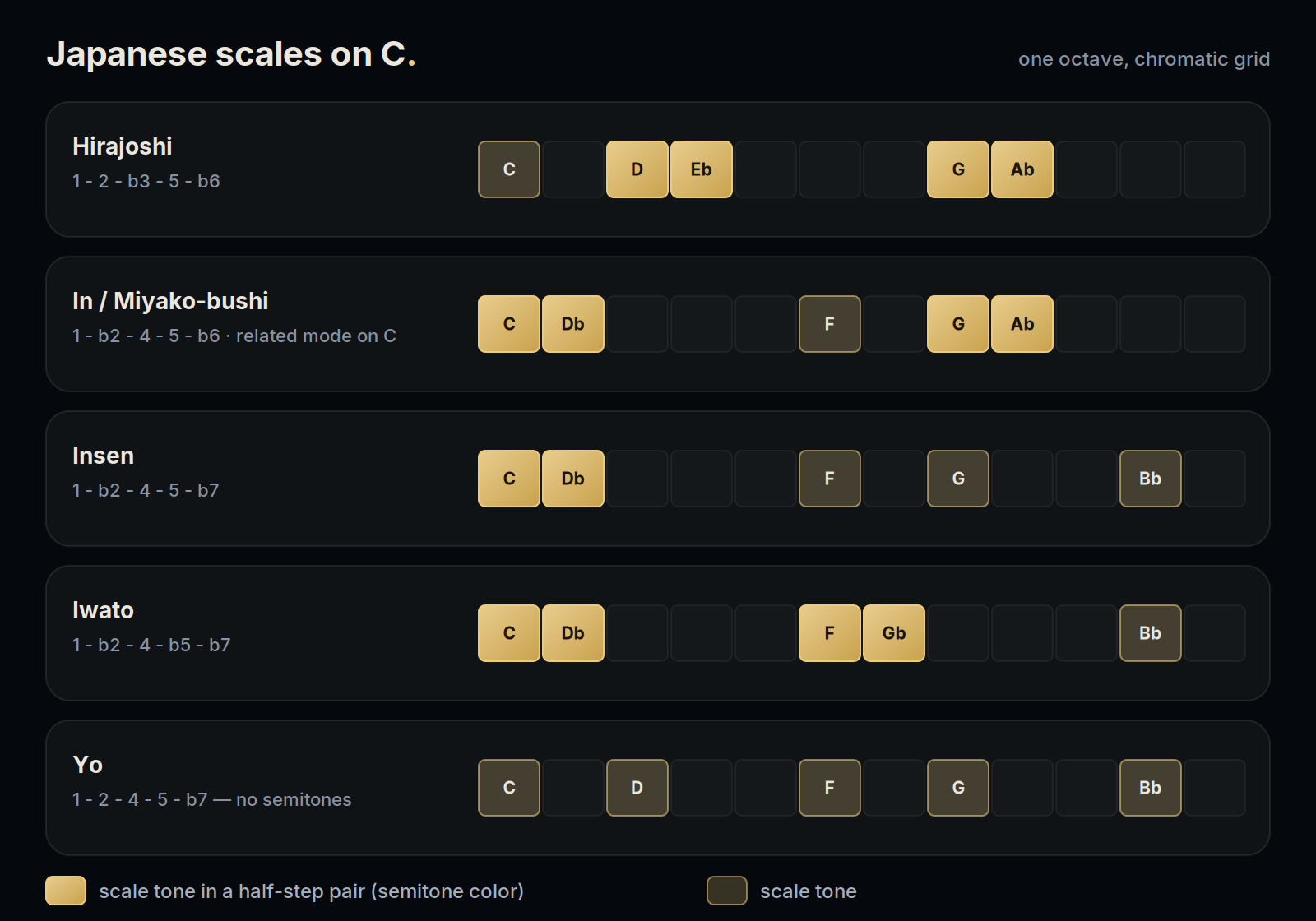
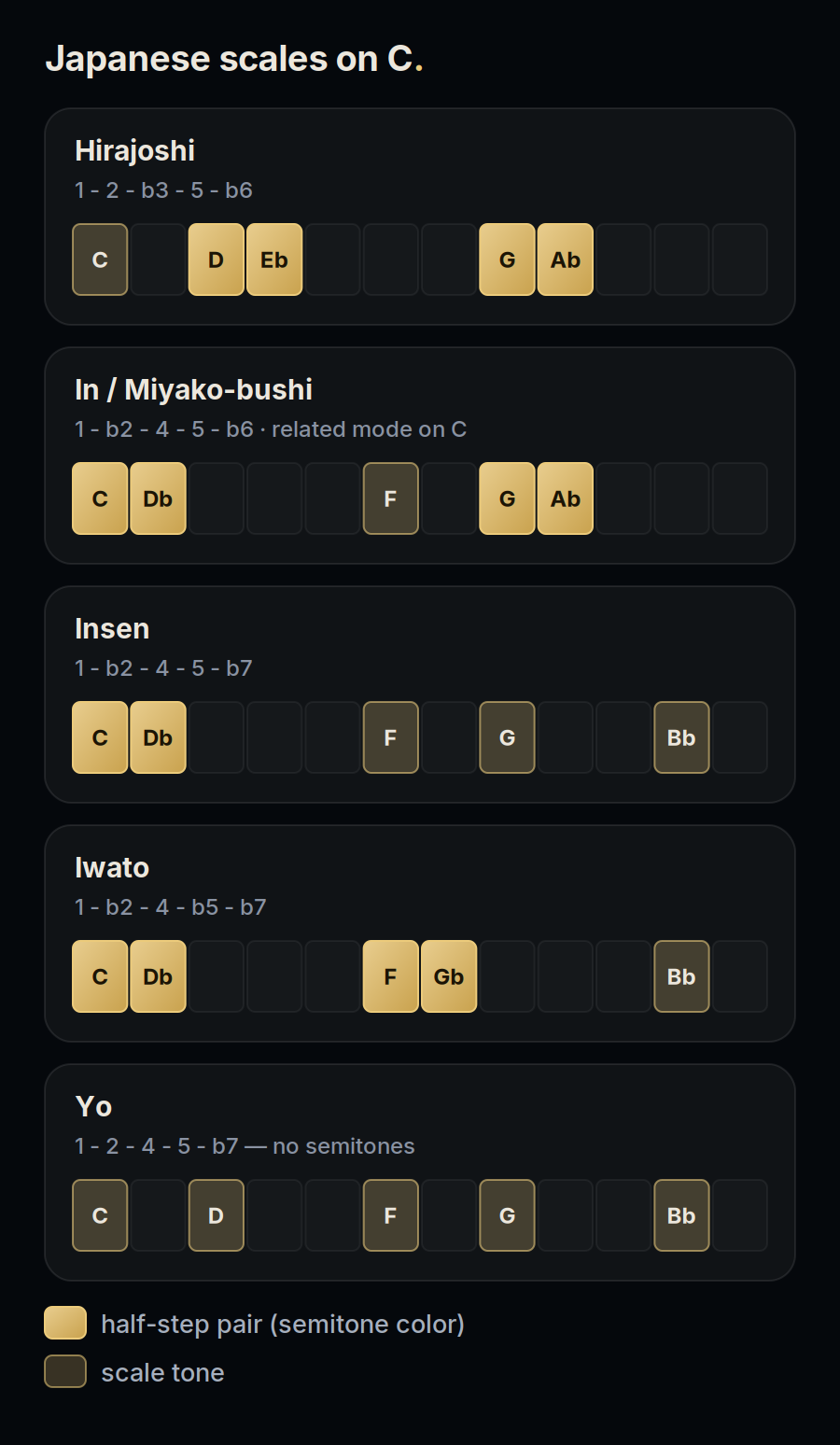
The name hirajōshi comes from the standard tuning of the 13-string koto — and depending on which note you treat as the tonic, the same five-note pattern can be spelled several ways. The form you'll most often see in Western scale references is C–D–Eb–G–Ab (1–2–b3–5–b6): minor-flavored, with two half steps (D–Eb and G–Ab) leaning against the scale's open frame. Rotate the pattern — read it from its 5th (G–Ab–C–D–Eb) — and transpose the new starting note back to C, and you get C–Db–F–G–Ab (1–b2–4–5–b6), which puts the half step directly above the root — a form you'll also find under names like the in scale or miyako-bushi. Don't let the naming tangle bother you: these forms are modally related — one interval pattern viewed from different starting points — and each shares the same DNA of perfect intervals with dark half steps folded in. Pluck through either form slowly and you're in a rock garden. (A related koto tuning, kumoijōshi, shifts the pattern to different strings.)
C–Db–F–G–Bb (1–b2–4–5–b7). Heard throughout traditional music of the Edo period, insen carries the in-family's half step above the root but brightens the top of the scale with a b7. Here's a detail Western theory nerds will enjoy: play all five notes of C insen at once and you get C7sus4(b9) — the so-called Phrygian chord, a sonority jazz and film composers use constantly. One scale, two worlds.
C–Db–F–Gb–Bb (1–b2–4–b5–b7). Iwato is insen with one change: the 5th is flattened. That single alteration removes the scale's one anchor of stability and leaves everything suspended and uneasy — the half step against the root and a b5 in the middle. Reach for it when you want traditional color with real tension: night scenes, ghosts, unease.
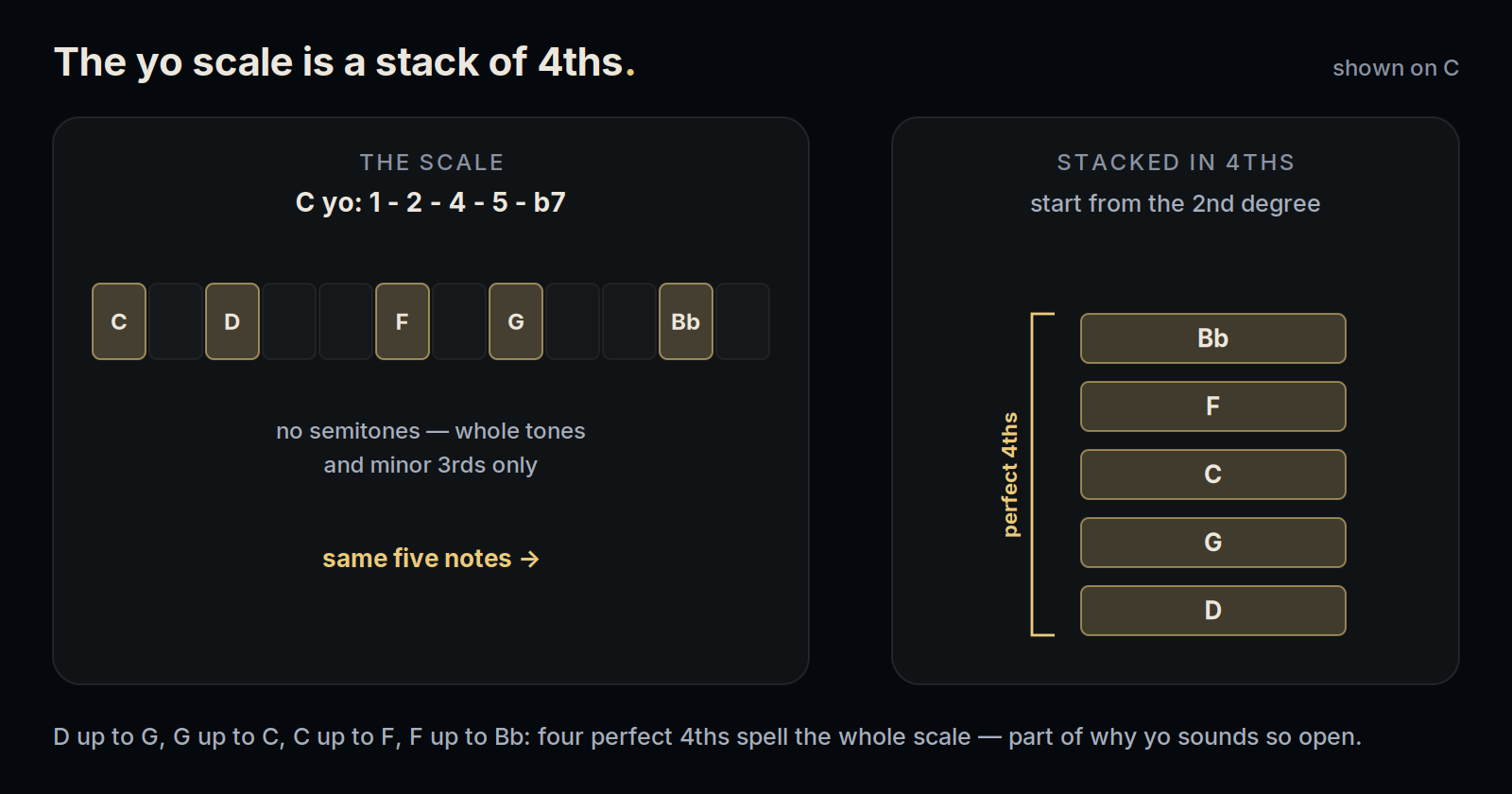
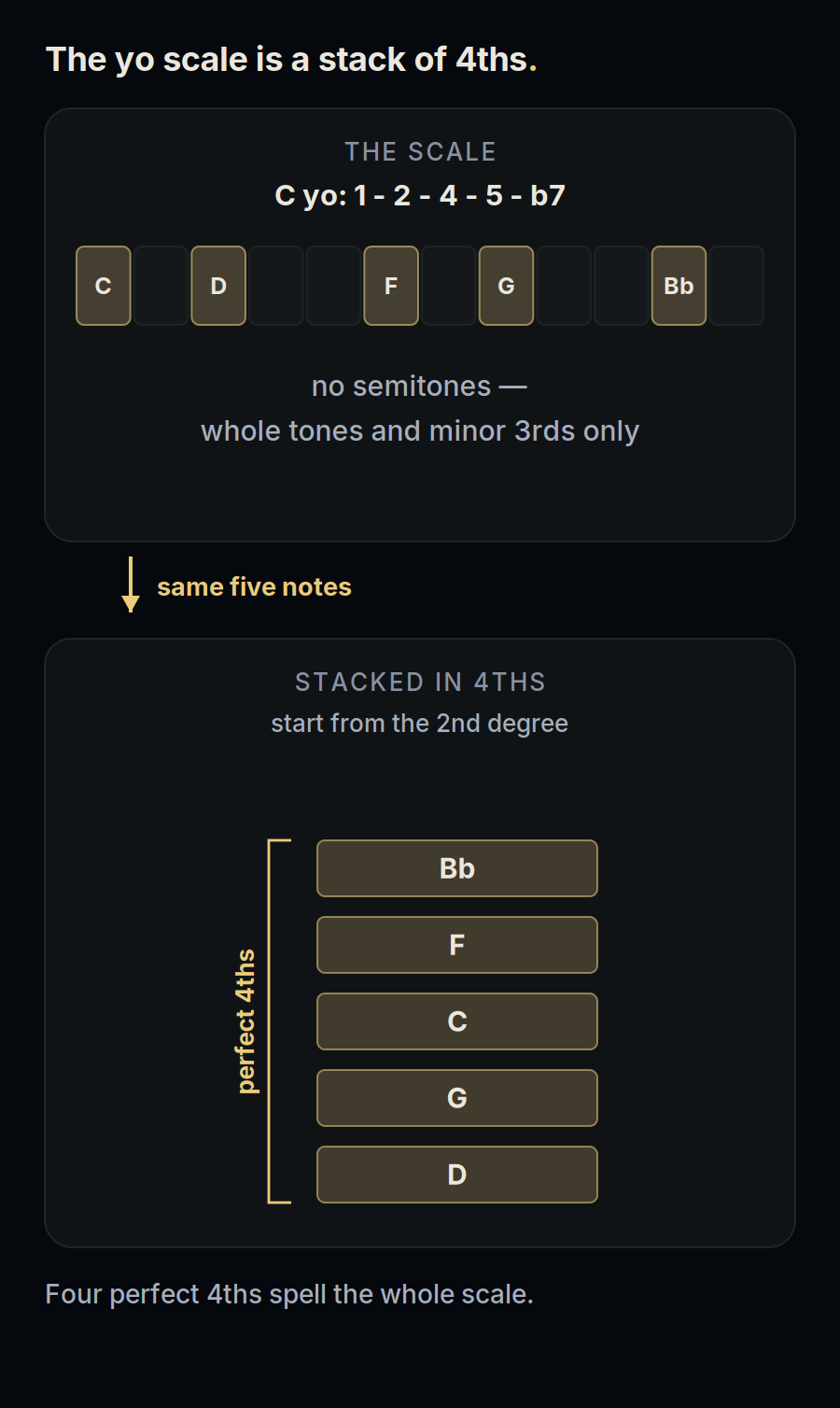
C–D–F–G–Bb (1–2–4–5–b7). The yo scale is like insen with a natural 2 instead of the b2 — and with that, the half steps disappear entirely: its ascending steps alternate between whole tones and minor thirds, with no semitones. It's the most open-sounding of the four, associated with folk and festival music. One beautiful property: starting from its second degree, the whole scale can be spelled as a stack of perfect fourths — in C: D–G–C–F–Bb. In a real sense, the yo scale is fourths, which is part of why it sounds so open.
A rough compass — and only a compass, not a law: the half-step "in" family tends toward the darker, courtly end of the palette, while the half-step-free yo family tends toward the brighter, folk end. Real usage is messier, and both families cover more emotional ground than any one-line summary.
A common approach in anime and game scoring is not to stay purely inside one of these scales — it's to write a melody with the scale's color and support it with Western harmony underneath. The scale provides identity; the chords provide motion. But the fit is your job: transpose the scale so its notes sit well on your progression, check which melody notes land on which chords, and decide deliberately where you want friction — a half step from the "in" family rubbing against a major chord is a strong spice, wonderful when chosen and jarring when accidental. (For the harmonic side, see our guides to the Royal Road progression and to writing anime music.)
Because of the pentatonic heritage described above, bare 4ths and 5ths read as "East Asian" to Western ears — so you can evoke the style even from a plain major or minor scale by adding a parallel line a 4th or 5th from your melody. There are two ways to do it, and the difference matters:
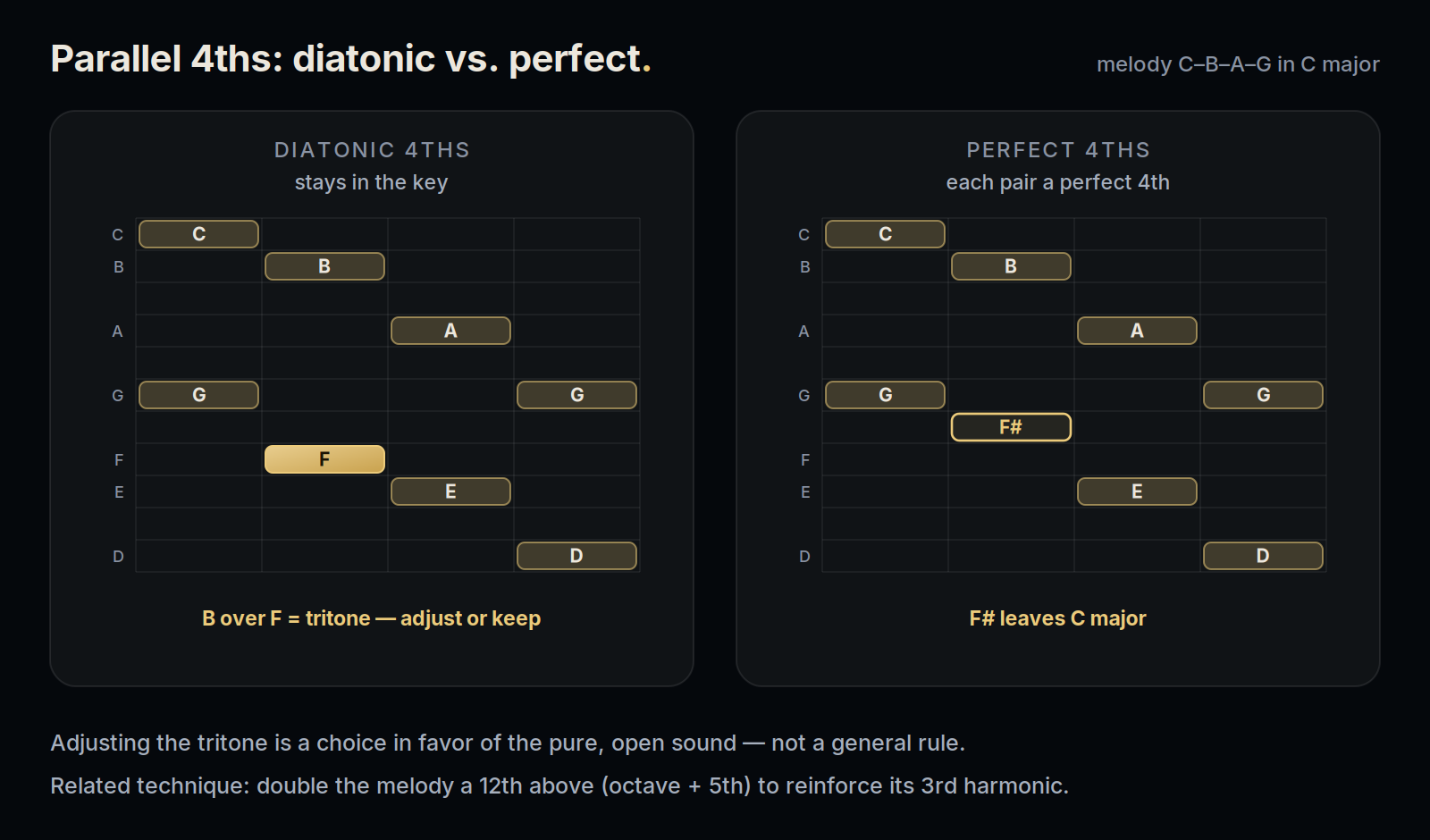
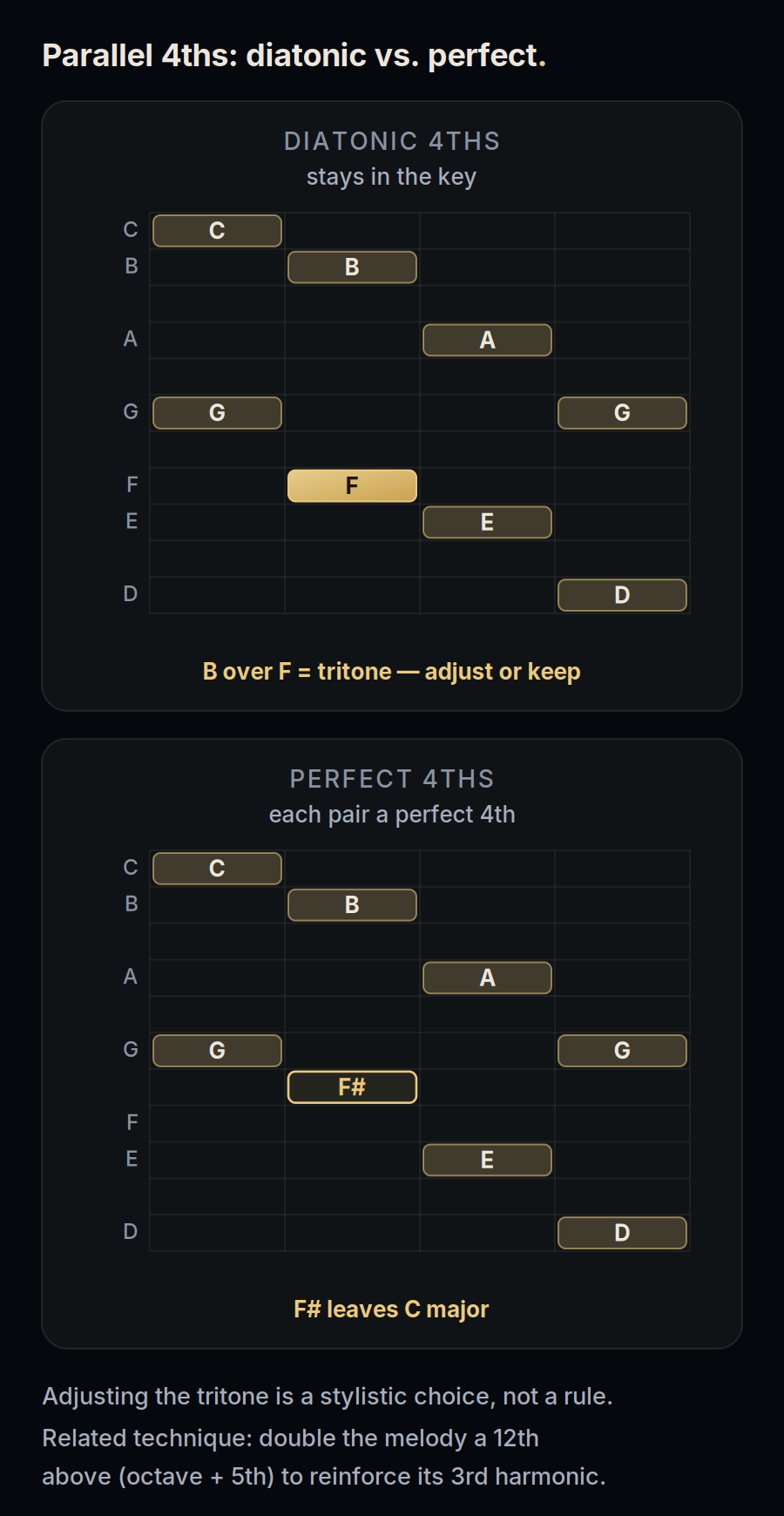
A related orchestration move: instead of harmonizing below, double the melody a 12th above — an octave plus a perfect 5th. Because the 3rd harmonic of any pitch sits an octave and a 5th above it, this doubling reinforces the melody's own overtone and reads more as a color change than as a second voice.
The same principle applies vertically: build chord voicings with perfect fourths stacked on top, drawn from the pentatonic. It turns even plain diatonic harmony open and floating — the step-by-step walkthrough is in the anime music guide.
The scales and the instruments evolved together, so knowing the connection makes both your writing and your mockups better. (For the instruments themselves — koto, shakuhachi, shamisen, biwa, and taiko — see our dedicated guide to Japanese instruments.)
Koto. The 13 strings are tuned to a scale before the piece begins — hirajōshi as the standard tuning — with movable bridges that can be re-set, even mid-performance, for other collections or Western tunes. For individual notes outside the tuning, players press the string down behind the bridge (a technique called oshide), raising the pitch by a half or whole step — so single chromatic inflections are very much available; it's wholesale re-collections that mean moving bridges. Writing idiomatically means thinking in the tuning: runs and cascades inside it are effortless and characteristic, pressed notes add expressive color, and relentless chromaticism fights the instrument — koto players who perform modern game scores describe exactly this tension. One lovely detail from our course's guest lecture: koto master Yoko Reikano Kimura demonstrates adjusting a semitone by ear rather than following equal temperament exactly.
Shakuhachi. On a standard 1.8 shakuhachi, the basic fingerings outline D minor pentatonic — the instrument's effortless home, where players fly. Additional pitches use combinations of fingering changes, partial hole coverage, and adjustments to the blowing angle; the meri technique in particular — lowering a pitch with the head and blowing angle — changes tone color along with pitch: softer, breathier, more inward. Write lines that live in the pentatonic home and treat the bent and shaded notes as deliberate expressive color, and you're writing what the instrument does best.
In the DAW. The koto and shakuhachi libraries we use in our course are mapped scale-first: separate instances for E hirajōshi, G hirajōshi, or chromatic playing, with the in-between keys triggering idiomatic articulations — bends, tremolos, harmonics, the shakuhachi's breathy muraiki. Not every library works this way, but the underlying idea transfers to any of them: work inside the scale, and reach for recorded idiomatic articulations before programming your own.
The Legend of Otoe: Levels 2 & 3 This is where these scales live: parallel 4ths and 5ths, modal and non-functional harmony, and writing for traditional Japanese instruments — including guest lectures from instrument masters Zac Zinger (shakuhachi) and Yoko Reikano Kimura (koto). Explore the course
Our Music Composition & Orchestration Courses
Our Music Production Courses
Our Music Trailer Courses
See All CoursesWhat scales are used in Japanese music? Mostly pentatonic scales: the bright yo scale and the darker "in"-family scales — hirajōshi, insen, and iwato — plus the yonanuki (pentatonic) patterns that underlie much Japanese melody. Modern Japanese music also uses the full Western major/minor system, often colored by these scales.
What is the hirajōshi scale? A five-note scale family named after the standard tuning of the 13-string koto. The form most often shown in Western references is C–D–Eb–G–Ab (1–2–b3–5–b6); the rotation with the half step directly above the root, C–Db–F–G–Ab, is also widely taught, sometimes under the names in scale or miyako-bushi. These forms are modally related; transposing each to C changes the actual notes.
What is the insen scale? 1–b2–4–5–b7 (on C: C–Db–F–G–Bb), heard throughout Edo-period traditional music. Played as one chord, its notes spell C7sus4(b9) — the "Phrygian chord" familiar from jazz and film scoring.
What's the difference between insen and iwato? One note: iwato flattens the 5th (C–Db–F–Gb–Bb instead of C–Db–F–G–Bb). Losing the perfect 5th removes the scale's main anchor of stability, which makes iwato the most suspended and unsettled of the common Japanese scales.
Is the pentatonic scale Japanese? No — pentatonic scales appear in musical traditions all over the world. Japan has its own characteristic pentatonics (and its own names, like yonanuki, for the patterns), but a generic pentatonic melody usually needs the characteristic scale variants, instruments, or harmony around it to point it toward Japan.
What scale does anime music use? Mostly standard Western major and minor, colored by modes, borrowed chords, and jazz harmony. The traditional Japanese scales appear when composers write for or evoke traditional instruments — our guide on how to write anime music covers the full picture.
What is the yo scale? 1–2–4–5–b7 (on C: C–D–F–G–Bb) — a pentatonic with no half steps at all, which makes it the most open-sounding of the common Japanese scales. It's associated with folk and festival music, and starting from its second degree its notes can be spelled as a stack of perfect fourths (D–G–C–F–Bb).
Learn with Master The Score
Courses on composition, orchestration, music production, trailer music and sound design, from composers writing for film, games and media. Students also get exclusive discounts on leading sample libraries and plugins.
Discover all courses →


Online education for media composers — orchestral writing, trailer music, mixing and more, taught by working professionals.