

Music Theory and Composition


David McCaulley is a pianist and composer known for his YouTube channel Film Score Analysis, home to more than 150 score reductions of iconic film scores. He studied composition and piano at the University of North Texas and teaches The Piano Composer at Master The Score.
Each octave of a piano contains twelve different notes, and a scale is a pattern for using them: which ones, in what order, at what distances. Most scales take a subset — seven for major and minor, five for the pentatonics — while a few, the chromatic scale among them, keep all twelve and take their character from the pattern alone. Either way, choosing one is the first creative move most pieces of music make, and it does much of the work of setting whether the music reads as bright or dark long before a single melody exists.
In this article you'll learn the single interval pattern that generates all twelve major scales, why minor comes in three versions and what each one is for, the seven diatonic modes written as one formula each along with the two things that decide whether a mode actually sounds modal, the five-note and symmetrical scales composers reach for when major and minor are too plain, and the order to practice all of it in so it ends up under your fingers. It follows how we teach scales and modes in The Piano Composer.
At its core, a scale is a collection of notes you draw from to make music. That is the practical value: instead of facing all twelve pitches and trying to work out which ones belong together, you pick a scale and most of the guesswork disappears.
The easiest one to see is the C major scale. Take two Cs an octave apart, play every white key in between, and you have it. Number those notes from one to seven and you get the scale degrees — the first degree is the tonic, the note the scale is named after and the one that feels like home. (Worth keeping apart: tonic is the first degree of a scale, while a chord's root is the note that chord is built on — which need not be its lowest note.)
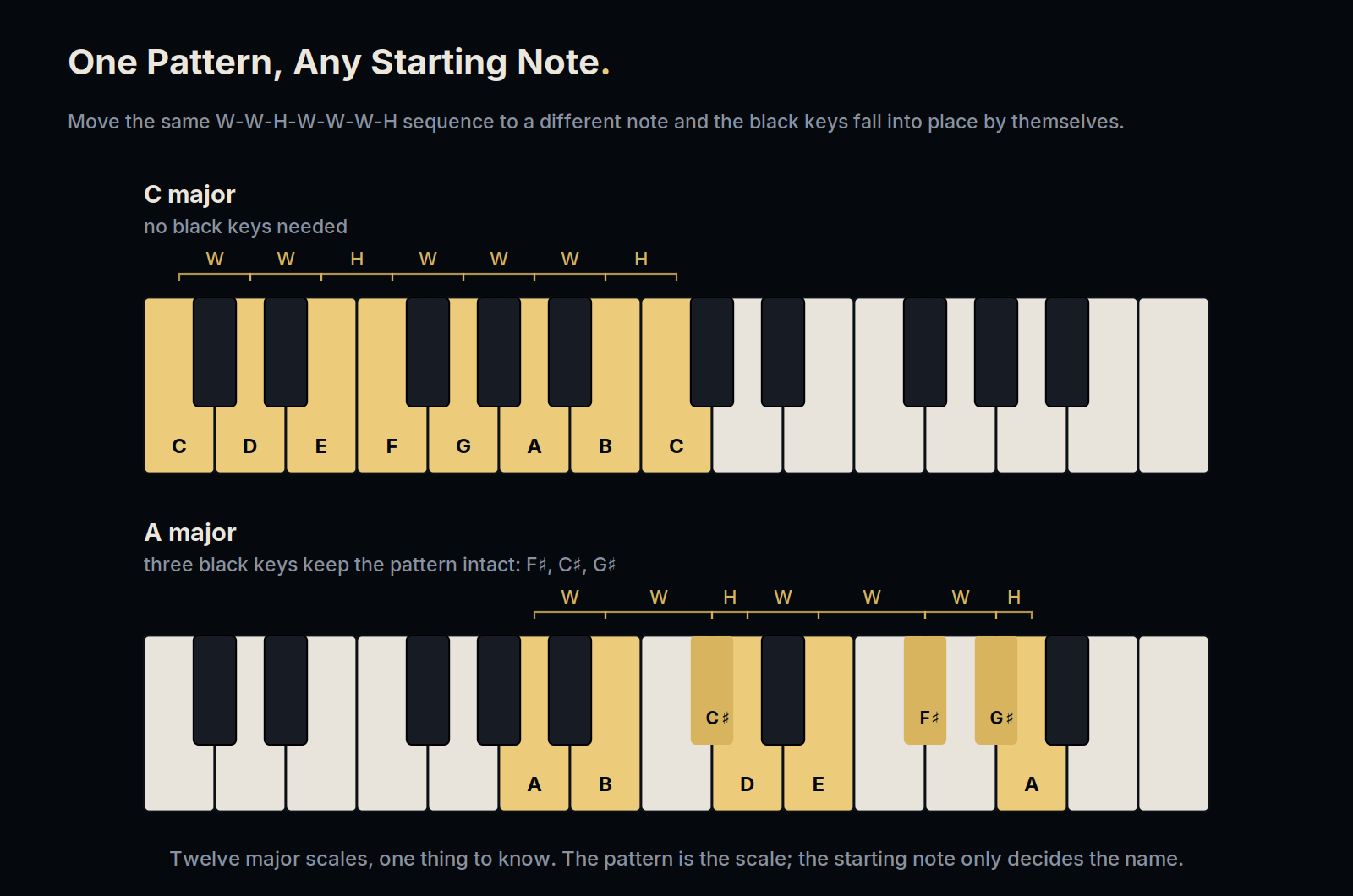
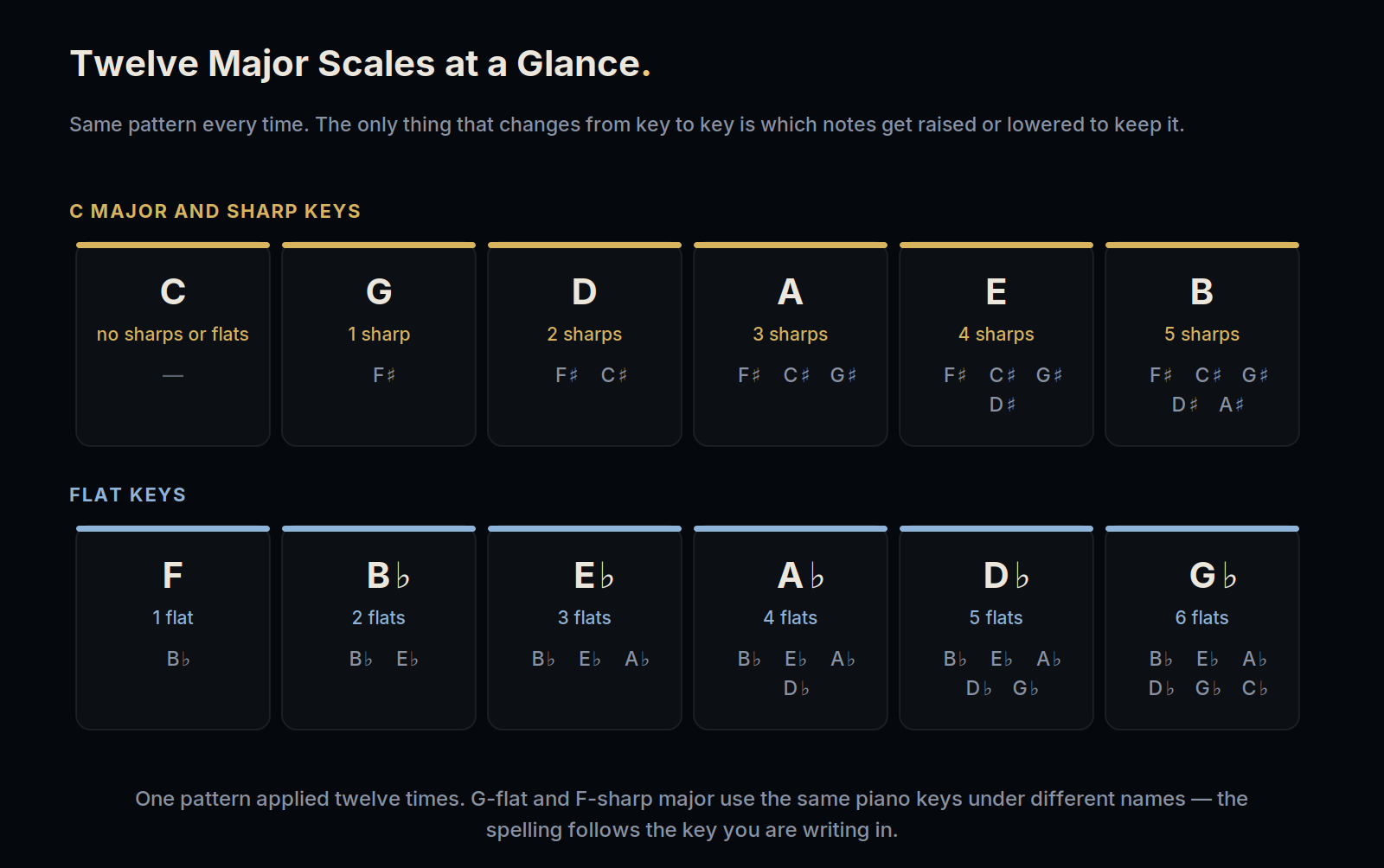
But here's the part that matters more than the notes: a scale is a pattern of intervals, not a fixed set of keys. Look at the distance between each note of C major and you get whole step, whole step, half step, whole step, whole step, whole step, half step. That pattern is the major scale. Start it on A instead and you get A major. Start it on E♭ and you get E♭ major. Same pattern, different starting point, same character.
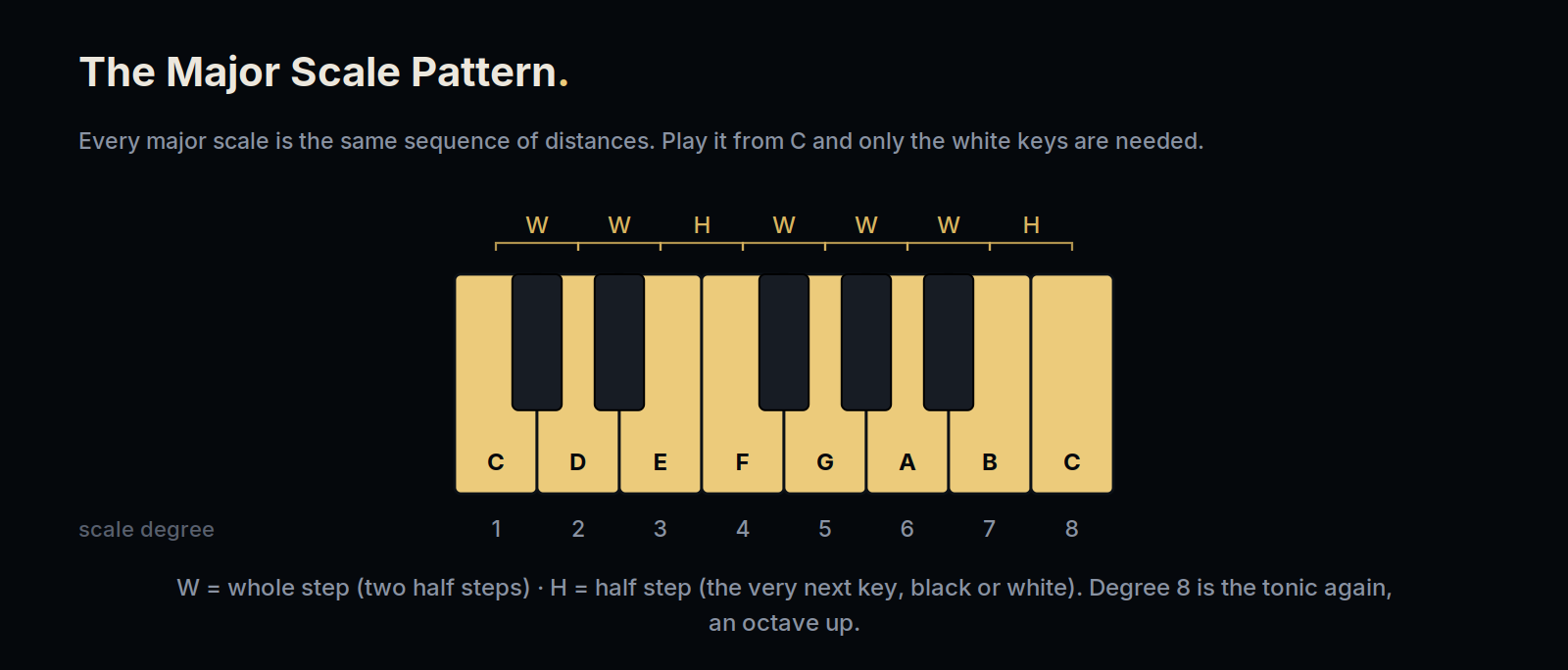
Once you internalize that, you stop memorizing twelve separate scales and start carrying one pattern you can drop anywhere on the keyboard.
The minor scale uses a different interval pattern: whole, half, whole, whole, half, whole, whole. Start it on C and you get the natural minor scale.
There is an easier way to remember it. Compare it to the major scale on the same root and only three notes differ: the third, the sixth and the seventh are each lowered by a half step. C major is C–D–E–F–G–A–B; C natural minor is C–D–E♭–F–G–A♭–B♭. Lower the third, sixth and seventh by a half step and you have natural minor — no second pattern to memorize.
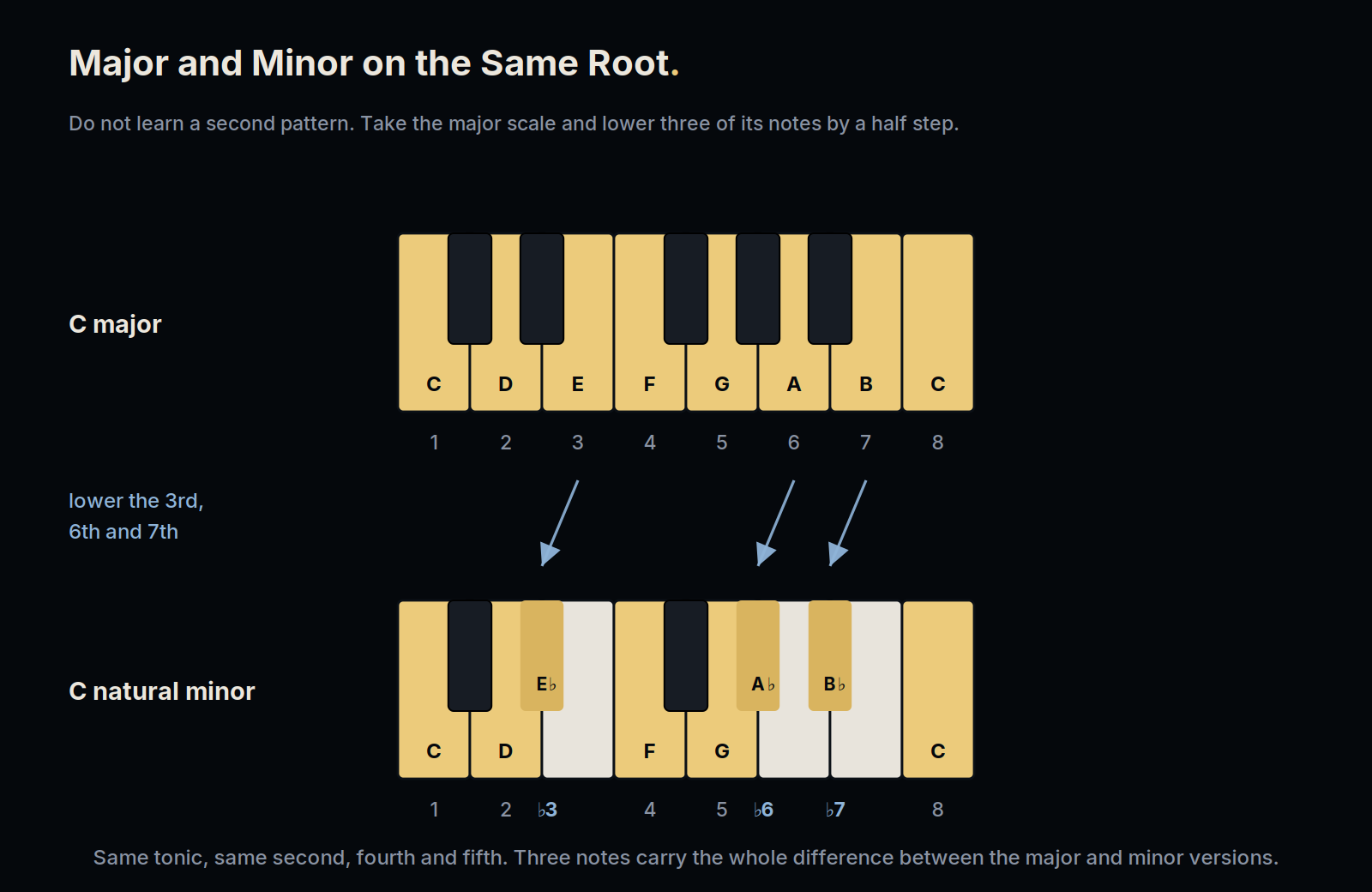
That comparison — C major against C minor — is the one that shows you what minor is. There is a second relationship worth knowing and not confusing with it: start the minor pattern on A and you get A natural minor, which uses exactly the same seven notes as C major. Same notes, different tonic, completely different mood. Every major scale has a relative minor built this way, a minor third below its tonic.
Two variants come up constantly, and both exist to solve a specific problem.
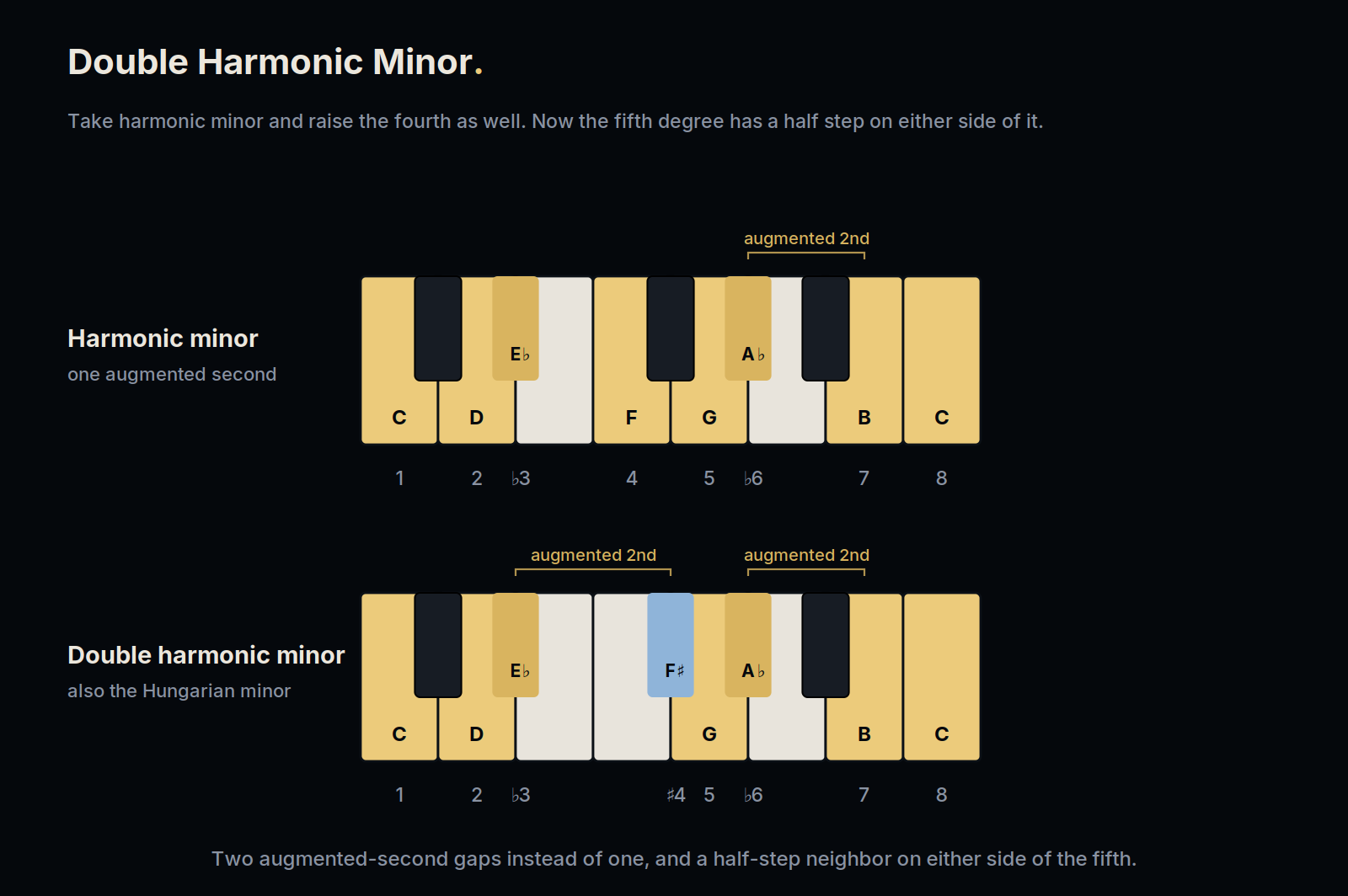
Harmonic minor raises the seventh degree back up. The reason is harmony: raising it creates a leading tone a half step below the tonic and turns the chord on the fifth degree from minor into major, which is what gives a V–i cadence its pull. The side effect is an augmented second between the sixth and the raised seventh — a wide, slightly exotic gap that is unmistakable once you know to listen for it.
Melodic minor, in its classical exercise form, raises both the sixth and the seventh on the way up and lowers them again on the way down. That sounds fussy, but it fixes the awkward leap harmonic minor creates while keeping the pull toward the tonic where you need it. In actual music those two degrees move with the harmony rather than with the direction, and jazz players generally keep the raised form going both ways.
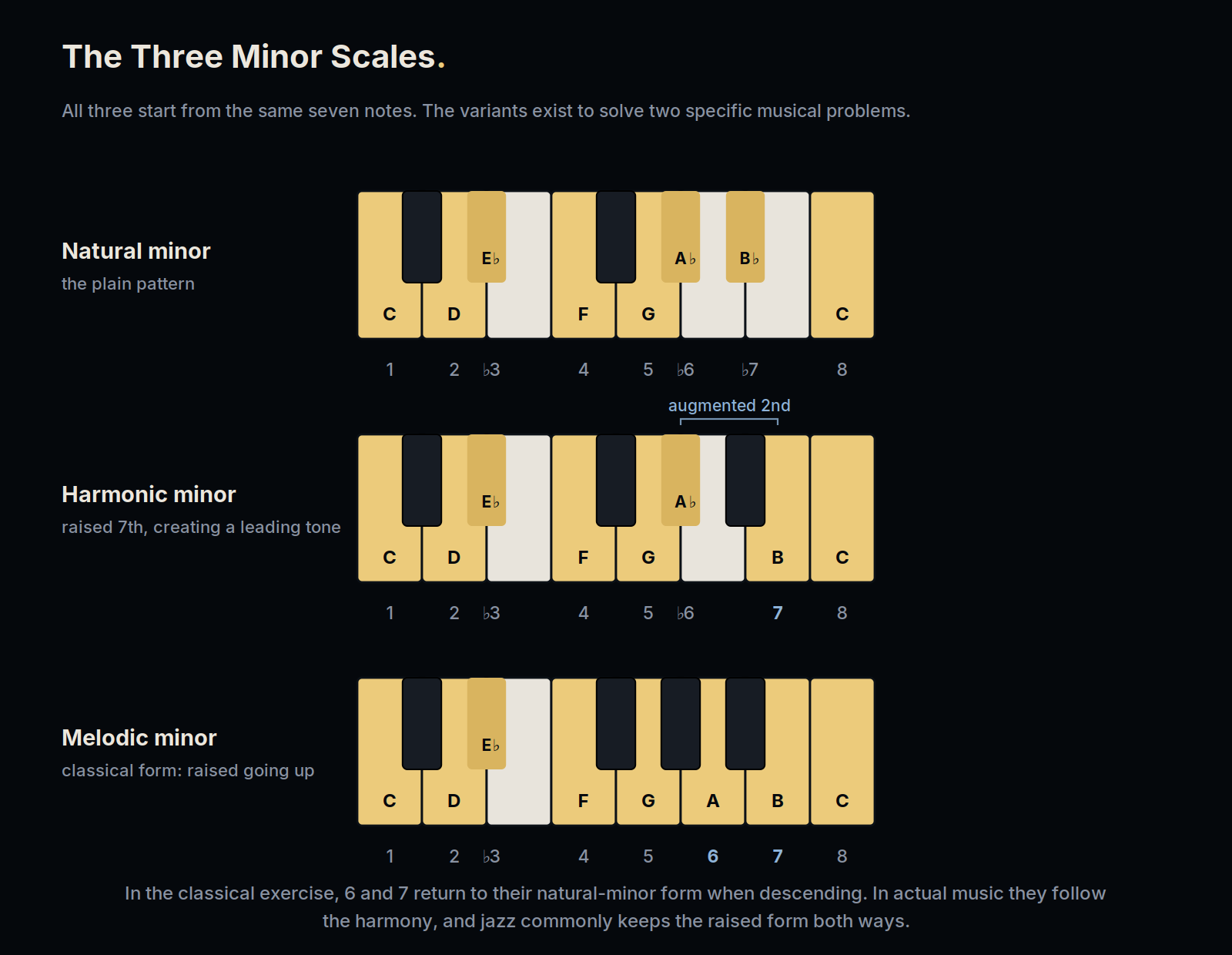
You do not have to treat the descending rule as law. Keeping the ascending form in both directions gives you one consistent minor palette rather than two, and the raised degrees move the tritones: C melodic minor has E♭–A and F–B, where C natural minor has D–A♭. How that lands depends on voicing and harmony; it is a common choice for uneasy, otherworldly writing.
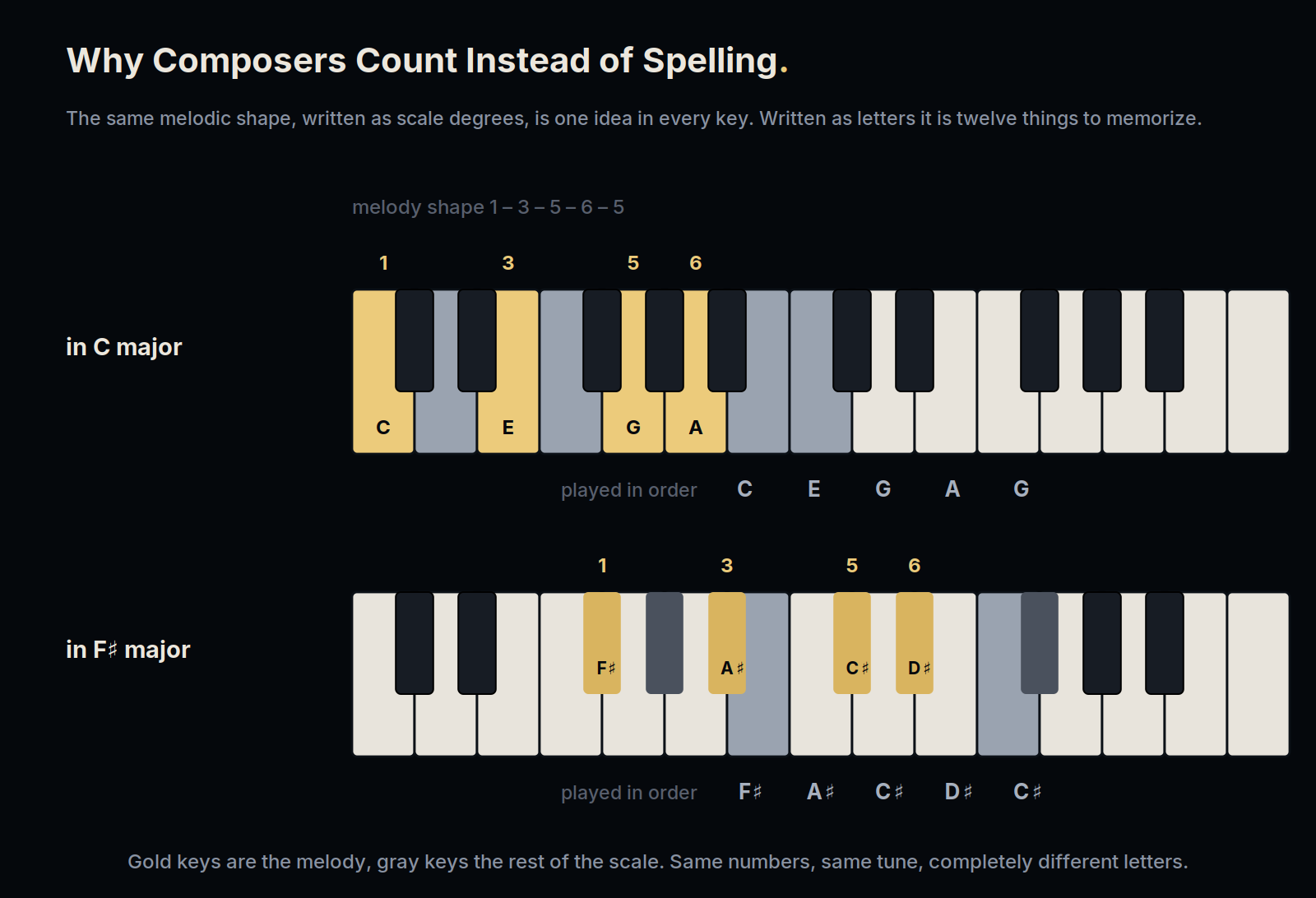
Once you think in degrees rather than letters, everything becomes portable. "Lower the third" works in every key. A melody described as 1–3–5–6–5 is the same shape in C, in F♯, in anything. Chord progressions written as Roman numerals travel the same way — which is why the chords built on scale degrees behave identically in every major key.
This is also the bridge between scales and harmony: stack every other note of a scale and you get that key's chords. Our guide to piano chords walks through exactly how that works, and the circle of fifths maps how the twelve keys relate to each other.
The Piano Composer David McCaulley teaches scales the way a composer actually needs them: as the material everything else is built from. Chapter one starts with the major and minor patterns and the chords that come out of them, chapter two puts five-finger and full-octave scales under your hands with proper fingering, and a downloadable sheet gives you every major and minor scale with its fingering so you can take them into all twelve keys. Explore the course
The major scale has seven diatonic modes. The names sound intimidating — Ionian, Dorian, Phrygian, Lydian, Mixolydian, Aeolian, Locrian — but two of them you already know, and the rest are one change each away from a scale you already know. Locrian is the exception, at two.
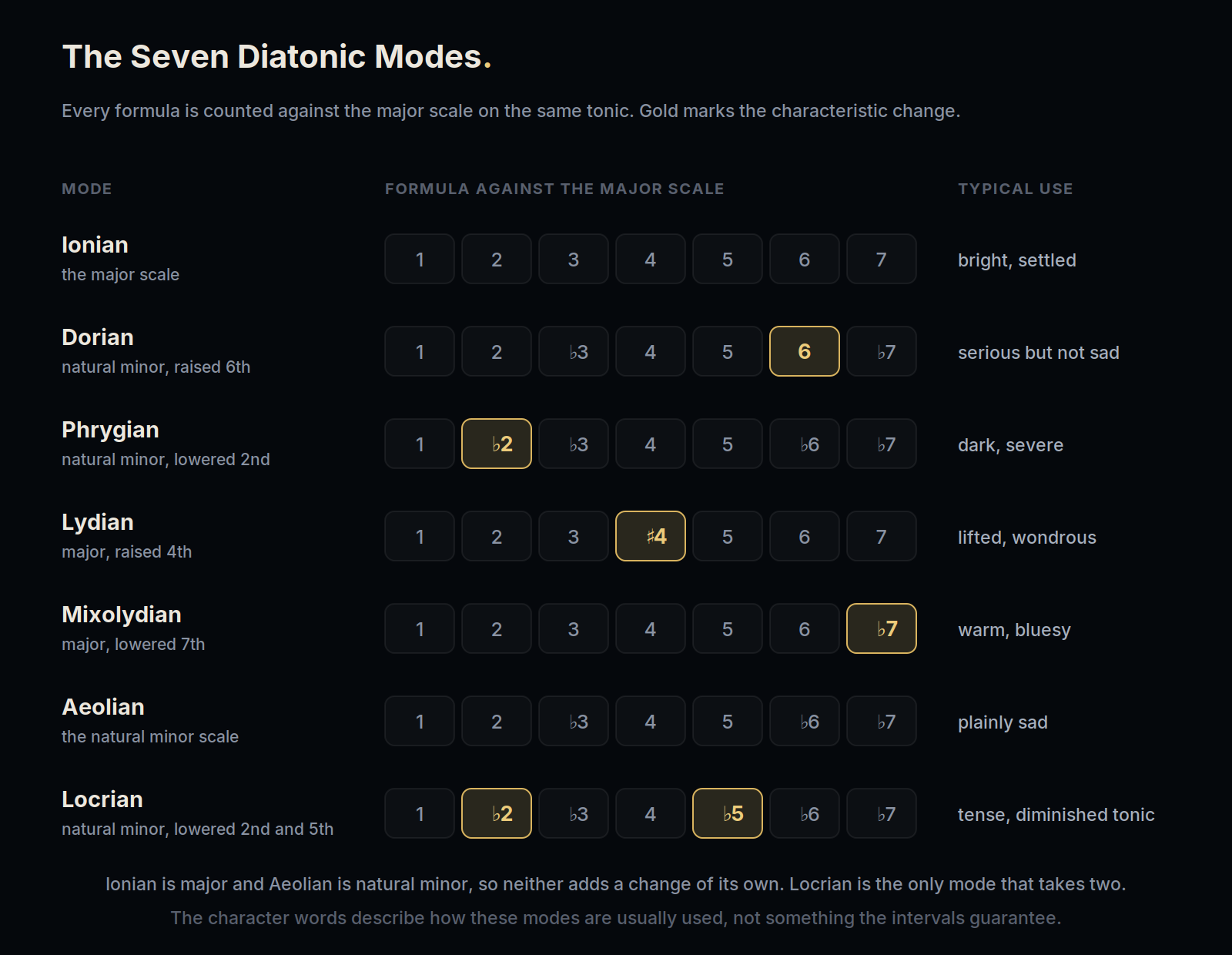
The alterations are fixed; the characters attached to them are conventions. They describe how these modes have been used in Western music rather than anything the intervals guarantee, and a change of tempo or orchestration can send any of them somewhere else. Locrian is the one place where the structure really does push the effect: with no perfect fifth above the tonic, its home chord is diminished, so the usual way of making a note feel like home is unavailable and you have to establish it some other way.
Two things make the difference between playing a mode and actually sounding like it.
The first is the color notes — the degrees that are altered. In Dorian that is the raised sixth; in Lydian the raised fourth; in Phrygian the flattened second. Aim your melody at those notes and use the chords that contain them, and the mode announces itself. Avoid them and the modal color stays implicit — the harmony and the tonal center can still carry it, but the melody will not.
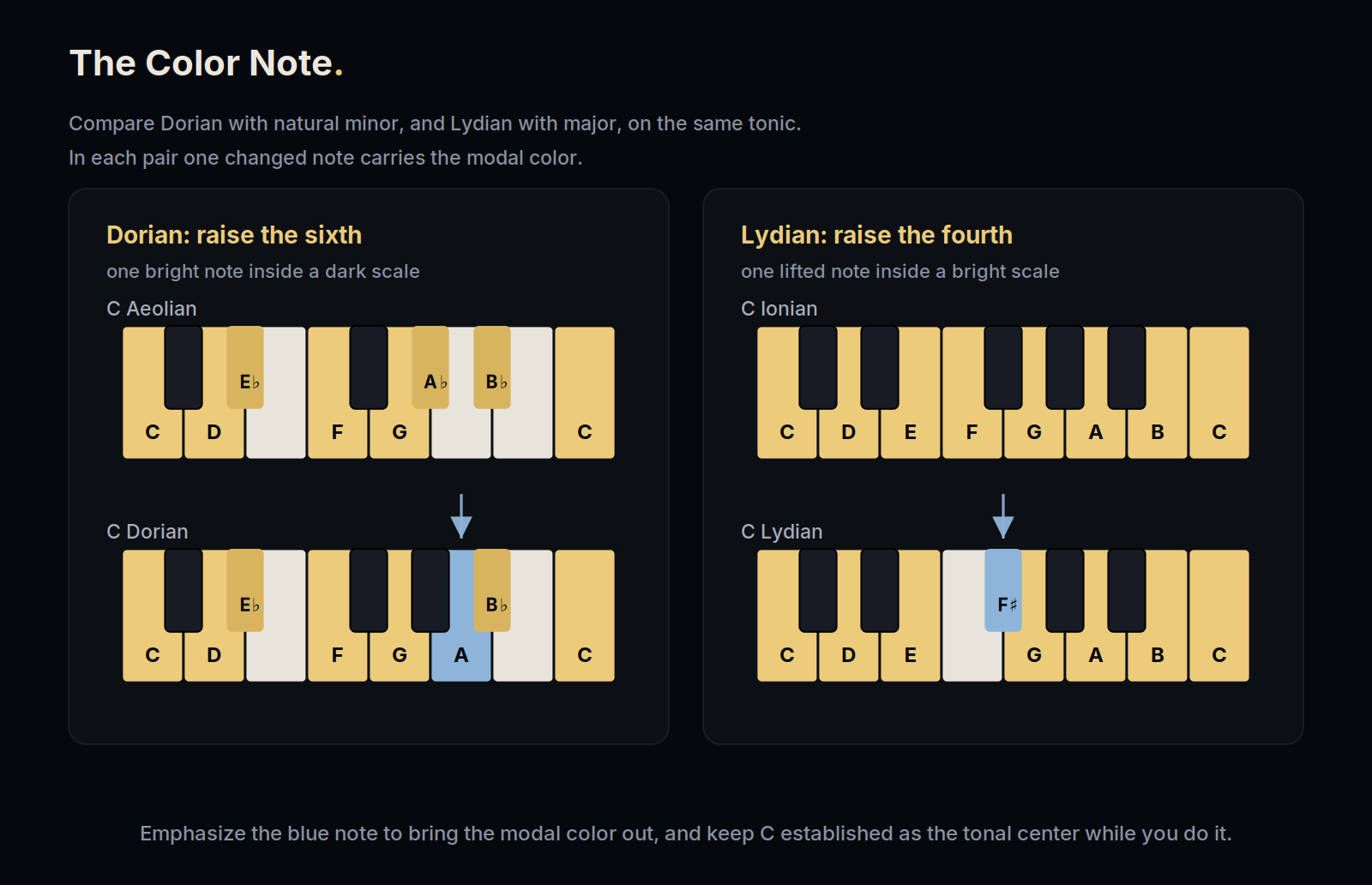
The second is the tonal center. A mode registers as that mode only when the ear hears its first degree as home, and there are plenty of ways to establish that: a pedal tone underneath, returning to the note at the ends of phrases, or simply building the harmony around it. A held bass note is the bluntest and most reliable of them, but it is one option rather than a requirement. What matters is that the context exists at all — without it, C Dorian tends to drift back into sounding like plain B♭ major.
Take five notes instead of seven and you get a pentatonic scale — penta for five, tonic for tones. The major pentatonic drops the fourth and seventh degrees; the minor pentatonic drops the second and sixth.
What makes it useful is what is missing. Neither the major nor the minor pentatonic contains a single half step: the steps that remain are three whole steps and two minor-third gaps. Removing every half step removes one source of close melodic tension, and the two gaps give a melody room to open up. The harmony underneath still decides how each note lands, but as a place to write a tune it is forgiving — countless melodies are built on five notes and nothing else.
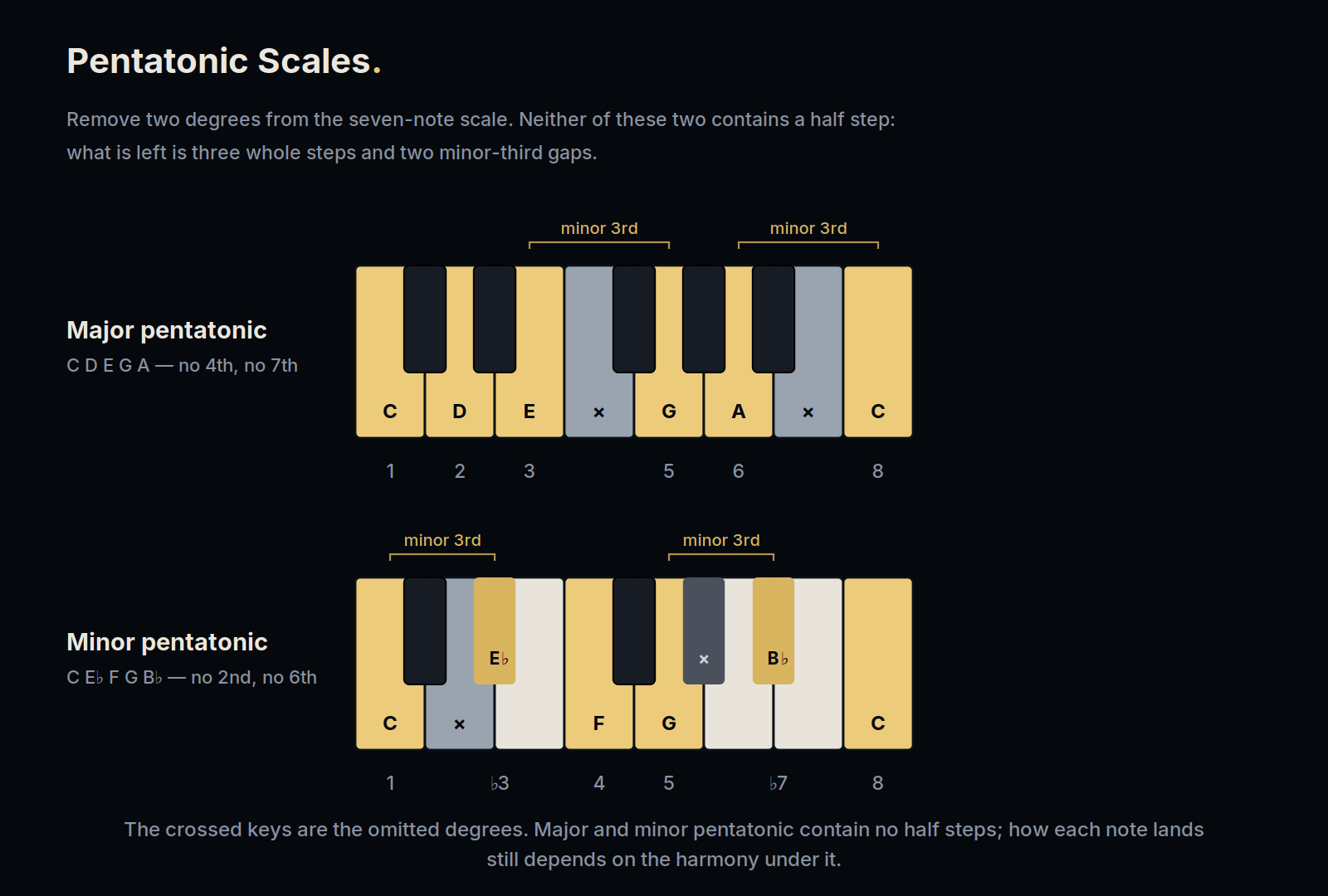
Pentatonic scales show up everywhere in media music, and they are a good place to be precise about what a scale does and does not do. For major and minor pentatonic the interval structure is fixed: five notes, no half steps, two minor-third gaps. Other five-note scales are built differently, as the Japanese ones below show. The character is not fixed either. A minor pentatonic is a standard choice for a theme that should sound stoic and tough without tipping into sadness, which is why it suits warriors and seafarers — and the same five notes are just as standard a starting point for an uplifting, fun trailer hook. Tempo, rhythm, instrumentation and harmony decide which one you get.
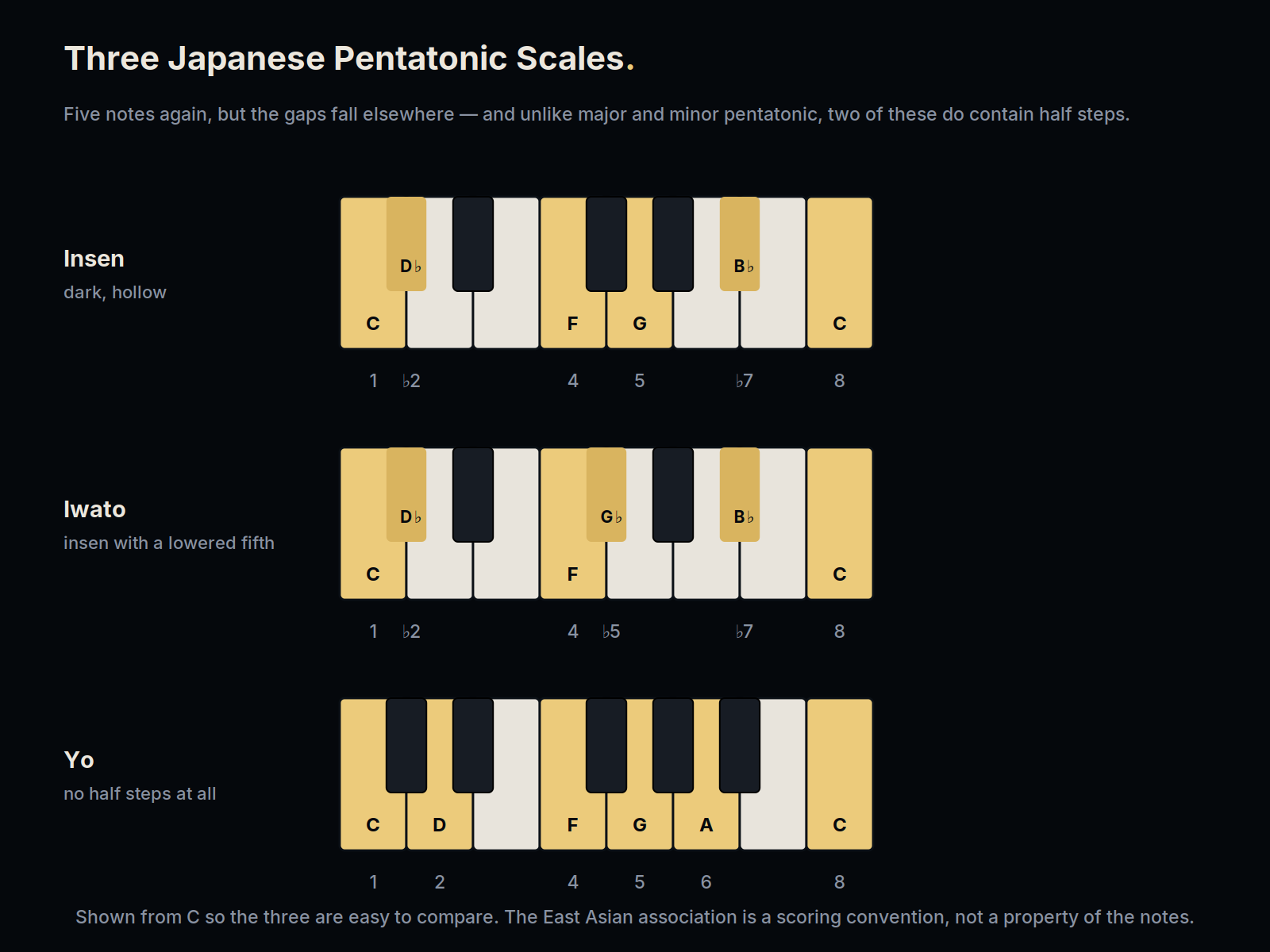
Japanese music uses several distinctive pentatonic scales of its own. Insen is 1–♭2–4–5–♭7; iwato is the same shape with a lowered fifth, 1–♭2–4–♭5–♭7; yo is the bright, semitone-free one at 1–2–4–5–6. Their gaps fall in different places from major and minor pentatonic, so building chords by skipping a scale note tends to produce fourths where a major scale would produce thirds. For Western listeners, melodies and voicings of that shape have become strongly associated with East Asian music, which is why harmonizing in open fourths and fifths evokes it even over an ordinary major or minor scale. That association is a scoring convention, not something the five notes themselves carry.
This is where scales stop being theory homework and start being a color palette.
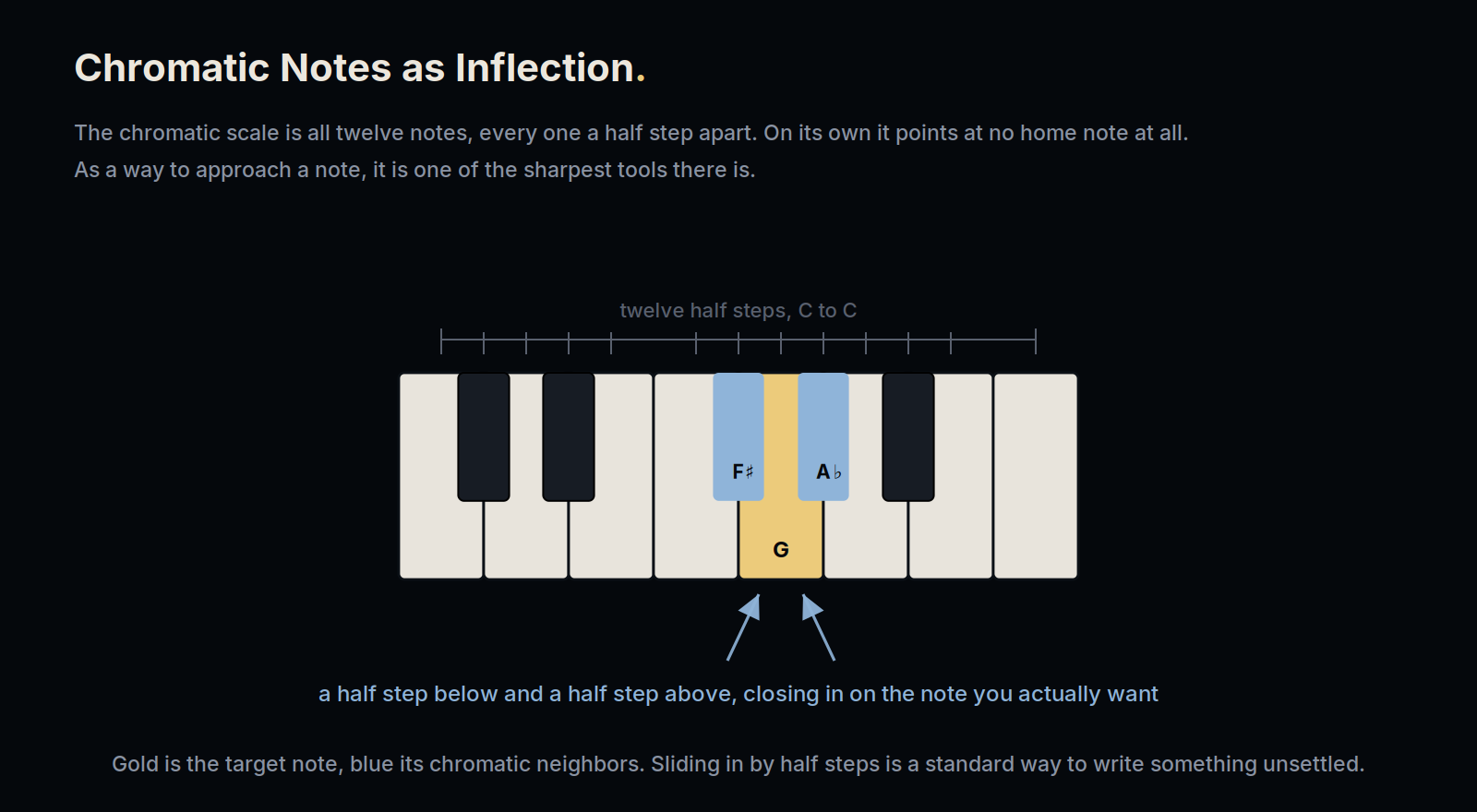
The chromatic scale uses all twelve notes, every one a half step apart. On its own it points at no home note at all, so as material for a whole passage it needs something else to give it shape — but as inflection it is one of the most effective tools there is. A chromatic neighbor above, a chromatic neighbor below, a line that slides by half steps where the ear expected a plain major — that small wrongness reads as sneaky, supernatural, unsettled.
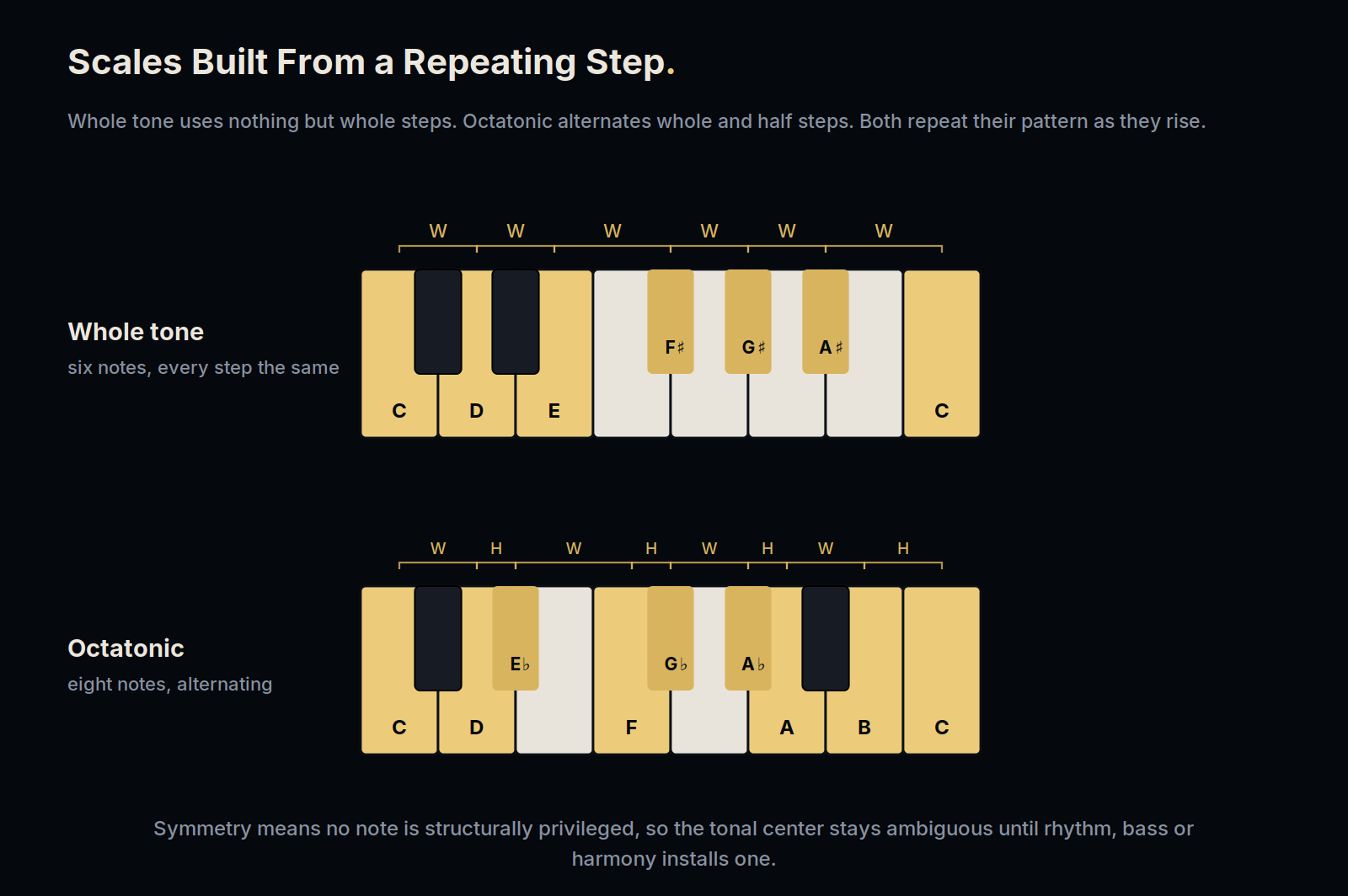
The whole tone scale moves entirely in whole steps: six notes, no half steps anywhere, no leading tone, nothing pulling toward a home note. It floats. Build a triad from it and you get an augmented chord, which is why the two sound so closely related. Run it up a harp and you have the sound of a dream sequence or a spell being cast.
The octatonic scale has eight notes built from an alternating pattern: whole step, half step, whole step, half step, all the way up. Start with the half step instead and you get its other form. Because the collection repeats itself when you transpose it by three semitones, there are only three distinct octatonic collections in all. That symmetry is what makes the tonal center slippery — no one note is structurally privileged, though rhythm, bass and harmony can still install one.
Double harmonic minor, also called the Hungarian minor, takes harmonic minor and raises the fourth degree as well. Now there are two augmented seconds instead of one, and the fifth degree sits surrounded by a half step on either side. It is darker and more tightly wound than harmonic minor, and in film and game scoring it is a standard reach when a theme should feel foreign to the world around it.
Composing Worlds: Vikings and Dragons Two contrasting worlds, two contrasting scale palettes — built in front of you. The Viking theme is written from Dorian and the minor pentatonic to get a sound that is serious without being sad; the dragon material is derived from double harmonic minor and the octatonic scale for something darker and genuinely foreign. Explore the course
Scales have a reputation as a chore, and it is not entirely undeserved. But little else builds finger independence as efficiently, and the shapes end up being what your hands reach for when you write.
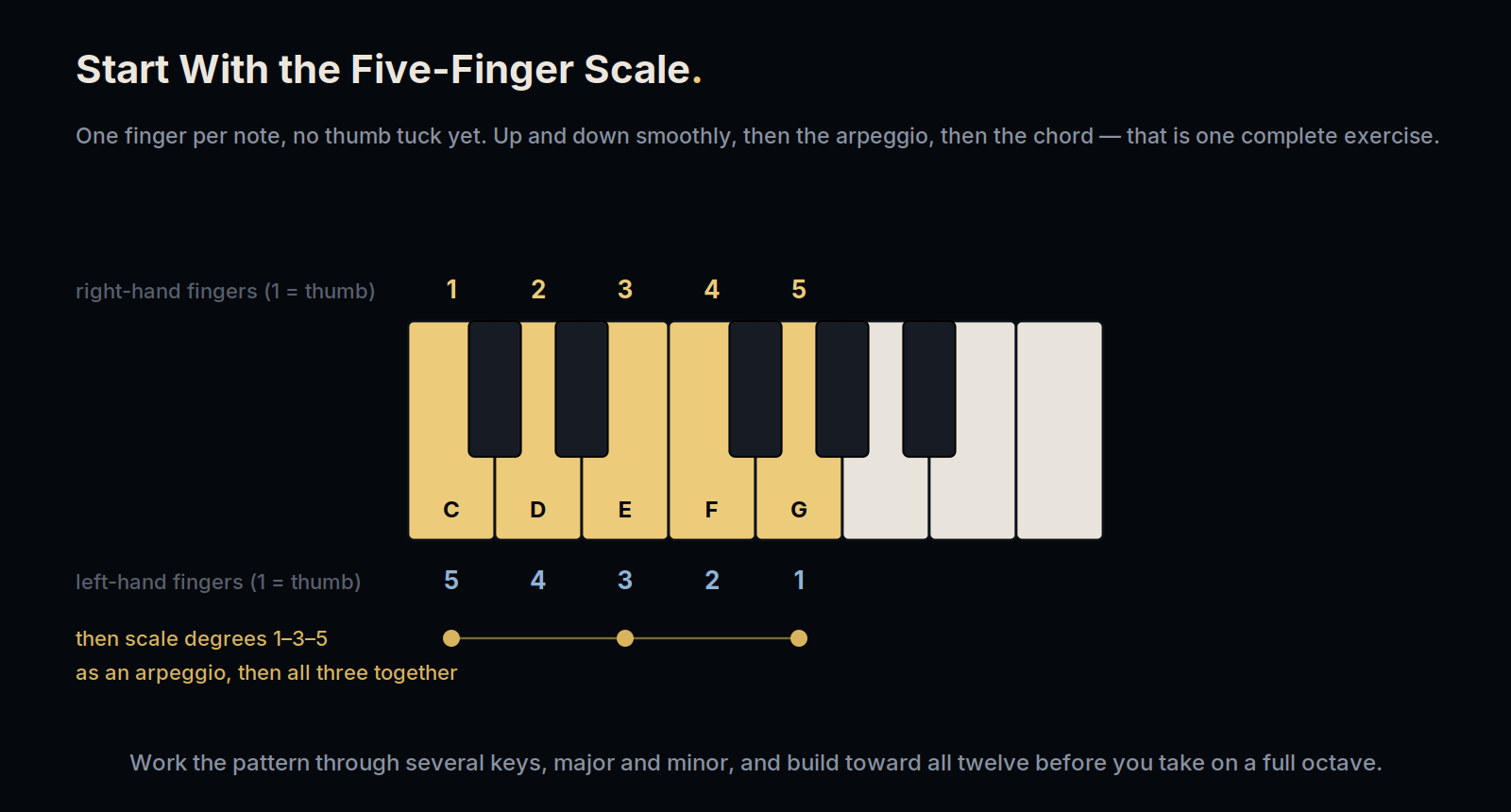
Start with five-finger scales. Thumb on the root in the right hand, pinky on the root in the left, one finger per note for the first five degrees. Up and down, smoothly, no bouncing wrists. Add the arpeggio and a blocked chord at the end and you have a complete small exercise. Work it through several major and minor keys, building toward all twelve as your control improves, before you go further.
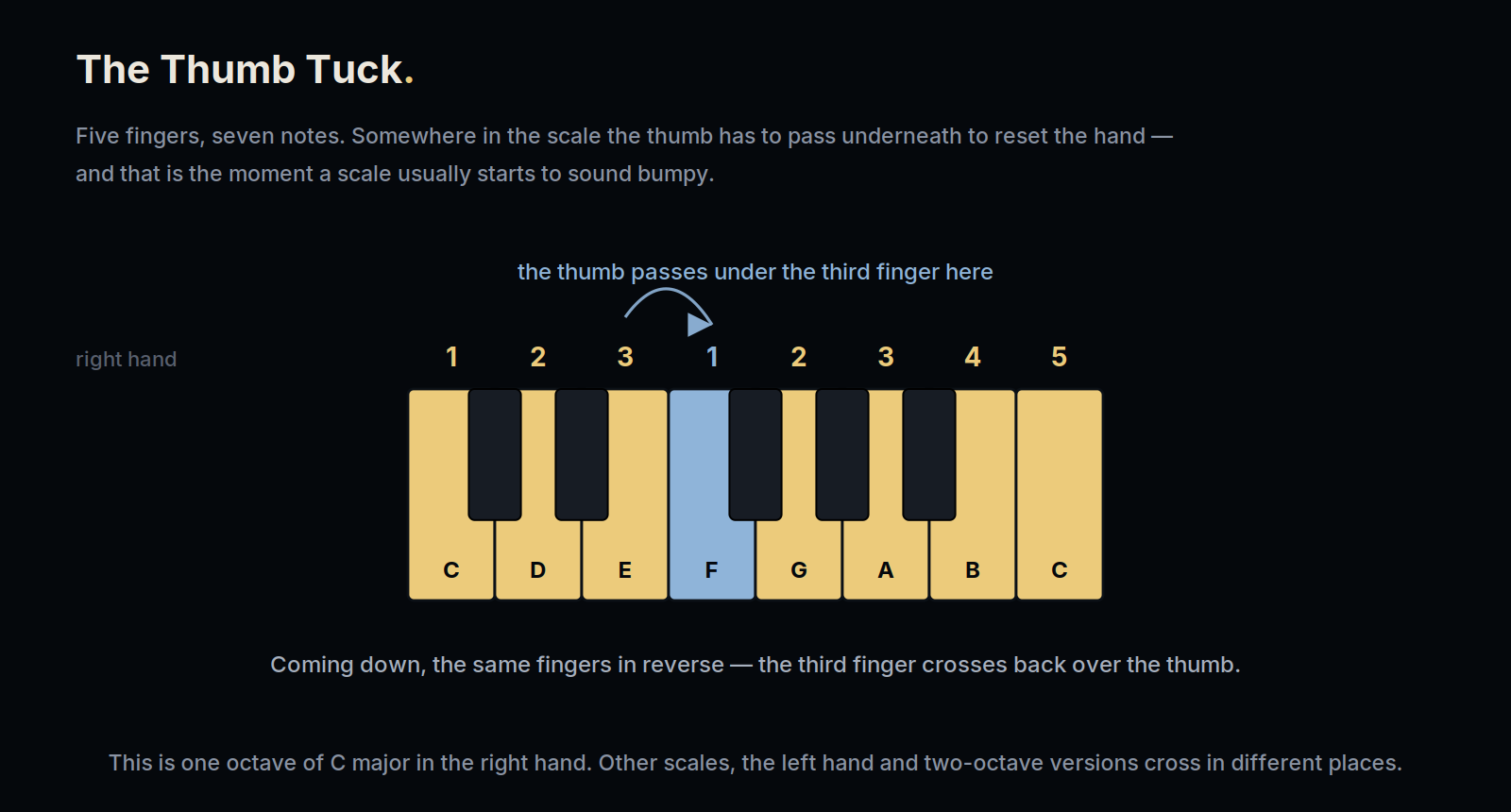
Then add the tuck and the crossover. A full octave needs more than five fingers, so somewhere in the scale the thumb passes underneath to reset the hand, and coming back down a longer finger crosses over the thumb. In right-hand C major the fingering is 1–2–3–1–2–3–4–5: you play E with the third finger and pass the thumb under to F. Where that crossing falls differs from scale to scale and between the hands, so follow the fingering written for the exercise. The goal is that nothing jerks.
Consider not starting with C major. It is the easiest to read, but with no black keys there is nothing for the hand to orient against. Many teachers, David included, start with E major or B major precisely because the black-key groups act as signposts. Come back to C once the motion is reliable.
Watch the thumb on black keys. Scales that start on a black key generally start on a different finger — B♭ major begins with the second finger in the right hand, tucking the thumb onto C immediately after. Fingerings genuinely differ from scale to scale, which is why written fingerings are worth following rather than improvising.
Multi-octave later. Two octaves is not simply the one-octave fingering played twice: it uses a fingering built to run through the octave rather than stop on it, so right-hand C major becomes 1–2–3–1–2–3–4–1–2–3–1–2–3–4–5, with the thumb taking the C in the middle. That is three thumb crossings rather than one. It is a goal to work toward, not a starting point.
One habit worth building is choosing the scale before writing a single note. Deciding on Dorian for its serious-but-not-sad quality, deciding to build the melody mostly from the minor pentatonic for openness, deciding on a triplet feel for motion — those constraints do a surprising amount of the compositional work before the first idea exists.
Once you are inside a scale, a few patterns recur:
Our Music Composition & Orchestration Courses
Our Music Production Courses
Our Music Trailer Courses
See All CoursesWhat is a scale in music? A scale is a set of notes, usually seven or five, arranged in order from a tonic and defined by the interval pattern between them. Most of those intervals are whole steps and half steps, but some scales include larger gaps — the pentatonics have minor thirds, harmonic minor has an augmented second. That pattern is what gives each scale its character, and it can be started on any of the twelve notes.
How many music scales are there? If you count every pattern that has ever been used, the number runs into the hundreds. In practice, a small group does almost all the work: major, the three minor forms, the seven modes, major and minor pentatonic, and a handful of symmetrical scales like whole tone and octatonic.
What is the difference between a scale and a key? A scale is an ordered set of notes. A key is the wider tonal framework built around a tonic and its harmony. Music in a key draws on the notes of the matching scale but is not limited to them — borrowed and chromatic notes are normal, and the key can change mid-piece.
What is the major scale pattern? Whole step, whole step, half step, whole step, whole step, whole step, half step. Apply it from any starting note and you get that note's major scale.
What is the difference between natural, harmonic and melodic minor? Natural minor is the plain pattern. Harmonic minor raises the seventh degree so the chord built on the fifth becomes major and pulls strongly home. Melodic minor, in its classical form, raises the sixth and seventh on the way up and lowers them again on the way down, smoothing out the wide gap harmonic minor creates; jazz usage commonly keeps the raised form in both directions.
Are modes the same as scales? Yes — each mode is a scale in its own right. The seven covered here are the diatonic modes, the ones you get by starting the major scale from each of its degrees; other modal families exist. In practice it is easier to learn each one as a major or minor scale with one or two specific alterations.
Which scale should I learn first? The major scale, then natural minor. Between them they cover most Western music and they are the reference point every other scale is described against.
Learn with Master The Score
Courses on composition, orchestration, music production, trailer music and sound design, from composers writing for film, games and media. Students also get exclusive discounts on leading sample libraries and plugins.
Discover all courses →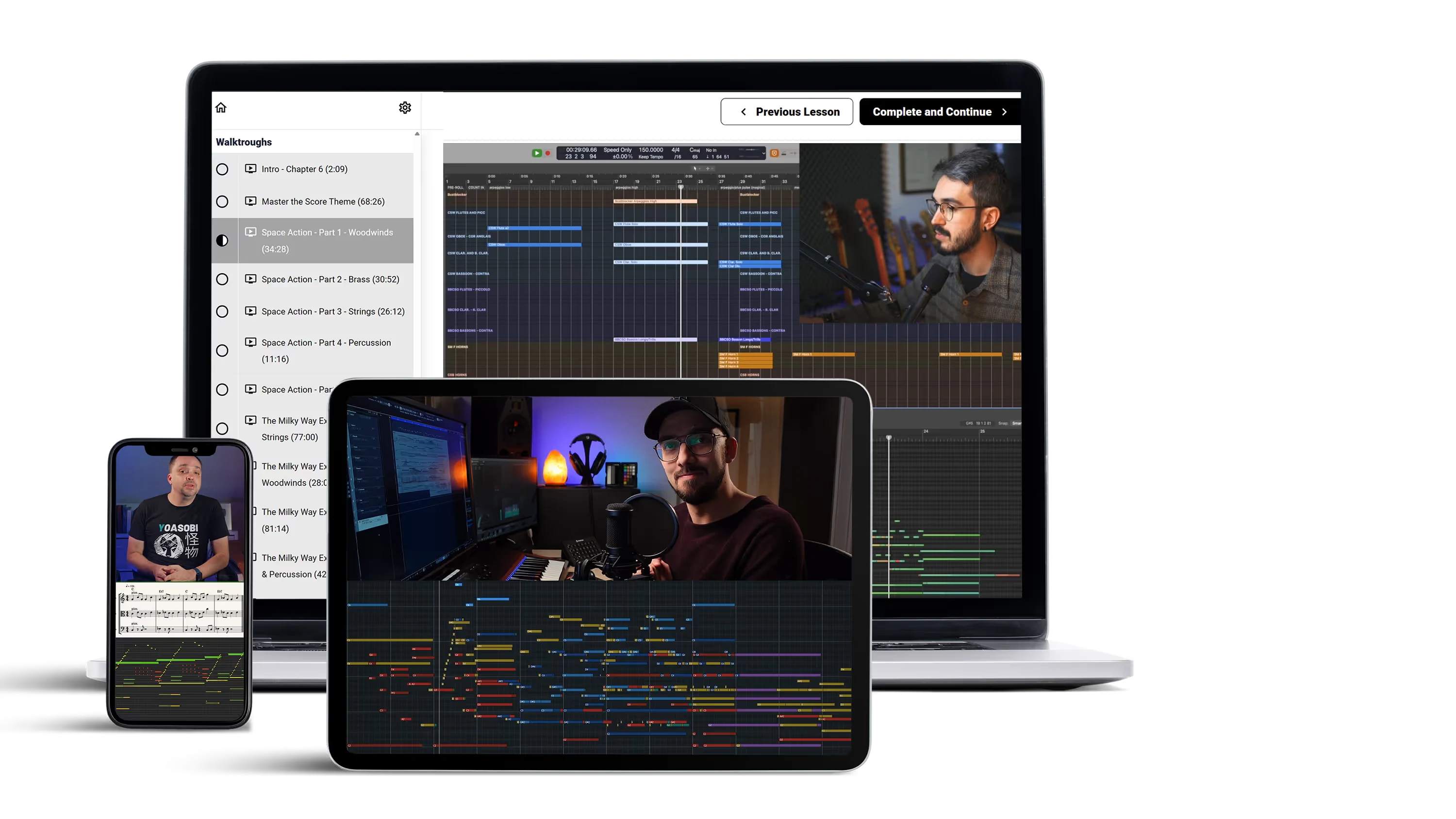


Online education for media composers — orchestral writing, trailer music, mixing and more, taught by working professionals.