

Music Theory and Composition


David McCaulley is a pianist and composer known for his YouTube channel Film Score Analysis, home to more than 150 score reductions of iconic film scores. He studied composition and piano at the University of North Texas and teaches The Piano Composer at Master The Score.
Piano chords are groups of notes played together, and they are the fastest way to make the piano sound like actual music. Learn a handful of chord shapes and you can accompany a melody, sketch a film cue, or write a song — long before you can play anything virtuosic with your right hand. This guide builds every common chord type from scratch, shows you fingerings that actually feel comfortable, and then goes one step further than most chord guides: how to voice, connect and use chords the way composers do. It draws on how we teach piano-based composition in The Piano Composer.
A chord is simply three or more notes played at the same time. The most basic and most important chord type is the triad — a group of three notes, each separated by an interval of a third. Triads are the fundamental building blocks of harmony: almost every chord you will ever play on the piano is either a triad or a triad with something added to it.
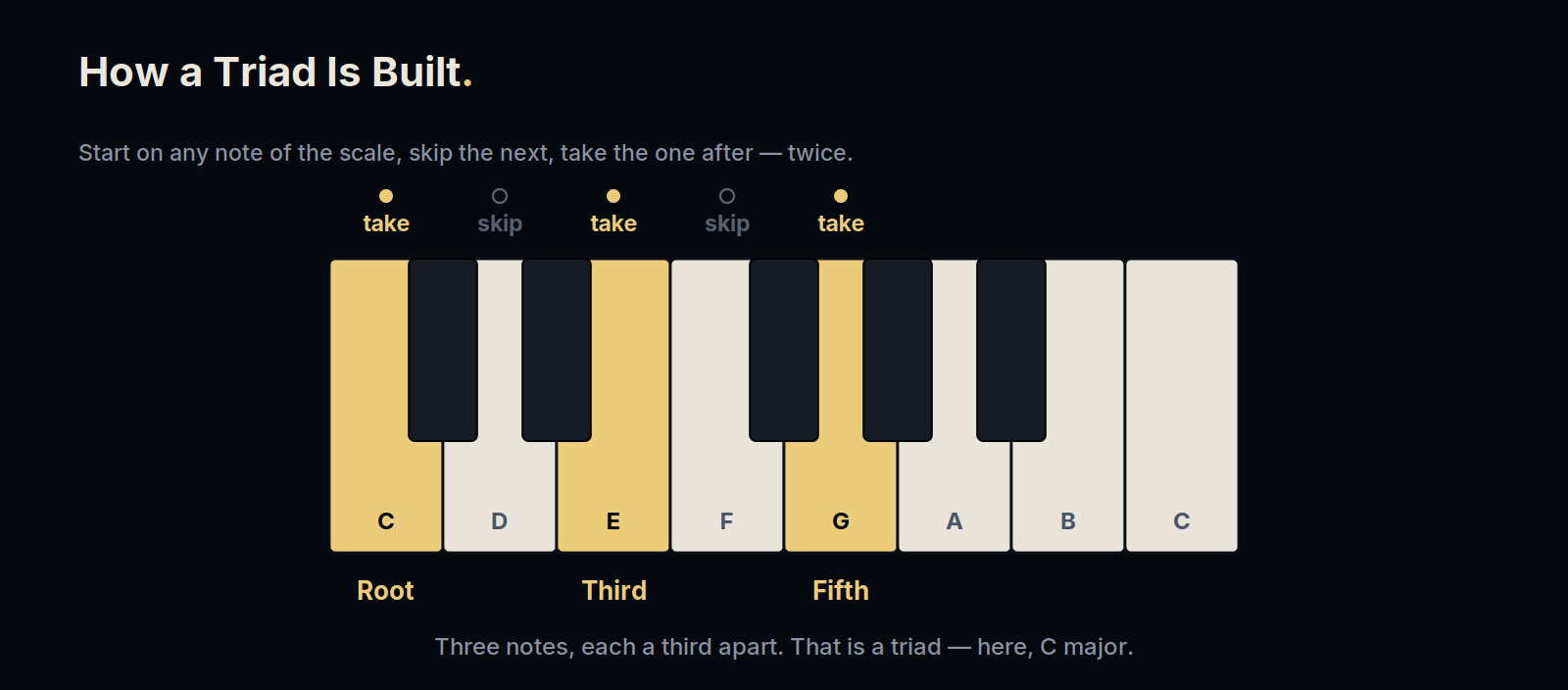
The three notes of a triad have names:
To build a triad from any scale, the recipe is short: pick a scale degree as your root, skip the next note of the scale, take the one after, skip again, take the next. Start on C in a C major scale and you get C–E–G: a C major chord.
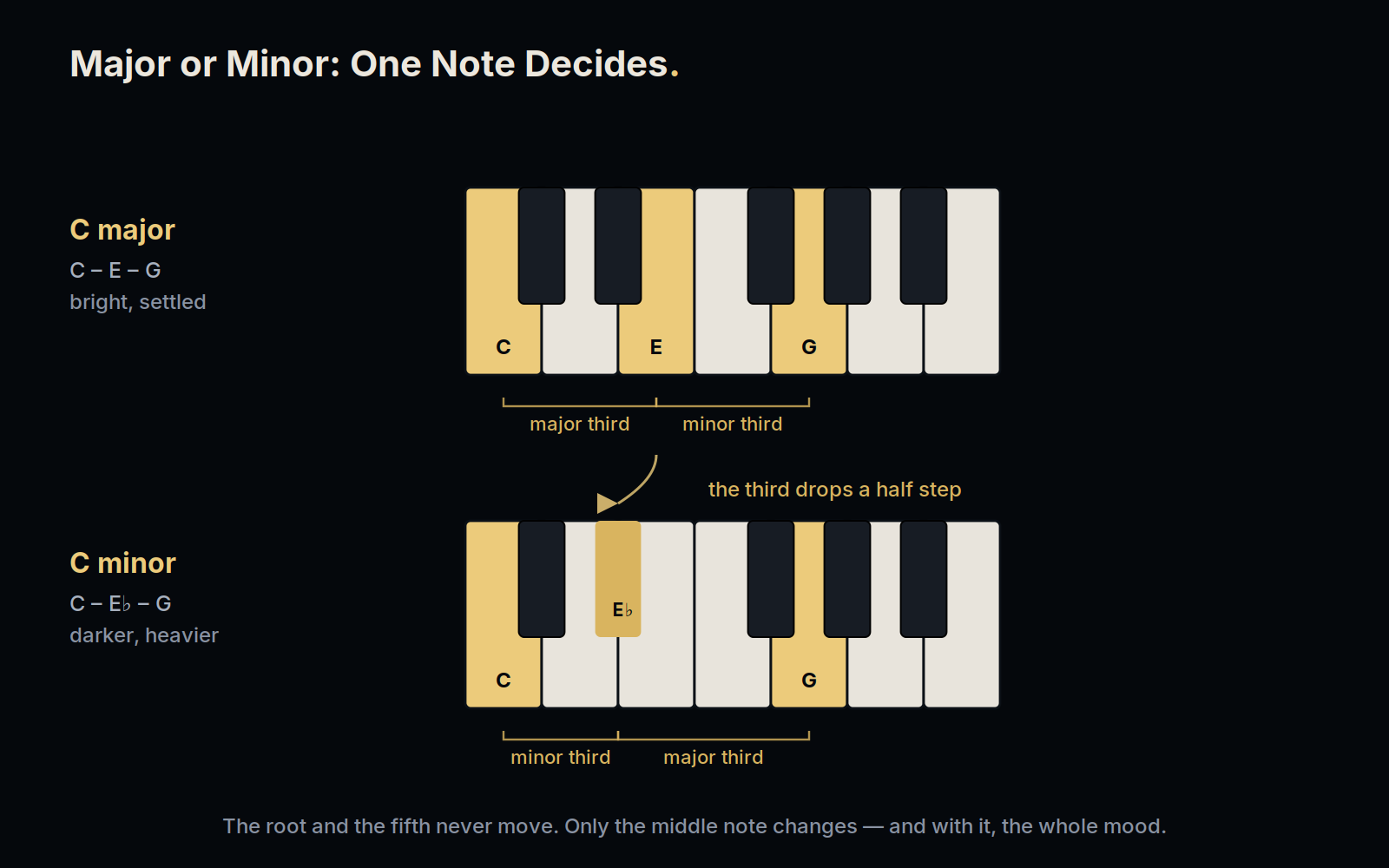
The difference between a major and a minor chord is one note — but it is the note that decides whether the chord sounds bright or dark.
Look at the intervals inside the chord. A major triad has a major third on the bottom and a minor third on top. A minor triad is the mirror image: minor third on the bottom, major third on top. In practice, that means the middle note — the third — moves down a half step when a chord turns minor:
This interval recipe works from any starting note, which means you do not need to write out a scale to build a chord. Want an E♭ major triad? Start on E♭, stack a major third on top (G), then a minor third on top of that (B♭). Done.
Here is where chords start turning into music. If you build a triad on every degree of a scale, you get the family of chords that belong to that key — the chords that sound right together. In a major key, the pattern of chord qualities is always the same, no matter which major key you are in:
The natural minor scale has its own fixed pattern, and it holds in every minor key:
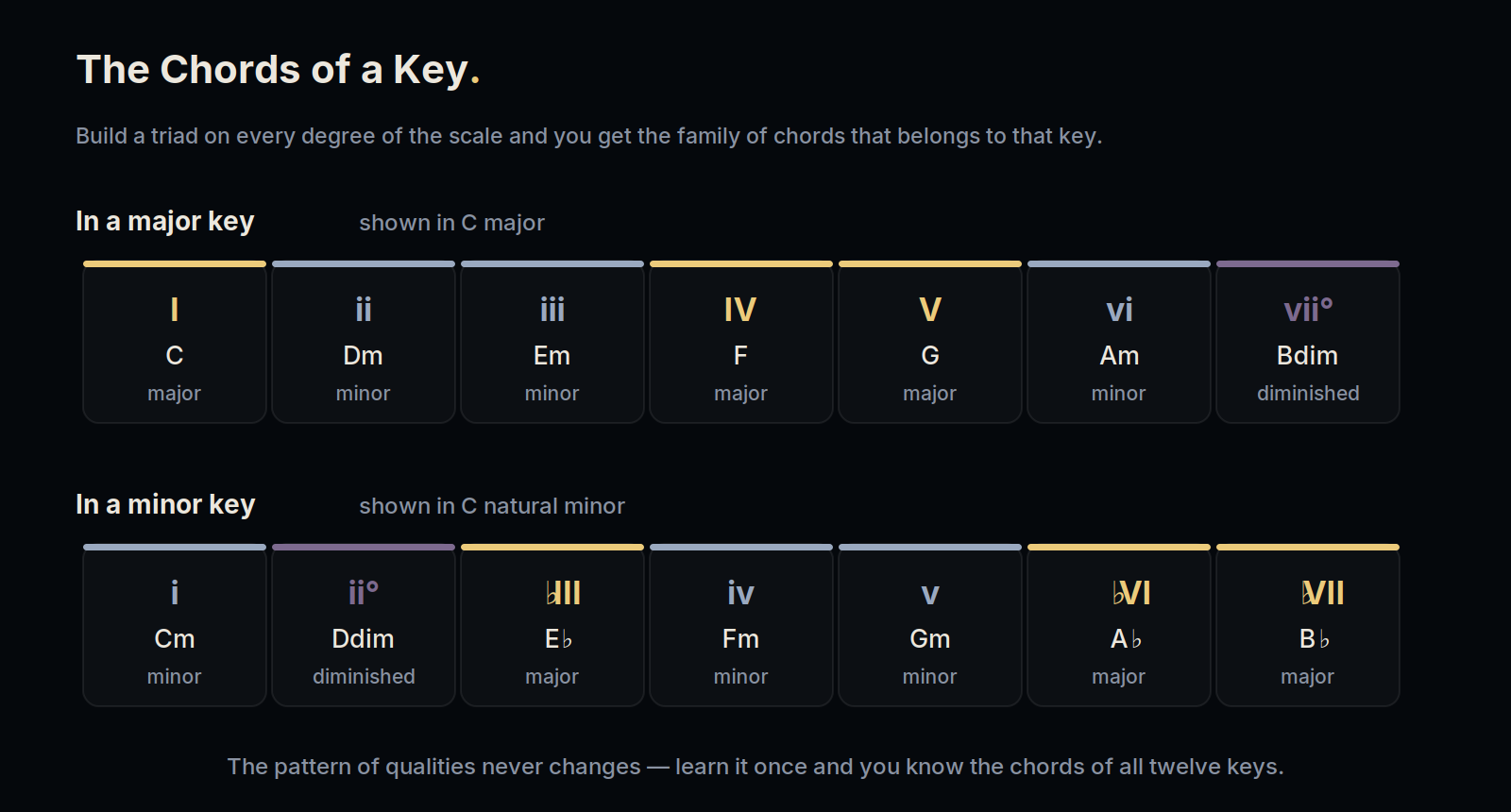
These Roman numerals matter because they make chord knowledge portable. I–V–vi–IV describes a progression in every key at once — and once you know the quality pattern, you can find the chords of any key in seconds. To see how these chord families connect across all twelve keys, the circle of fifths is the map for exactly that.
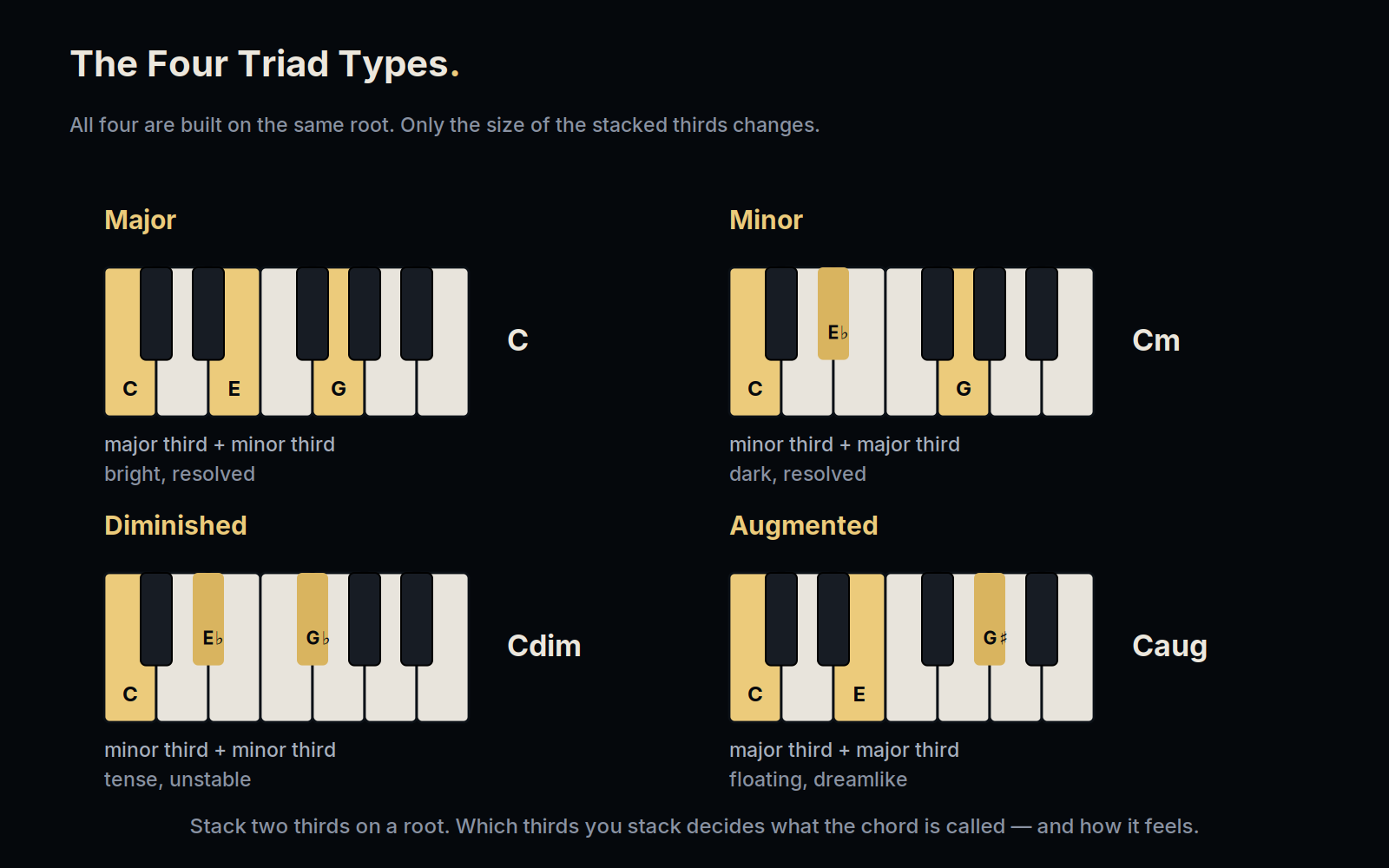
Two more triad types complete the set. Stack two minor thirds and you get a diminished triad (C–E♭–G♭) — tense, unstable, wanting to move. Stack two major thirds and you get an augmented triad (C–E–G♯) — strange, floating, dreamlike. You will meet the diminished triad naturally as the vii° chord of every major key.
Add one more third on top of any triad and you get a seventh chord — four notes instead of three. The most useful ones to know:
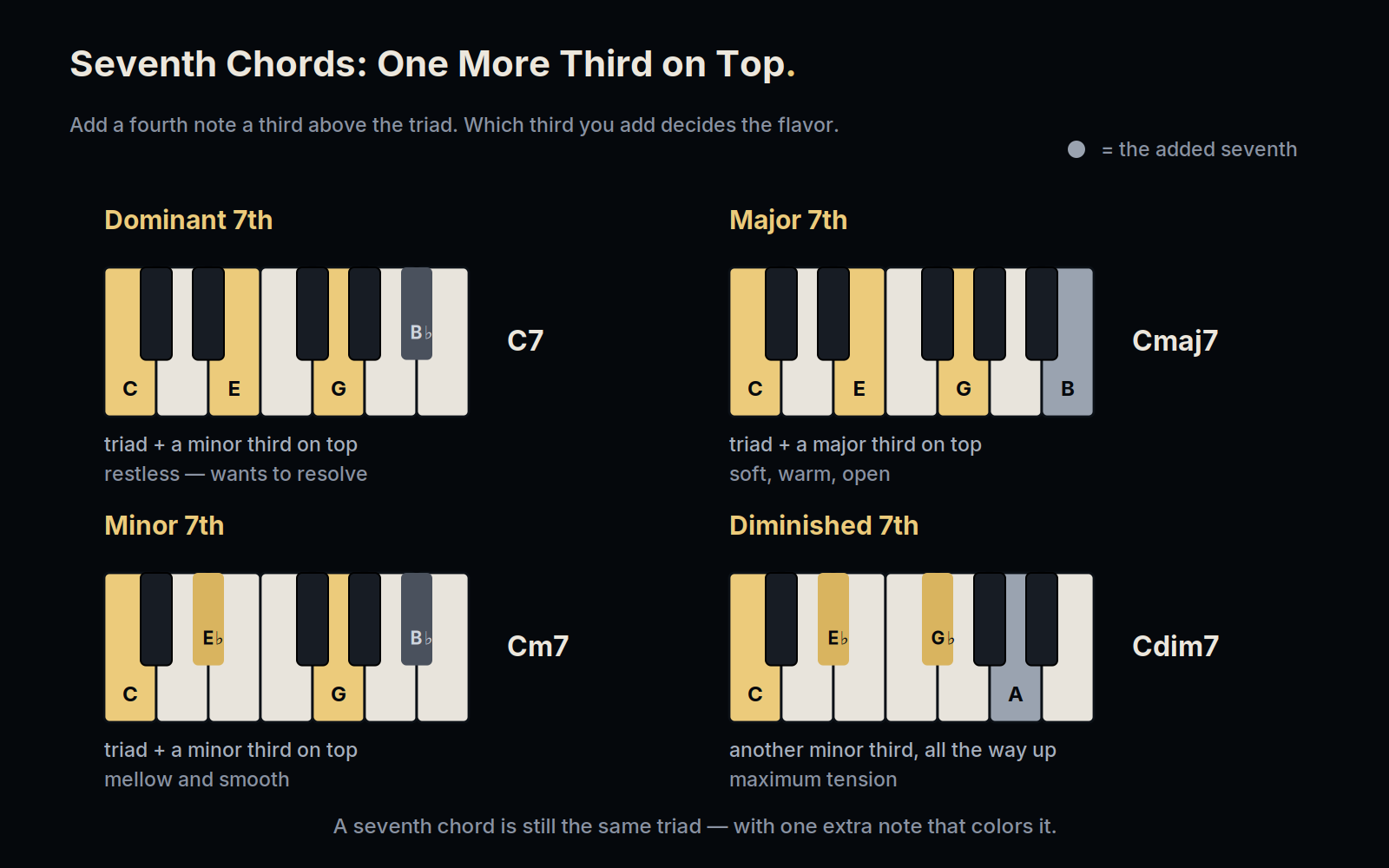
A little tension goes a long way. One well-placed diminished seventh before a resolution carries more emotion than a page full of exotic chords.
A chord does not have to keep its root on the bottom. Take C major (C–E–G) and move the C up an octave: now E is the lowest note. That is first inversion. Move the E up too, and G becomes the bass: second inversion. The chord is still C major — same three notes — but the color and the sense of stability change with each version.
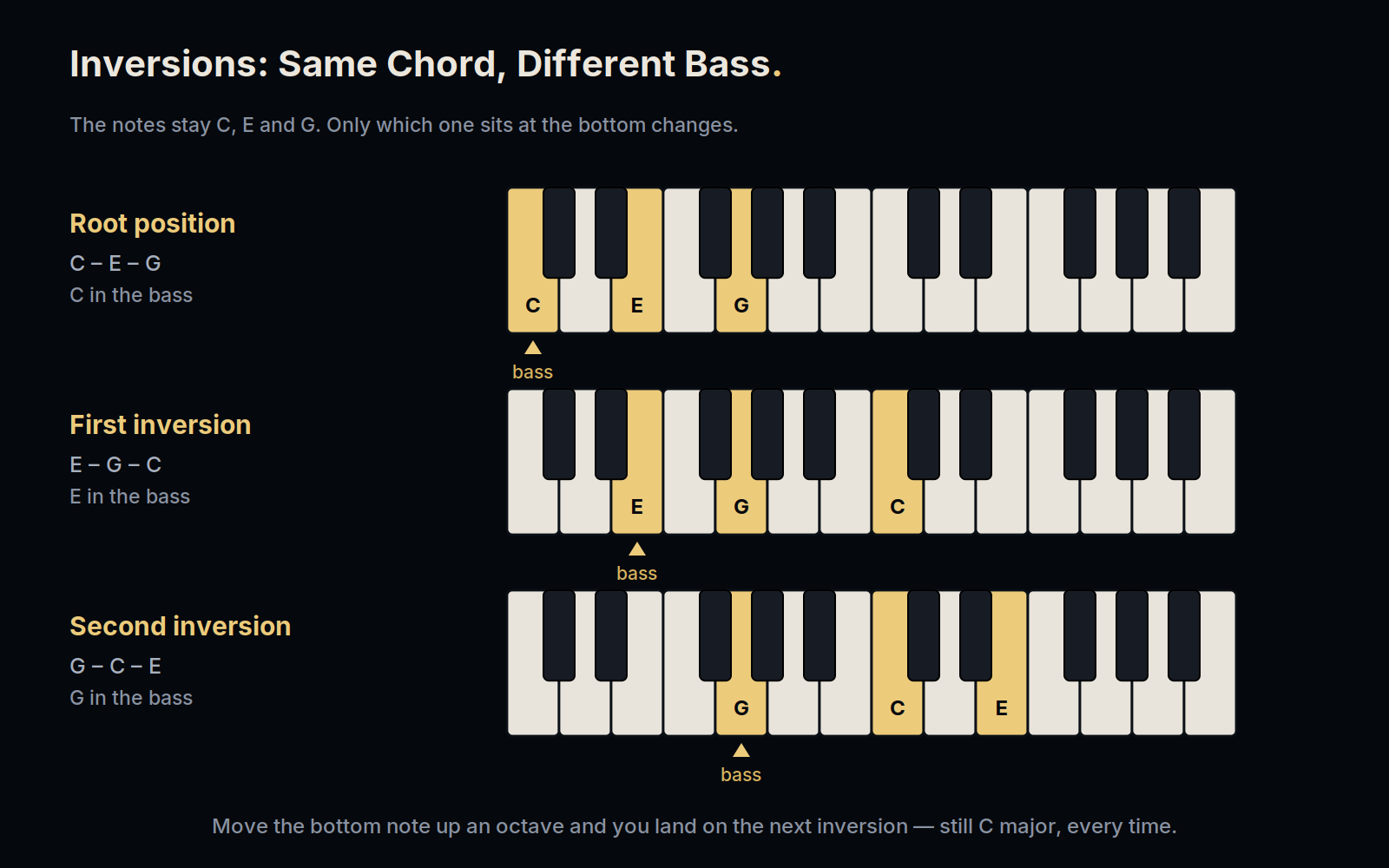
Why bother? Because an inversion hands you a choice you otherwise would not have: which note of the chord sits in the bass. And that choice changes how far every voice has to travel to reach the next chord — which is exactly what voice leading is about.
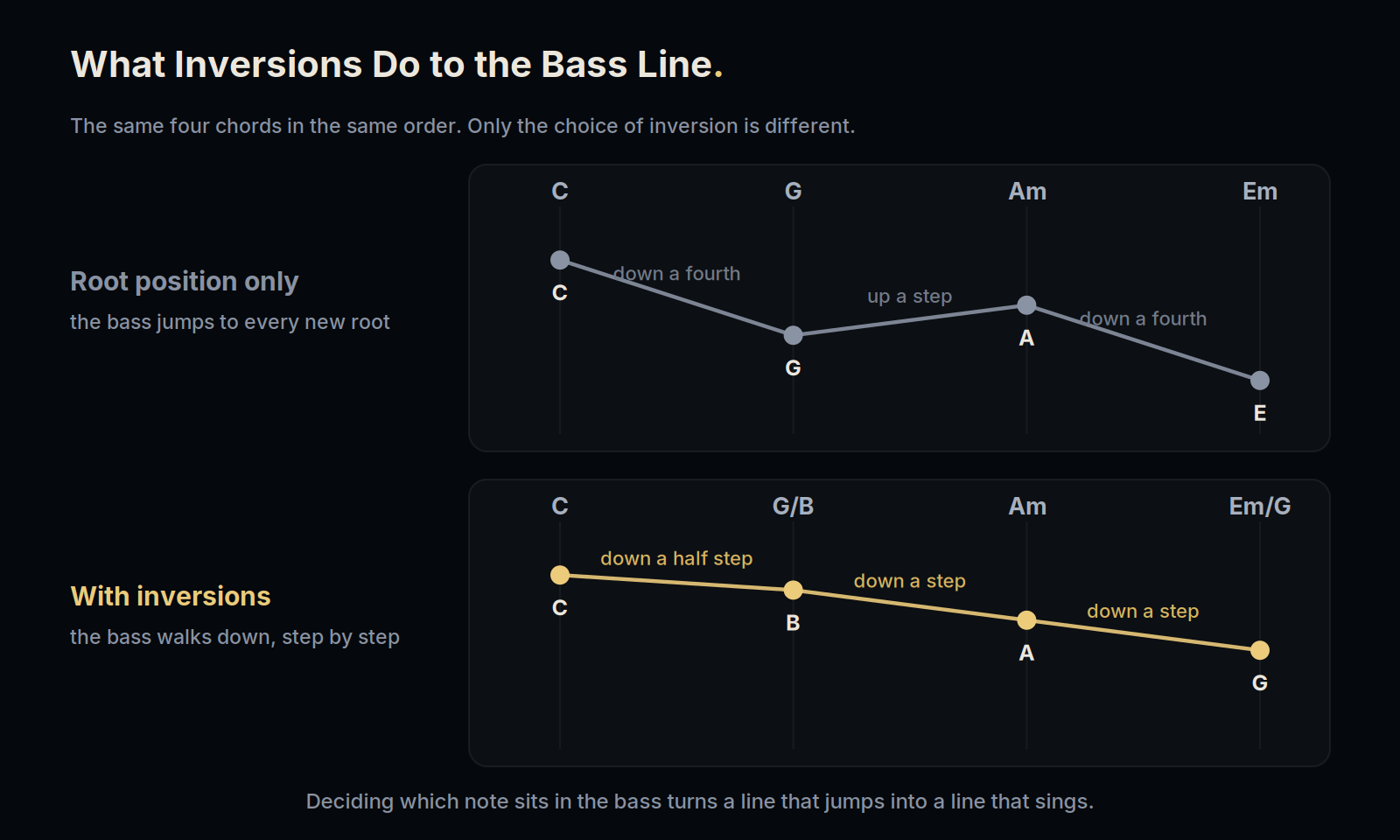
You hear it most clearly in the bass. In root position the bass is stuck jumping from root to root: C down to A, up to F, down to G. Pick a different inversion and you decide where it goes instead, so a leap can shrink to a step — put A in the bass of that F chord and the line walks down a third rather than dropping a sixth. The bass stops being a byproduct of which chords you chose and becomes a line you shape on purpose.
The notes above the bass work the same way. An inversion never changes which notes are in the chord — C major is C, E and G in every position — it changes where those notes sit. And that is precisely what lets you improve the voice leading: position the chord so the notes it has in common with the previous one stay exactly where they are, and the notes that do have to change move by the smallest distance available. The chords connect instead of jumping, and your hand barely travels.
One practical guideline while you experiment: first inversion, with the third in the bass, is the workhorse and fits almost anywhere. Second inversion, with the fifth in the bass, has a floating, unresolved quality that is traditionally saved for special moments.
Knowing a chord and playing it comfortably are two different skills. A few things make the physical side much easier.
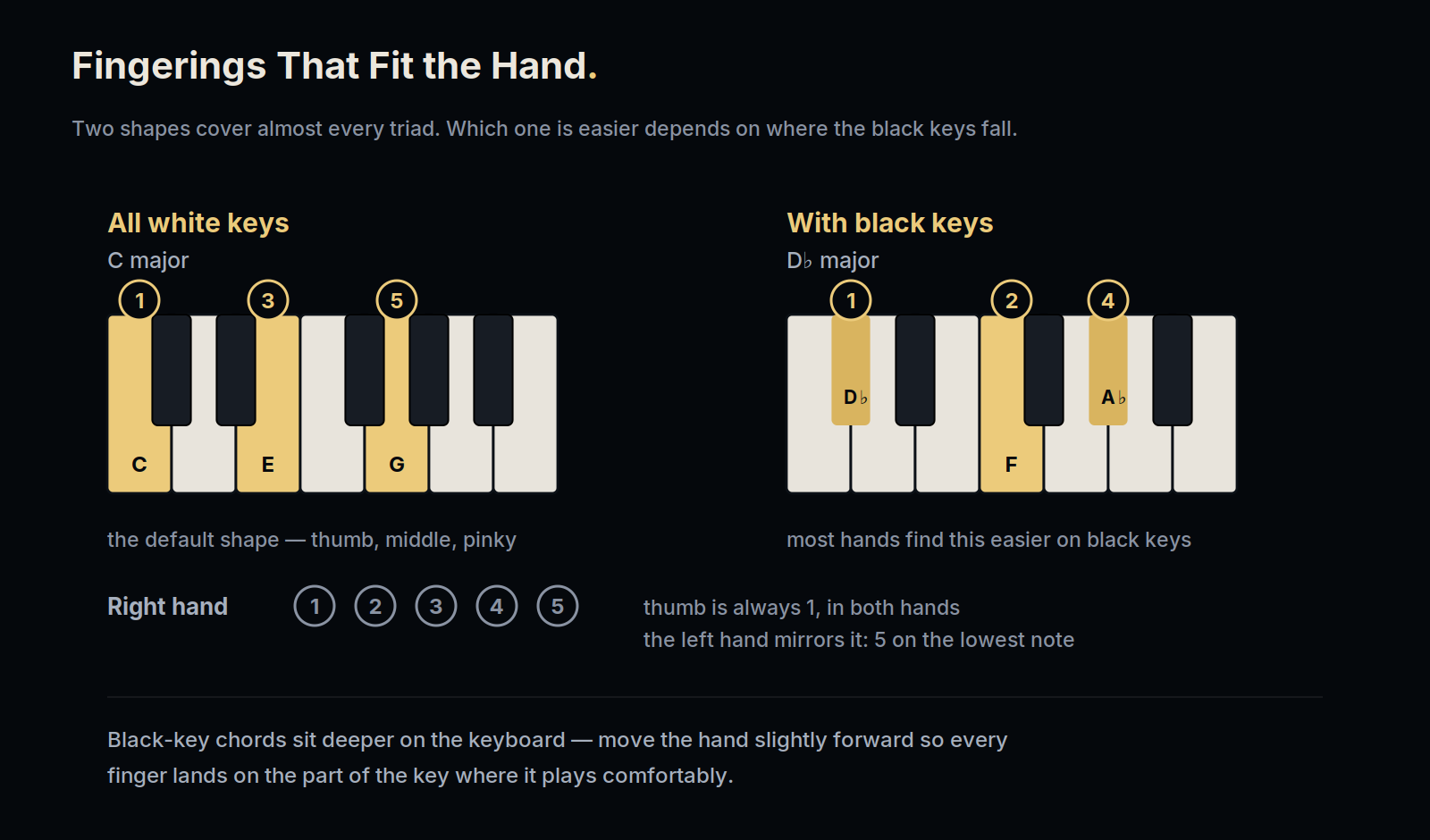
Fingering. The home-base fingering for a root position triad is 1–3–5 in each hand: thumb, middle finger, pinky. The most useful alternative is 1–2–4, which many hands find easier on chords with black keys. Get comfortable switching between the two — being able to swap fingers quickly pays off enormously later.
Black keys. Chords like D♭ major sit deeper on the keyboard, so move your hand slightly forward and consider 1–2–4, which keeps the longer fingers off the awkward spots.
The motion. A balanced chord does not come from pressing fingers down individually. Play the chord with a small drop of the wrist and a little arm weight, so all three notes speak evenly and with a full sound.
Practice pattern. The simplest way to build chord fluency is to play the triads of a key stepwise up and down the scale — I, ii, iii, IV, V, vi, vii°, I — alternating your two fingerings as you go. Then do the same in other keys. It puts the chord shapes directly into your muscle memory, which is exactly where you want them when you start writing.
The Piano Composer David McCaulley teaches piano technique and composition side by side, for producers and composers in any genre. Chapter one alone covers posture and injury-free hand position, the finger-independence drills behind clean chord playing, root-position triads and inversions in all twelve keys, and the pedals — and it ends with you writing your first chord progression. Explore the course
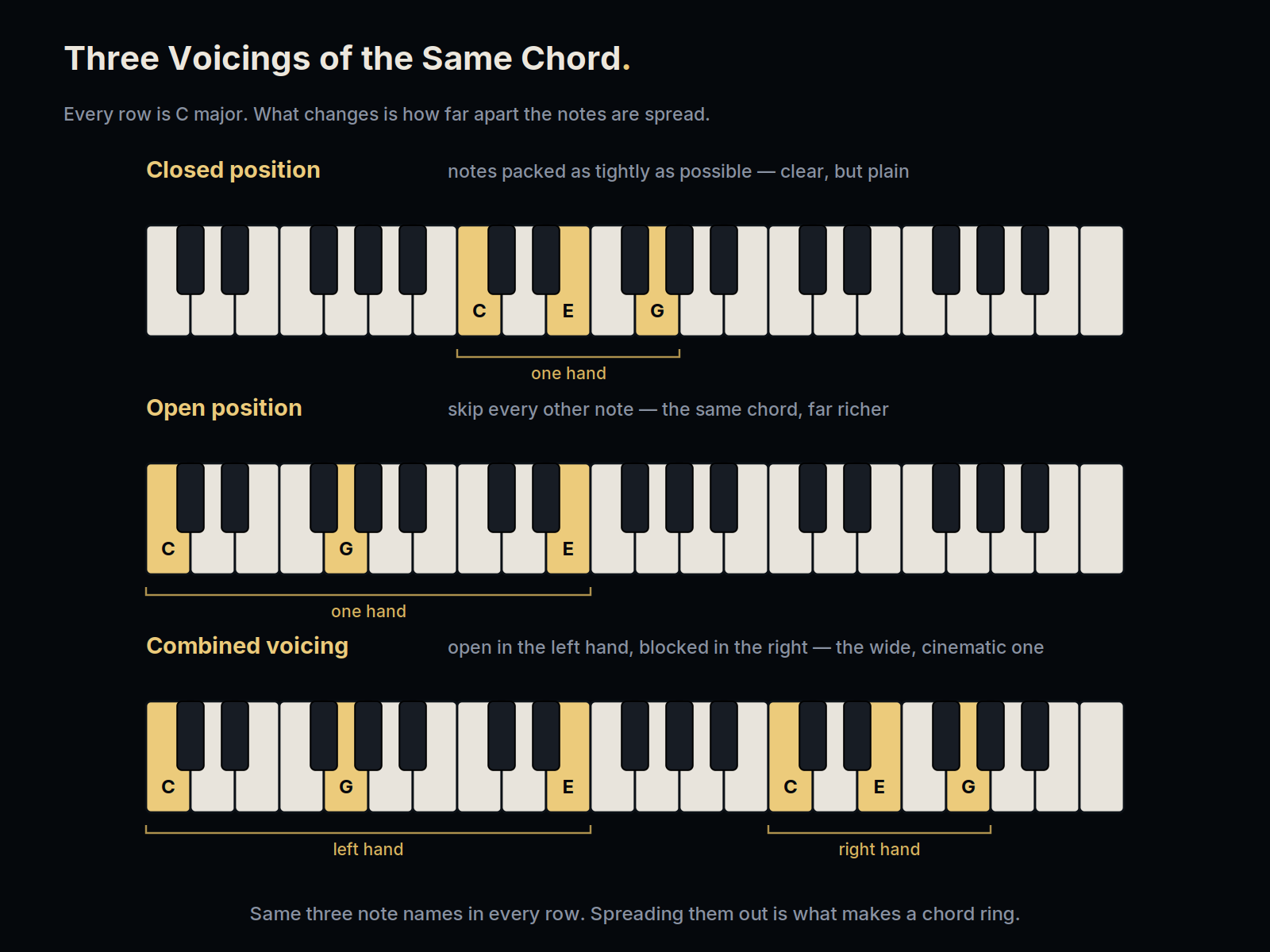
Here is the step most chord guides skip — and it is the one that separates playing chords from sounding like a composer. A voicing is how you distribute the notes of a chord across the keyboard. Same chord, radically different sound.
Closed position is what you have been playing so far: the three notes packed as tightly as possible. It is clear and compact, but it can sound a little plain.
Open position spreads the chord out by skipping every other note: instead of C–E–G stacked together, you play C, jump past E to G, then past C to E. The same C major chord suddenly rings out with a much richer, more resonant sound. Open voicings tend to sound best around the C below middle C. If your hands are small, roll the chord or catch the top note with your other hand.
Combined voicing puts an open position in the left hand and a blocked chord in the right. It fills the space between your hands and produces that wide, cinematic piano sound with only four or five notes.
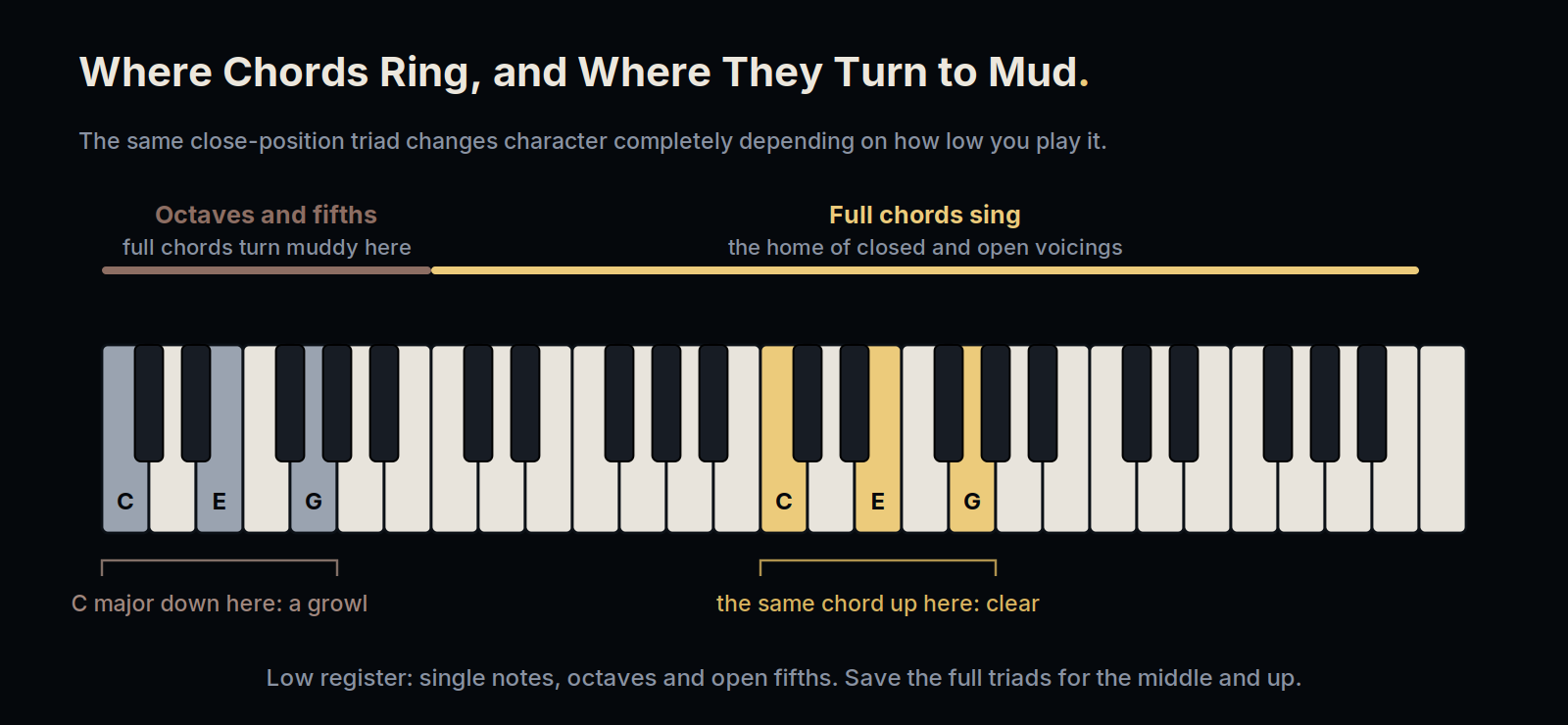
One warning that will save your recordings: do not put closely packed chords too low. The deeper you go on the keyboard, the muddier stacked thirds become, until the chord turns into a growl. Low register: single notes, octaves, or open fifths. Full chords: middle register and up.
Chords rarely live alone, and how you move between them matters as much as the chords themselves. Voice leading is the craft of moving from one chord to the next with as little motion as possible: keep the notes the two chords share, and move the remaining notes to the closest available chord tone.
Going from C major to G major? They share a G. So hold the G where it is, and let C and E slide down a step to B and D — G major in first inversion. Three moving lines, none of them jumping. The progression suddenly sounds smooth and intentional instead of blocky, and as a bonus, your hand barely has to move.
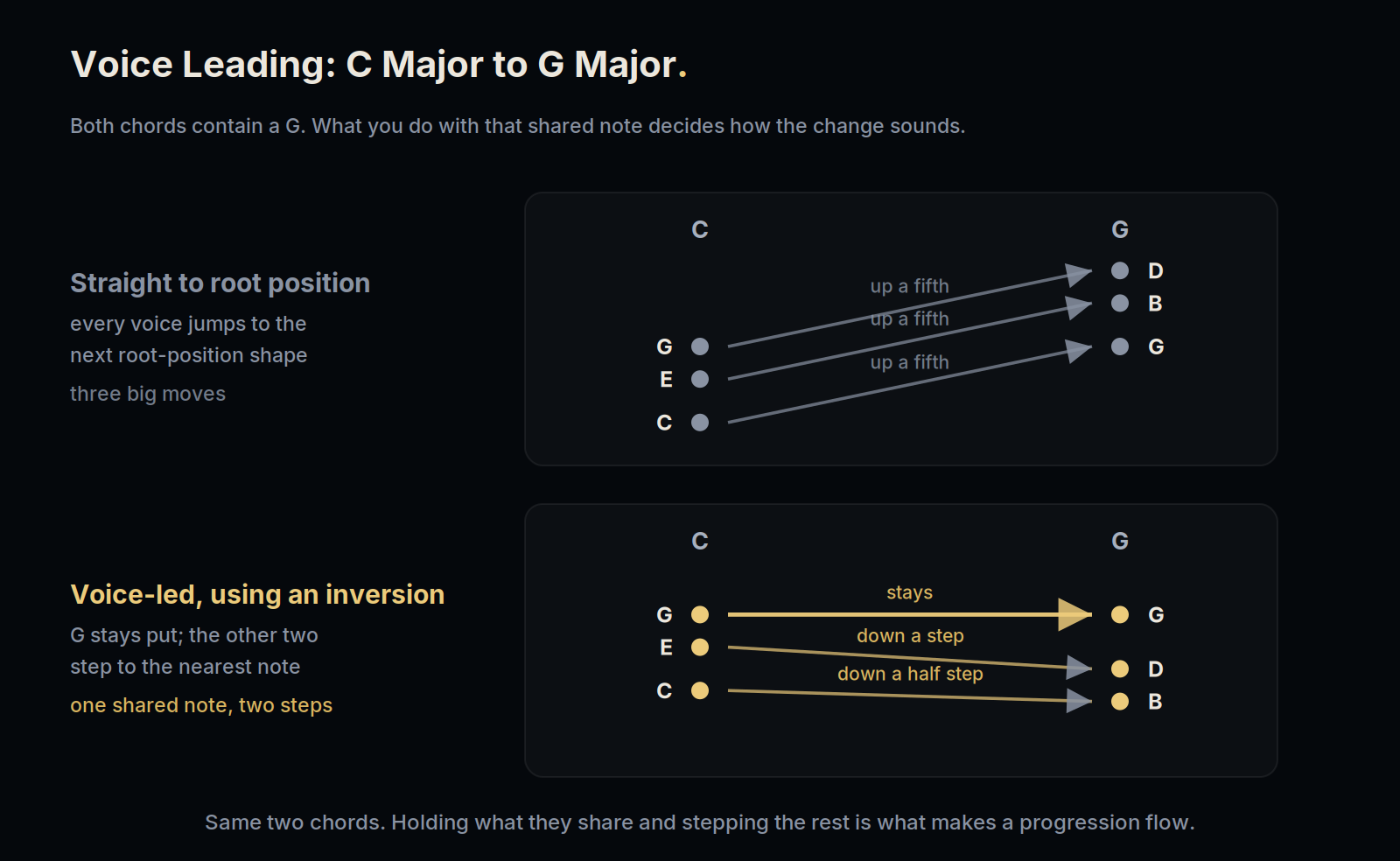
In practice this means picking an inversion for almost every chord — not for its own sake, but because that is what puts the next chord within reach. Watch an experienced pianist's hands during a chord progression: they drift, they do not leap.
Once you can build and connect chords, the question becomes how to turn a plain progression into something expressive. Five steps, applied in order, each one adding depth:
Which chords to choose in the first place, and why some pairs pull toward each other so strongly, is its own craft. Our guide to chord progressions covers it in depth.
The piano is the composer's sketchpad. Most orchestral scores begin life as two hands on a keyboard, and the chord tools above translate directly.
Functional harmony gives your music direction. Every chord in a key plays a role: the I chord is home (the tonic), V and vii° pull strongly back toward home (the dominant), and the rest — ii, iii, IV, vi — act as bridges that lead toward the dominant (the predominants). Tension and release, on tap.
Parallel harmony breaks the rules beautifully. Take one chord shape and drag it around the keyboard, every note moving by the same interval, ignoring the key entirely. Slide major triads chromatically under a melody line and you land instantly in John Williams territory; this planing technique is all over classic film scores. Keep the moves inside one scale instead and you get a gentler, diatonic version of the same effect.
Chromatic mediants deliver the epic moment. Jump from a chord to another chord a third away that does not belong to the key — C major straight to A♭ major, or to E major — and you get that striking, trailer-worthy harmonic shift that signals wonder or dread in a single move.
Pedal tones build anticipation. Hold one bass note while the chords above it change and rub against it. The tension that accumulates over a pedal tone is one of the oldest and most reliable ways to make a listener lean forward.
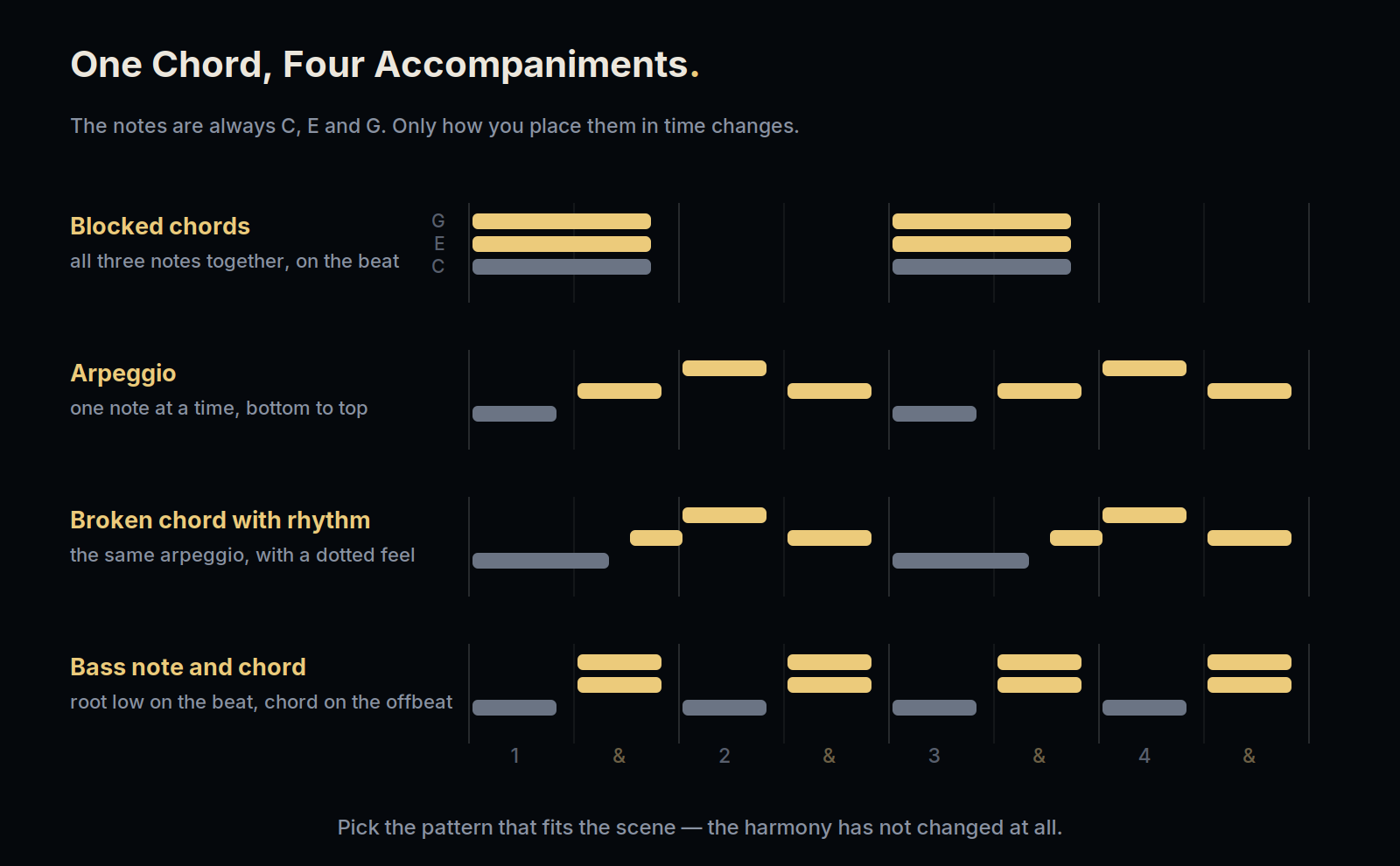
And when it is time to turn chords into an accompaniment, think orchestrally even at the piano: arpeggiate the left hand like cellos, hold blocked chords like horn pads, keep the melody singing on top. An accompaniment that would work in the orchestra almost always sounds better on the piano too.
Our Music Composition & Orchestration Courses
Our Music Production Courses
Our Music Trailer Courses
See All CoursesWhat piano chords should I learn first? Start with the triads of C major — C, Dm, Em, F, G and Am — in root position with the 1–3–5 fingering. These six chords cover an enormous amount of real music, and every other key follows the same pattern of shapes.
What is the difference between a chord and a triad? A chord is any group of three or more notes played together; a triad is the specific three-note chord built from stacked thirds. Every triad is a chord, but chords can also have four or more notes, like seventh chords.
How many piano chords are there? Each of the twelve root notes can carry every chord type — major, minor, diminished, augmented, the various seventh chords and more — so the count runs into the hundreds. The practical core is much smaller: the four triad types and a few seventh chords, movable to any root.
What makes a chord major or minor? The middle note. A major chord stacks a major third plus a minor third (C–E–G); a minor chord flips that order (C–E♭–G). Lowering the third by a half step is all it takes to turn a major chord minor.
What is a chord inversion? An inversion is the same chord with a note other than the root as the lowest note. First inversion puts the third in the bass, second inversion the fifth. Inversions make bass lines smoother and chord changes easier to play.
Do I need to read sheet music to play piano chords? No. Chords are shapes and patterns, and you can learn them entirely by letter names and keyboard geometry. Reading music becomes valuable later, especially for composition, but it is not a prerequisite for playing chords.
Learn with Master The Score
Courses on composition, orchestration, music production, trailer music and sound design, from composers writing for film, games and media. Students also get exclusive discounts on leading sample libraries and plugins.
Discover all courses →


Online education for media composers — orchestral writing, trailer music, mixing and more, taught by working professionals.