

Music Theory and Composition

Chord progressions are one of the most direct tools a composer has for shaping emotion over time. This guide covers what a chord progression is, a number of progressions that appear across many styles — from the concert hall to modern anime openings — approaches to writing sad, dark, or colorful progressions, and a step-by-step process for writing your own.
The material in this article is drawn directly from the Master The Score course curriculum, where these concepts are taught in depth — with notation, demonstrations, and writing assignments — by our instructors, all of them working composers for film, games, and media.
A chord progression is a sequence of chords played in a particular order. When we group chords and their harmonic functions together, that grouping is a chord progression.
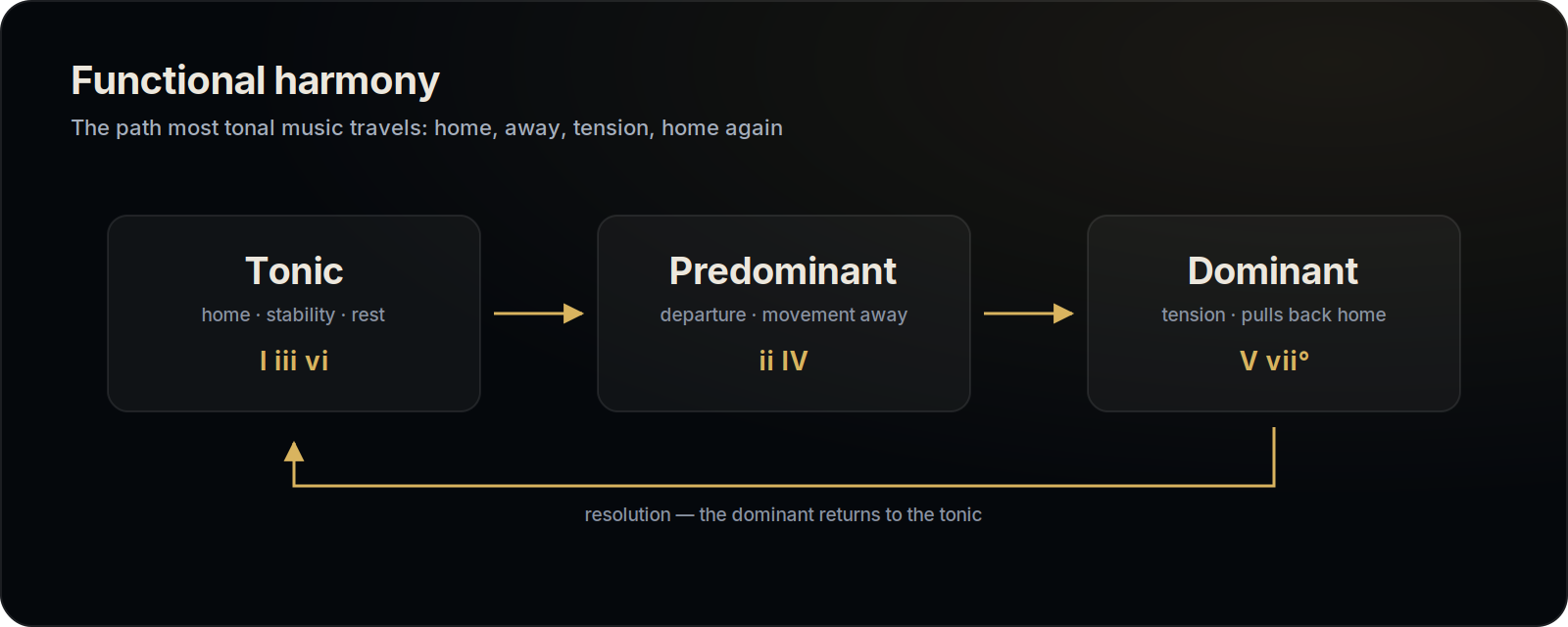
One useful way to think about progressions is through functional harmony — the idea that each diatonic chord tends to play one of three roles:
Seen this way, a progression is a path through these functions, and the path tonic → predominant → dominant → tonic has shaped a great deal of Western music over the centuries. It's also the template we use when students write their first progression in our courses.
In a major key, the diatonic chords group into these functions as follows:
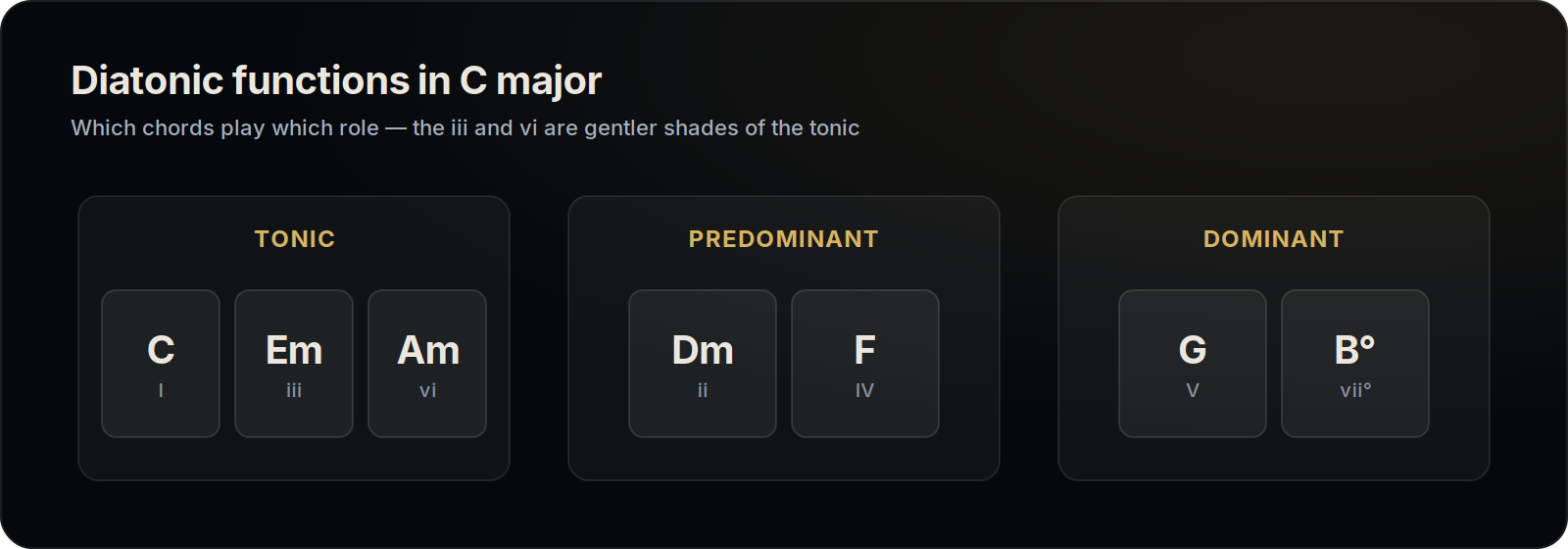
The iii and vi act as gentler, more colored shades of the tonic, while the diminished vii° leans so strongly toward resolution that it almost always carries dominant function.
It's worth saying clearly: you don't have to build your progressions on functional harmony. Plenty of compelling music — modal writing, planing, much film and game scoring — moves outside functional logic entirely. But functional harmony is a practical foundation, and knowing it makes the departures from it more deliberate.
Composers write progressions in Roman numerals so they work in any key: uppercase for major chords (I, IV, V), lowercase for minor (ii, iii, vi). In C major, I–IV–V–I means C–F–G–C.
Before looking at longer progressions, it helps to know five common two-chord pairings that appear again and again in tonal music:
These pairings are common largely because our ears have heard them across so many genres that they've become part of the shared vocabulary of Western harmony. Combined into longer progressions, they produce sequences many listeners will recognize:
One practical refinement from our piano curriculum: instead of a plain I–IV–V, try inserting the iii chord — I–iii–IV–V. That single addition can make a simple progression sound noticeably more expressive, because iii offers a softer, more wistful shade of the tonic.
The Piano Composer Progressions like these are its starting point — developed into complete pieces through voicing, variation, and form. Explore the course
Minor keys play a central role in cinematic and dramatic writing — though of course a great deal of film and game music lives in major keys and modes as well. The functional mechanics are the same; what changes are the qualities of the diatonic chords: i, ii°, III, iv, v (or V), VI, VII. The groups below are a practical functional model, not the only way to analyse every style. Here the minor-key numerals refer to the natural-minor degrees: VI in A minor means F major. Grouped by function:
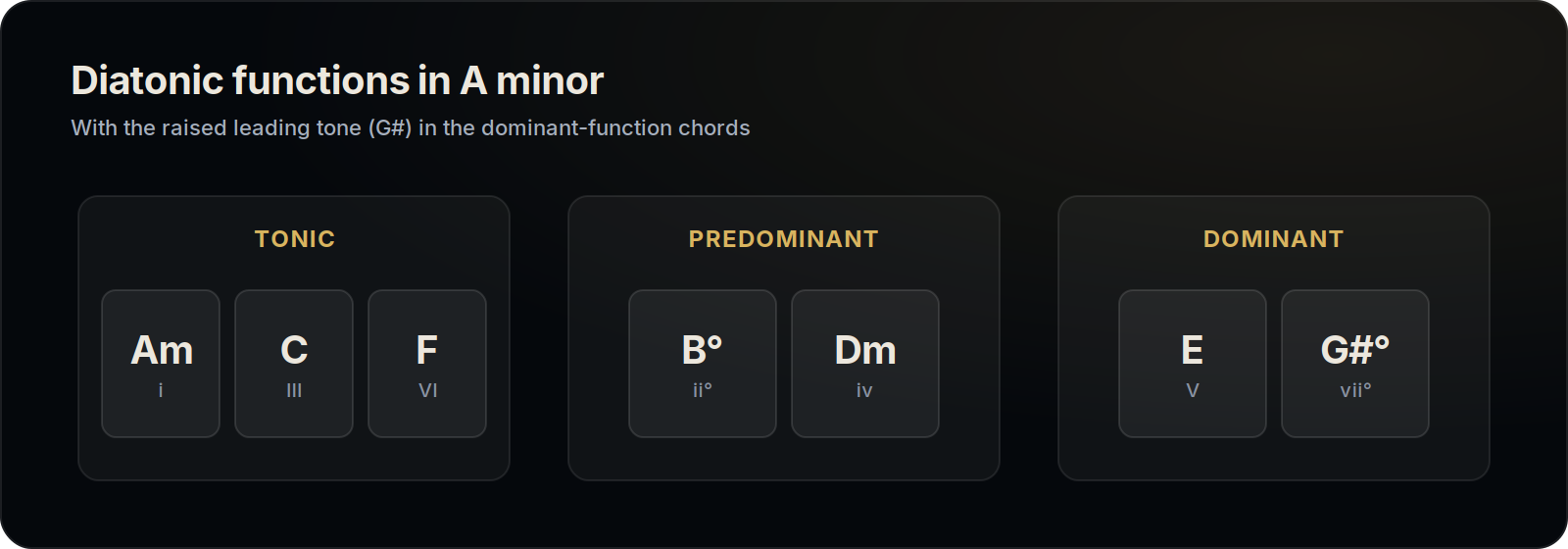
The dominant-function chords shown here use the raised leading tone (G♯ in A minor, from harmonic minor). Two honest footnotes to that: the vii° built on it (G♯°) is textbook-correct but rarely used as a chord in its own right — in practice it tends to appear in inversion, or folded into V7 (E7 contains all of its notes). And the raised leading tone itself is an option, not a requirement. V major offers the strongest, most classical resolution; the natural-minor v (Em) and VII (G) resolve more gently and often behave modally rather than functionally — a color that modern film and game writing uses constantly, as several of the progressions below show.
Some widely used minor progressions:
A useful habit from our trailer curriculum: when writing in a minor key, occasionally think in the parallel or relative major as well — noting both readings of the same progression can suggest ideas that a single frame of reference wouldn't.
Sadness in harmony comes from more than the choice of diatonic chords. One of the most reliable sources of emotional color is the borrowed chord — taking a chord from the parallel minor (or another mode) and placing it inside a major-key progression, a technique known as modal interchange.
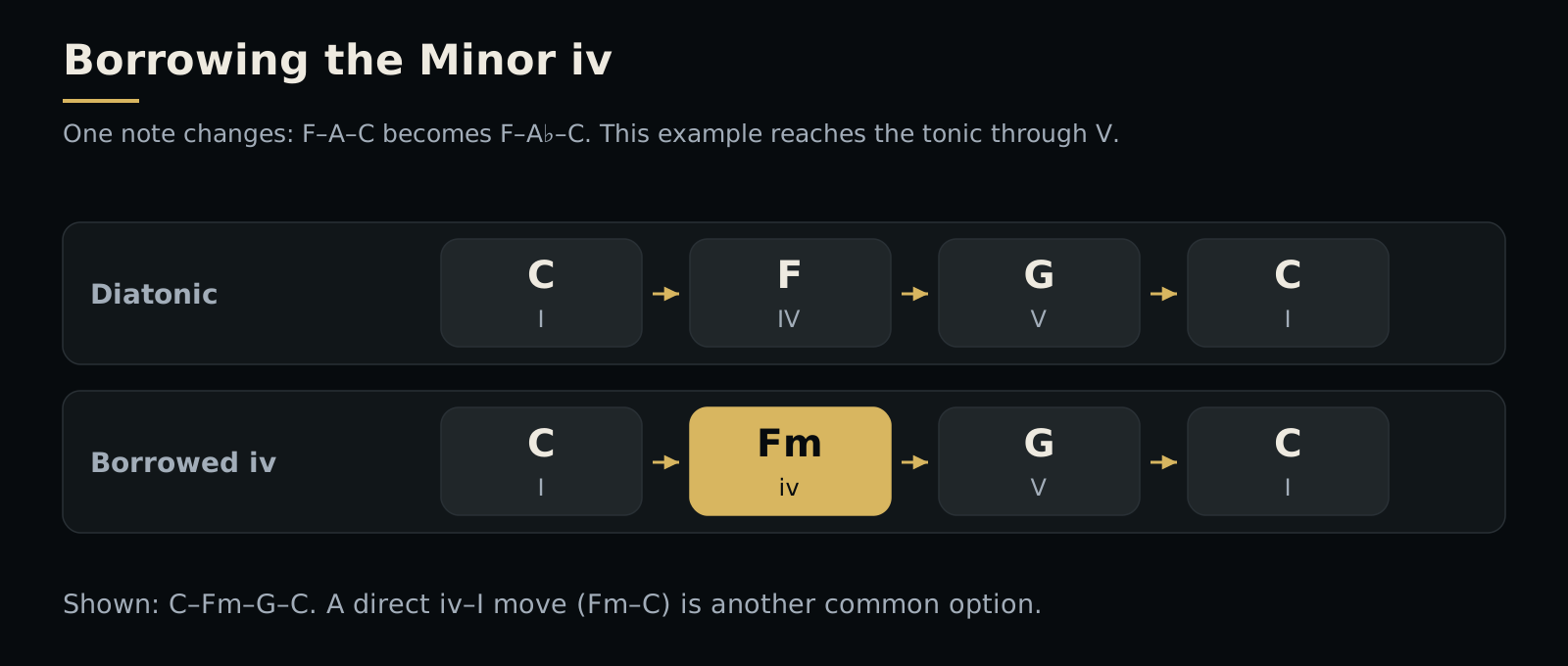
A very common and effective move: changing IV to iv. Take a plain I–IV–V–I in C major and let the F chord become F minor. That single altered note (A → A♭) changes the mood significantly — in the borrowed-chord workshops of our course The Legend of Otoe, it's described as giving a straightforward diatonic progression "spice and life and mystery." A refinement from the same workshop: rather than replacing the IV outright, you can divide its duration — let the F sound first, then darken it to F minor within the same bar before resolving. The minor iv also tends to pull directly home: the descending line from iv to I is often more satisfying than routing through V.
Other reliably emotional colors:
The underlying principle from those workshops: you're mixing and matching flavors of tonality while grounding them on straightforward, logical progressions. The simpler the base progression, the more room the borrowed colors have to speak. Our guide to modal interchange goes through the full palette of borrowed chords and where each one tends to work.
For villains, horror, and tension writing, composers often move beyond borrowed chords into more ambiguous territory:
Each of these trades functional clarity for atmosphere — which is precisely why they suit unsettling material.
You don't need to write jazz to make use of its harmonic colors. Adding sevenths to every chord of a diatonic progression — a technique demonstrated in our anime and JRPG composition course — makes the same progression noticeably more colorful without changing a single root. Continue extending into 9ths, 11ths, and 13ths and the palette expands quickly: different chord qualities, extensions and voicings offer many possible colours. Check each extension against the melody and the intended harmonic function.
The ii–V–I cadence is a natural entry point: in C, Dm7–G7–Cmaj7. It appears well beyond jazz, often woven quietly into film scoring. It is also the last three links of the descending-fifths chain around the circle of fifths, which is why it extends backwards (vi–ii–V–I, iii–vi–ii–V–I) so naturally.
Modern Japanese music — anime openings, city pop, JRPG soundtracks — has developed its own set of characteristic progressions, and they're a core part of our anime and JRPG composition curriculum. Four of them define much of the style:
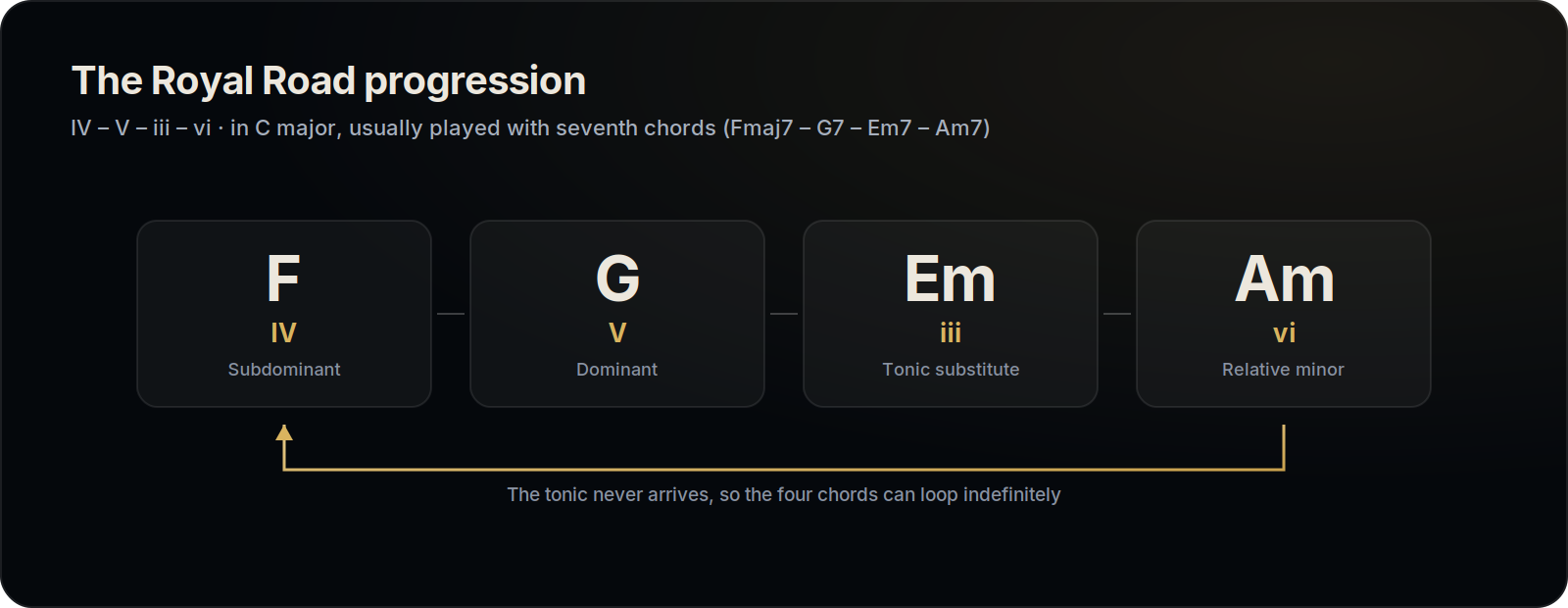
1. The Royal Road Progression (王道進行, Ōdō Shinkō) — IV–V–iii–vi. Japanese musicians call it "the royal road" — a well-traveled path, like a broad imperial road. In C major: F–G–Em–Am. It begins away from home, moves through the dominant, and settles on minor chords rather than resolving — one reason anime openings can feel triumphant and bittersweet at once. It often appears in the later stages of a progression, though in opening themes it frequently serves as the main idea itself. For the full story, including how Japanese composers modify it, read our complete guide to the Royal Road progression.
2. The "Seal" Progression — IV–V–VI. A stepwise, chromatic variant that climbs from IV and lands on a major VI chord — technically outside the key, which is exactly where its lift comes from. It's the harmonic engine of Seal's Kiss from a Rose, which is where the nickname — our own course name for the shape — comes from.
3. Diatonic Walks. Stepwise chord motion up or down the scale — IV–iii–ii–I, or climbing to V before falling home. These are useful starting points; the melody, voicing and rhythm still determine how the progression works.
4. The Nichijou Progression. The most involved of the four — a chain of secondary dominants and secondary ii–V–I motions, another name we use in our courses, after its prominent use in the opening of the anime Nichijou.
More progressions in this style, from Just the Two of Us to the Mario cadence and the Blackadder chord, are collected in our guide to anime chord progressions.
The Legend of Otoe — Composing Music for Anime and JRPGs The progressions in this section are taught in Level 1 — continuing into melody writing, extensions, and full arrangement. Explore the course
One well-established way to make a progression more interesting is the secondary dominant: borrowing the pull of the V–I resolution and aiming it at a chord other than the tonic. Through what theory calls tonicization, the target chord is treated, briefly, as a temporary home — and preceded by its own V.
Take I–ii–V–I in C. Replace the D minor with D major — a V-of-V — and the progression gains a stronger pull: I–V/V–V–I. Aim a secondary dominant at the ii chord instead (A major, V-of-ii) and it naturally sets a fresh ii–V–I in motion — a device our course highlights at the end of the Kakariko Village theme from Ocarina of Time. The idea extends further: a major or minor target chord can be approached by an appropriate ii–V or IV–V progression, as heard in passages of Joe Hisaishi's One Summer's Day from Spirited Away. For the full method — finding the secondary dominant of any chord, checking it against the melody, and the tritone-substitute and leading-tone alternatives — see our complete guide to secondary dominants.
Every mode has color notes — and the chords containing them are the ones that make the mode audible. In a Dorian progression, that means emphasizing the chords built on Dorian's raised 6th; in Phrygian, the ♭II chord carries much of the character, supported by the other chords containing that lowered second.
A brief reference for dramatic writing: Lydian tends toward wonder (I–II), Dorian toward a noble melancholy (i–IV), Phrygian toward threat (i–♭II), Mixolydian toward a heroic, folk-like quality (I–♭VII). Our guide to modes in music goes through all seven, with the chords that reveal each one.
And the practice habit our courses return to again and again: play everything in all 12 keys, and experiment with progressions you find in other music — the simpler the base progression, the more room there is to explore.
Our Music Composition & Orchestration Courses
Our Music Production Courses
Our Music Trailer Courses
See All CoursesWhat is a chord progression in simple terms? A sequence of chords played in a particular order — often one that creates a sense of departure from and return to a home chord.
What is the most common chord progression? Across the history of tonal music, I–IV–V–I is probably the most widespread; in modern popular music, I–V–vi–IV is especially common. The I–V pairing underlies both as one of the most fundamental motions in tonal harmony.
What makes a chord progression sad? Often the use of borrowed chords — the minor iv within a major key is a frequent source — alongside minor keys, tempo, and voicing.
What is the Royal Road progression? IV–V–iii–vi (F–G–Em–Am in C), a characteristic progression of anime and J-pop, known in Japan as Ōdō Shinkō ("royal road").
What is the 1-3-5 rule? It describes how a basic chord (a triad) is built: take a scale, then stack its 1st, 3rd, and 5th degrees — in C major, C–E–G. Progressions are then built from triads like these on different scale degrees.
How many chord progressions are there? There's no fixed number — chord extensions alone yield thousands of possible chord colorations before considering their order.
Learn with Master The Score
Courses on composition, orchestration, music production, trailer music and sound design, from composers writing for film, games and media. Students also get exclusive discounts on leading sample libraries and plugins.
Discover all courses →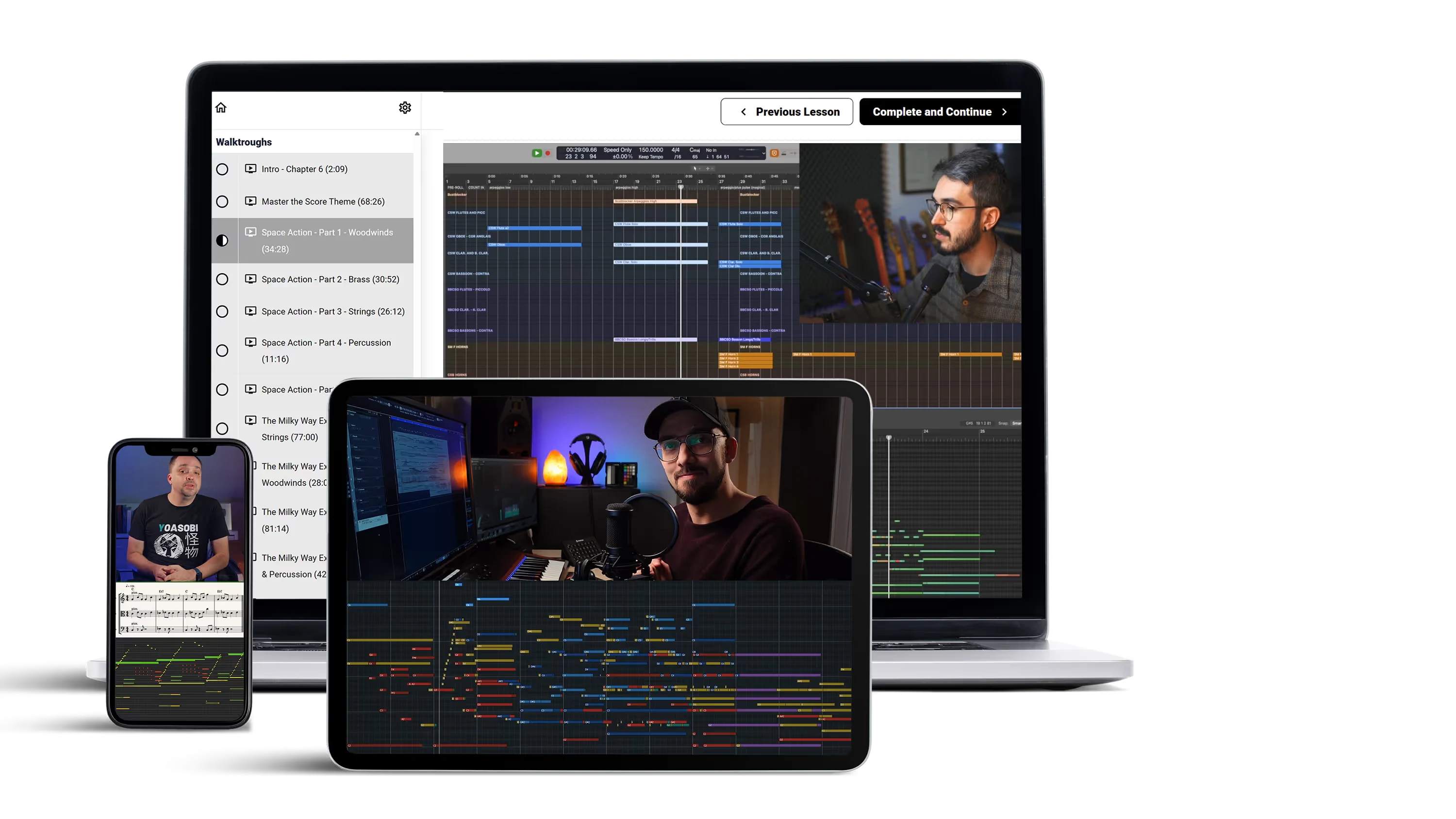


Online education for media composers — orchestral writing, trailer music, mixing and more, taught by working professionals.