

Music Theory and Composition

Ryan Leach is an Award Winning Composer for film and tv. His music has been heard on Every major Network. His clients includes Disney, Mtv and Netflix.
Diminished chords are the odd ones out among the basic triads: the only chord type built from two identical minor thirds, and the only one with a tritone inside it. That structure makes them unstable, ambiguous and surprisingly flexible — a diminished seventh can resolve into eight different keys — which is why they turn up in everything from Baroque cadences to horror cues and anime battle themes. This guide explains what diminished chords are, the three kinds you will meet, why they sound the way they do, and how film, game and anime composers actually use them, drawn from the harmony material in The Legend of Otoe, Pillars of Composition II and Composing Worlds.
A diminished chord is a triad built from two minor thirds stacked on top of each other. Start on C, go up a minor third to E♭, then up another minor third to G♭: C–E♭–G♭ is a C diminished triad, written Cdim or C°.
Compare that with the two chords you know best. A major triad is a major third with a minor third on top (C–E–G); a minor triad is the reverse (C–E♭–G). Both are built from a pair of opposite thirds. Diminished chords, like augmented chords, are built from a matching pair — which makes them symmetrical, and that symmetry is the source of almost everything interesting about them.
The other defining feature is the interval between the root and the top note. C to G♭ is a tritone: six semitones, exactly half an octave. A diminished triad is really a minor triad whose fifth has been lowered by a half step — take C–E♭–G and drop the G to G♭ — and that "diminished fifth" is where the chord gets both its name and its restless, unresolved sound.
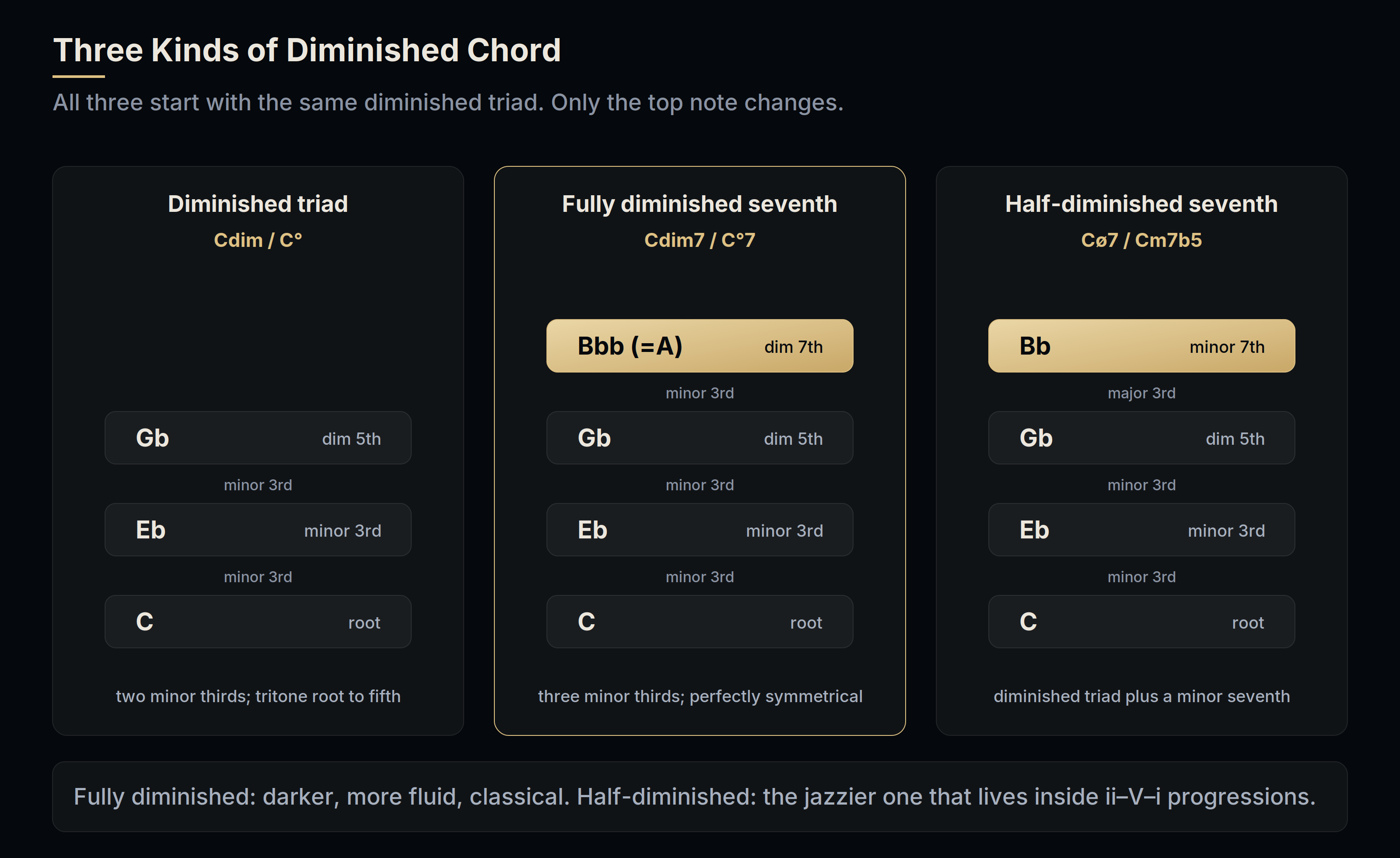
In practice you will meet three chords that all go by the name "diminished", and it pays to keep them apart.
The diminished triad (dim, °). Three notes: root, minor third, diminished fifth. C–E♭–G♭. This is the chord that appears naturally on the seventh degree of every major key.
The fully diminished seventh (dim7, °7). Keep stacking minor thirds. C–E♭–G♭–B♭♭ (which sounds as A). The top interval is a diminished seventh: a major seventh would be B, a minor seventh B♭, and the diminished seventh is a half step lower still. Because every interval in the chord is a minor third, the chord is perfectly symmetrical — you can rotate the four notes into any order and still have a stack of minor thirds. That property has consequences we will come back to.
The half-diminished seventh (ø7, or m7♭5). A diminished triad with a minor seventh on top: C–E♭–G♭–B♭. Only the fifth is diminished, hence "half". Many composers prefer the name minor seven flat five, because the chord looks exactly like Cm7 with the fifth lowered, and because that name describes how it usually behaves: as a minor-key ii chord rather than as a dominant.
A quick way to remember the difference: fully diminished is the darker, more fluid, more classical-sounding chord; half-diminished is the jazzier one that lives inside ii–V–i progressions. Both can carry dominant tension, but they do very different jobs.
Two things give a diminished chord its character.
The first is the tritone between the root and the diminished fifth. Like every tritone, it wants to resolve by half step in both voices — inward or outward — and until it does, the chord sounds like a question. Our guide to the tritone covers that mechanism in detail; here the important point is that a diminished chord contains the same tension engine as a dominant seventh, which is why it can do a dominant chord's job.
The second is the ambiguity that comes from the tritone's symmetry. Take C and G♭. Read the top note as G♭, and the voices want to resolve inward, C up to D♭ and G♭ down to F: you land on D♭ major. Respell the top note as F♯, and the voices want to resolve outward, C down to B and F♯ up to G: you land on G major. Same two notes, two possible destinations, a tritone apart from each other. Part of the magic of diminished chords is exactly this: the listener cannot tell which way the chord is going to go, and you can flip the polarity whenever you want.
To the ear, a diminished triad reads as a minor triad with a much darker fifth. If you are training yourself to hear them, listen first for the minor third between root and third, then for that lowered fifth; in a major key you will also hear the leading tone pulling toward the tonic without the dominant note underneath to anchor it.
Build a triad on every degree of a major scale and one of them comes out diminished: the seventh. In C major that is B–D–F, the vii° chord. Add the diatonic seventh and you get Bm7♭5, the half-diminished chord — the only naturally occurring seventh chord in a major key that is neither major, minor nor dominant.
In a minor key the diminished chord moves to the second degree: in A minor, ii° is B–D–F, and as a seventh chord Bm7♭5 again. This is the chord that makes the minor-key ii–V–i sound the way it does: a spicy subdominant that leans into the V.
If you raise the leading tone of the minor key (the harmonic minor scale), a second diminished chord appears on the new seventh degree — G♯–B–D–F in A minor — and this one is fully diminished: G♯dim7. It generates noticeably more tension than the half-diminished vii chord of the major scale, and it is a large part of what gives harmonic-minor progressions their classical sound.
The modes each place their diminished chord somewhere else, and knowing where is a useful shortcut to the colour of each mode:
The most common functional job of a diminished chord is to stand in for the V chord. vii° in a major key has a dominant function: in a progression it does the same work as V, pulling back to the tonic. It is closely related — in C major, Bdim is simply G7 without its root — but it has a little more motion in it, because every note of the chord is a tendency tone. The most important of them is the leading tone: the seventh degree of the scale, sitting a half step below the tonic (B in C major), which pulls upward into it more strongly than any other note. A dominant chord contains the leading tone; a diminished chord on the seventh degree is built on it.
Two conventions make the triad work in traditional writing. First, put it in first inversion: not B–D–F but D–F–B, with the D in the bass. A diminished triad in root position is unstable in a way that sounds unintended; with the third in the bass it sits properly. Second, resolve the tendency tones by step: the leading tone B rises to C, and the diminished fifth F falls to E, so the tritone closes inward onto the third of the tonic. The remaining note, D, moves to whichever tonic note is nearest — down to C or up to E — and in four-part writing it is the note you double, one copy going each way. That leaves the tonic without its fifth, which is normal in strict part writing; if you want a complete triad, the F may instead rise to G, a resolution that appears in Bach but is usually reserved for this vii°6–I move, because it resembles parallel fifths.
The same idea works one level down as a leading-tone chord, which is a diminished chord used exactly the way you would use a secondary dominant. Instead of V of something, it becomes vii° of something. The root sits a half step below the target — the leading tone is on the bottom, hence the name. In C major, C♯dim resolving to D minor is vii° of ii; first inversion again, leading tone up (C♯ to D), diminished fifth down (G to F), and the E in the bass to D or F. Any chord you can precede with its own dominant, you can also precede with its own leading-tone chord, and in reharmonization the two are interchangeable: for a C major target, G7, Bdim or the tritone substitute D♭7 all point at the same place.
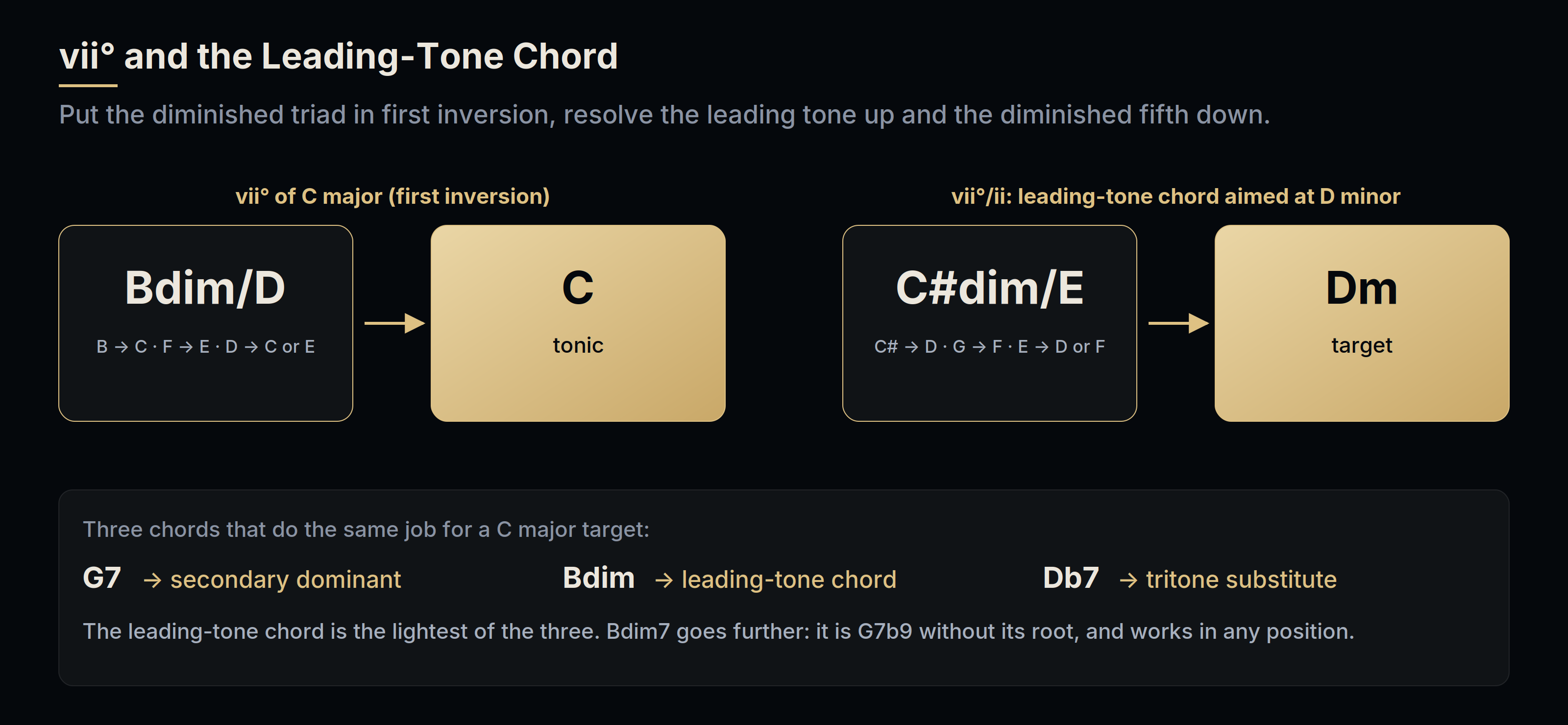
The diminished seventh is the stronger version of the same move. Think of it as a dominant seventh with a flat nine and no root: Bdim7 (B–D–F–A♭) is G7♭9 with the G removed, which is why dominant ♭9 chords are among the most tension-rich altered dominants available. Because the chord is fuller than the triad, you do not have to put it in first inversion; a diminished seventh works in any position. And it resolves very naturally a half step up — so if you find a dominant seventh a little plain, the diminished seventh built on its third is a drop-in replacement with a little more bite. In a cue in E♭ harmonic minor, for example, a Ddim where a B♭7 would have been expected creates slightly more tension while doing essentially the same job.
Pillars of Composition II Leading-tone chords, secondary dominants and tritone substitution as reharmonization tools, taught by building a complete piece module by module. Explore the course
A word of honesty about all this: in mainstream contemporary music, the bare diminished triad as a dominant has a slightly old-fashioned sound — Baroque and Classical, or 1930s jazz. Modern scores use diminished seventh chords far more than triads, and use both more often for colour than for cadences. Knowing the functional rules is still worth it, because the moment you break them deliberately, you want to know what you are breaking.
Here is the property that makes the diminished seventh unlike any other chord. Because it is perfectly symmetrical, any of its four notes can be treated as the root — and any of its four notes can be treated as a leading tone. Each of those leading tones resolves up a half step into a major or minor key. So a single diminished seventh chord belongs, in effect, to eight different keys.
Take Edim7: E–G–B♭–D♭. The E can resolve up to F, giving F major or F minor. The G can resolve to A♭, giving A♭ major or A♭ minor. The B♭ can resolve to B (spelled C♭ in the flat keys). And the D♭, respelled as C♯, can resolve to D major or D minor. Four notes, four leading tones, eight destinations — and the listener has no way of knowing which one is coming.
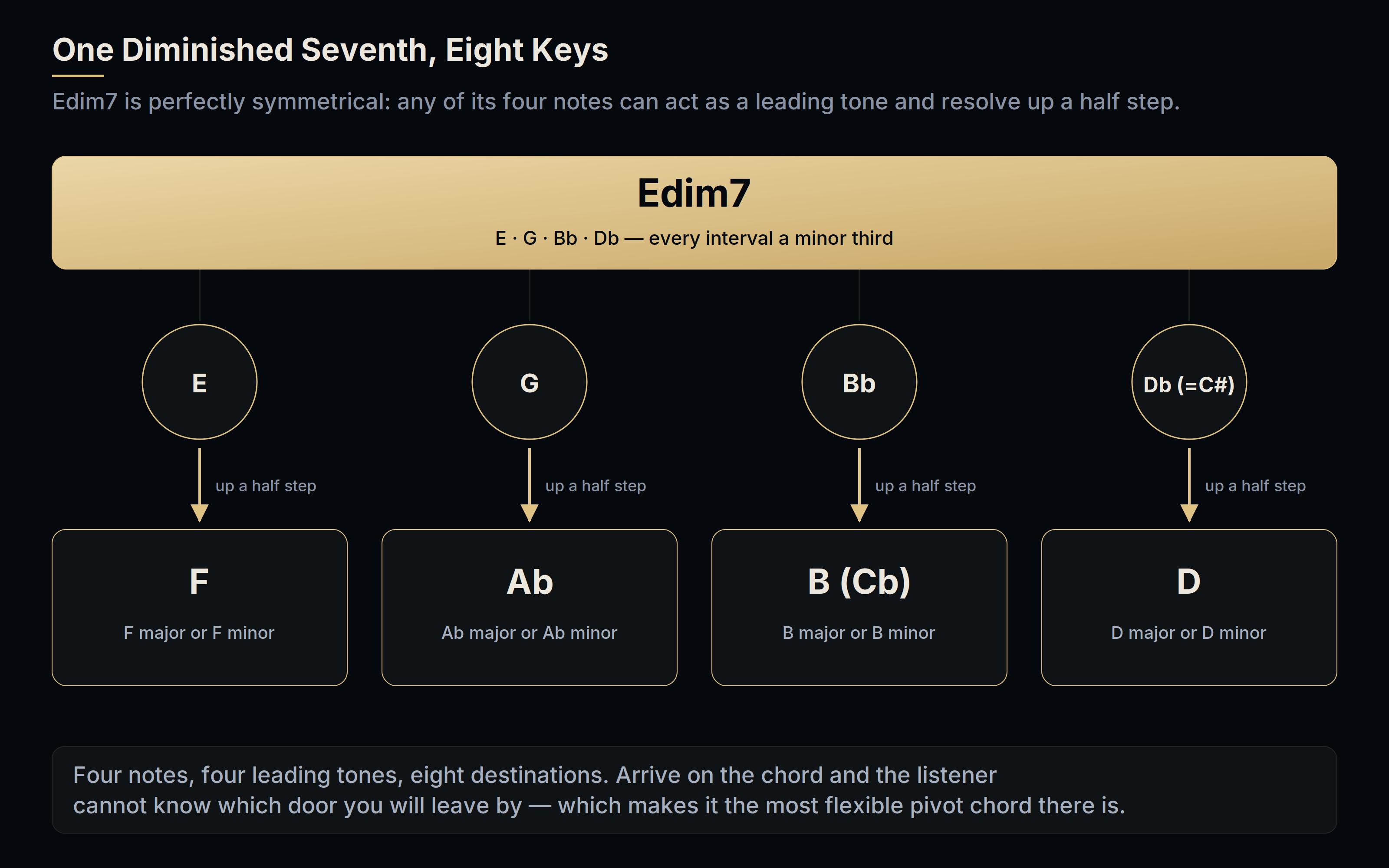
That makes the diminished seventh an extraordinarily convenient pivot. When you need to get from one key to another, especially to a distant one, land on a diminished seventh that both keys can claim, and leave through whichever door you like. The chord is also the reason diminished sevenths are among the most tonally ambiguous and dissonant chords available: a chord that could go anywhere sounds, for a moment, like it is nowhere. Stravinsky is often quoted as saying that when he was at a loss for how to proceed, he would take a chord — often a diminished seventh — and vary it in every possible way until it yielded the solution. The chord rewards exactly that kind of experimentation.
If you know your way around the circle of fifths, notice that the eight keys a diminished seventh can reach are spread all the way around it, which is why the chord can jump distances that a normal pivot chord cannot.
The half-diminished seventh mostly lives a different life from its fully diminished cousin. Its home is the ii chord in minor: in A minor, Bm7♭5–E7–Am is the minor-key ii–V–i, and the ♭5 in the ii chord is what gives that cadence its particular pull.
The same shape can be used inside a major key in two ways. The first keeps the chord in its natural surroundings: aim a ii–V at a minor chord of the key, and you get a small minor-key cadence inside the major one — in C major, Bm7♭5–E7 targeting A minor. The second treats the chord as a borrowed colour: use the half-diminished ii from the parallel minor in place of the diatonic ii, resolving to the ordinary major V and I — in C major, Dm7♭5–G7–C instead of Dm7–G7–C. Because both chords come from C minor, this has the same bittersweet quality as the borrowed minor iv (Fm instead of F), and it works for the same reason. John Williams uses it in the introduction to Marion's theme from Indiana Jones. It is one of the simplest ways to darken a major-key passage without leaving the key for long.
Anime and JRPG writing adds one more: the ♯ivø7 from the Lydian mode. In the context of a Royal Road progression (IV–V–iii–vi), that chord can replace the IV, tonicizing the iii that follows and giving the opening of the progression an extra lift. Our Royal Road guide covers that modification in context.
The half-diminished chord is also a lovely voice-leading tool. To get from F♯m7♭5 to Fmaj7, move the bass down a half step and leave every other voice where it is: F♯–A–C–E becomes F–A–C–E. One note moves, and the whole colour of the chord changes.
Outside the rules of functional harmony, diminished chords become a colour rather than a signpost, and this is where media composers use them most.
Mood and atmosphere. A fully diminished seventh sustained on its own, or arpeggiated, is one of the most reliable ways to make a scene feel creepy and uncomfortable. Diminished chords lend themselves particularly well to arpeggiation, and to spreading the arpeggio across a wide range; put the same notes under a quiet string tremolo and you have a vibrating, uneasy resonance that establishes a mood without stating a key. Rocking back and forth between two diminished chords a step apart feels ominous and mysterious — the kind of thing that sets the stage for a curse or a villain.
Half versus full. Because the half-diminished and fully diminished versions of the same chord differ by a single note, alternating between them makes a mysterious pulsing figure: E–G–B♭–D, then E–G–B♭–D♭, and back. Try the same passage with the seventh changed from D♭ to D — one note — and hear how much less menacing the half-diminished version feels.
Minor to diminished over a held bass. Keep the same note in the bass and move from a minor chord to the diminished chord on the same root — A minor to A diminished, or F♯ minor to F♯ diminished — and you get an unsettling, menacing shift from a single half-step change in the upper voices. The common tones keep the ear anchored; the one slippery note does the work. A progression like I–vi–iii–ii° (major, minor, minor, diminished) builds the same darkening into a loop.
A moment of tension. In a romantic, functional theme, a diminished chord can be a single moment of tension between two more stable chords — an Fdim leading into an F7, say — where it works alongside a half-diminished chord to keep the phrase from settling too early.
Making things sound slightly wrong. A diminished chord where the ear expects something diatonic makes a passage sound just a little off, which is exactly the effect a comedic or mischievous cue wants. Instead of a bright Lydian move, the same melody over a diminished chord dances around the chord tones in a way that reads as mysterious rather than pretty.
The climax chord. In a piano piece, landing the climax on a diminished seventh — then arpeggiating it quickly as a flourish — gives the high point a dramatic, unresolved intensity. And in trailer writing, the interlude before the climax is a common place for diminished chords, suspensions and augmentations if the track lives in a darker mood: they build the tension that the climax then releases.
The Legend of Otoe: Levels 2 & 3 Diminished and augmented chords, non-functional harmony and circle-of-fifths gestures, with a full sketch written in every level. Explore the course
Working quickly. One habit worth copying from a non-functional harmony workshop: when you decide to use a diminished chord, use the first one that sounds interesting and move on. The perfect diminished arpeggio does not exist, and trusting the initial idea is a bigger hurdle in composition than finding a better chord.
The diminished chord has a scale to go with it. Alternate half steps and whole steps — half, whole, half, whole — and you get the octatonic scale, also called the diminished scale, because a diminished seventh chord sits inside it at every step. The same scale contains ordinary major and minor triads a minor third apart, which is why it produces such an odd, fantastical sound: the chords are familiar, the relationships between them are not. Debussy explored it extensively, and it is a staple of fantasy and adventure scoring. If you want to write a melody over a diminished chord, the diminished scale is the first place to look.
For the harmonic context these moves live in, see our complete guide to chord progressions for composers and our guide to the tritone, the interval at the heart of every diminished chord.
Our Music Composition & Orchestration Courses
Our Music Production Courses
Our Music Trailer Courses
What is a diminished chord? A triad built from two stacked minor thirds — for example C–E♭–G♭. It is a minor triad with the fifth lowered by a half step, which puts a tritone between root and fifth and gives the chord its unstable, unresolved sound.
What is the difference between diminished and half-diminished? A fully diminished seventh chord (dim7 or °7) stacks three minor thirds: C–E♭–G♭–B♭♭. A half-diminished seventh (ø7 or m7♭5) has a diminished triad with a minor seventh on top: C–E♭–G♭–B♭. The half-diminished chord is usually a ii chord in minor; the fully diminished chord usually acts as a dominant or a pivot.
Where does the diminished chord occur in a major key? On the seventh degree: vii°. In C major that is B–D–F, and as a seventh chord Bm7♭5. In a minor key the diminished chord is ii°, and harmonic minor adds a fully diminished vii°7 on the raised leading tone.
How do you resolve a diminished chord? Traditionally, the root — the leading tone — resolves up by a half step, and the diminished fifth resolves down into the third of the target chord. The triad is usually placed in first inversion; the diminished seventh can be used in any position and resolves naturally a half step up.
Why can a diminished seventh chord resolve to so many keys? Because it is perfectly symmetrical: every note is a minor third from the next, so any note can be treated as the leading tone of a new key. Four notes, each resolving into a major or a minor key, gives eight possible destinations.
What does a diminished chord sound like? Dark, tense and unresolved — like a minor chord with a much darker fifth. On its own it sounds mysterious or creepy; inside a progression it sounds like it is about to go somewhere.
Is a diminished chord the same as a dominant seventh? No, but they are closely related. A diminished seventh chord is a dominant seventh flat nine with the root removed: Bdim7 is G7♭9 without the G. That is why diminished chords can do the dominant chord's job.
Learn with Master The Score
Courses on composition, orchestration, music production, trailer music and sound design, from composers writing for film, games and media. Students also get exclusive discounts on leading sample libraries and plugins.
Discover all courses →


Online education for media composers — orchestral writing, trailer music, mixing and more, taught by working professionals.


