

Music Theory and Composition

David McCaulley is a pianist and composer known for his YouTube channel Film Score Analysis, home to more than 150 score reductions of iconic film scores. He studied composition and piano at the University of North Texas and teaches The Piano Composer at Master The Score.
The Mixolydian mode is a major scale with a lowered seventh degree. That one note takes away the leading tone, the note that pulls hardest toward home, and gives the mode a sound many listeners describe as more relaxed than major: warm, open, a little earthy, sometimes bluesy. It's a mode composers often reach for when a scene needs confidence without polish, whether that's folk music, a rustic adventure, or a rock groove.
This guide covers the Mixolydian scale formula, how to build it in every key, how it differs from the major scale, which chords bring out its color, and how it's used in film, concert, folk, and popular music. It's part of our series on the modes; for the big picture of all seven, start with our guide to modes in music.
The Mixolydian mode is the fifth mode of the major scale. Seen from its own root, it's a major scale with a lowered seventh degree, and that one lowered note gives it its character.
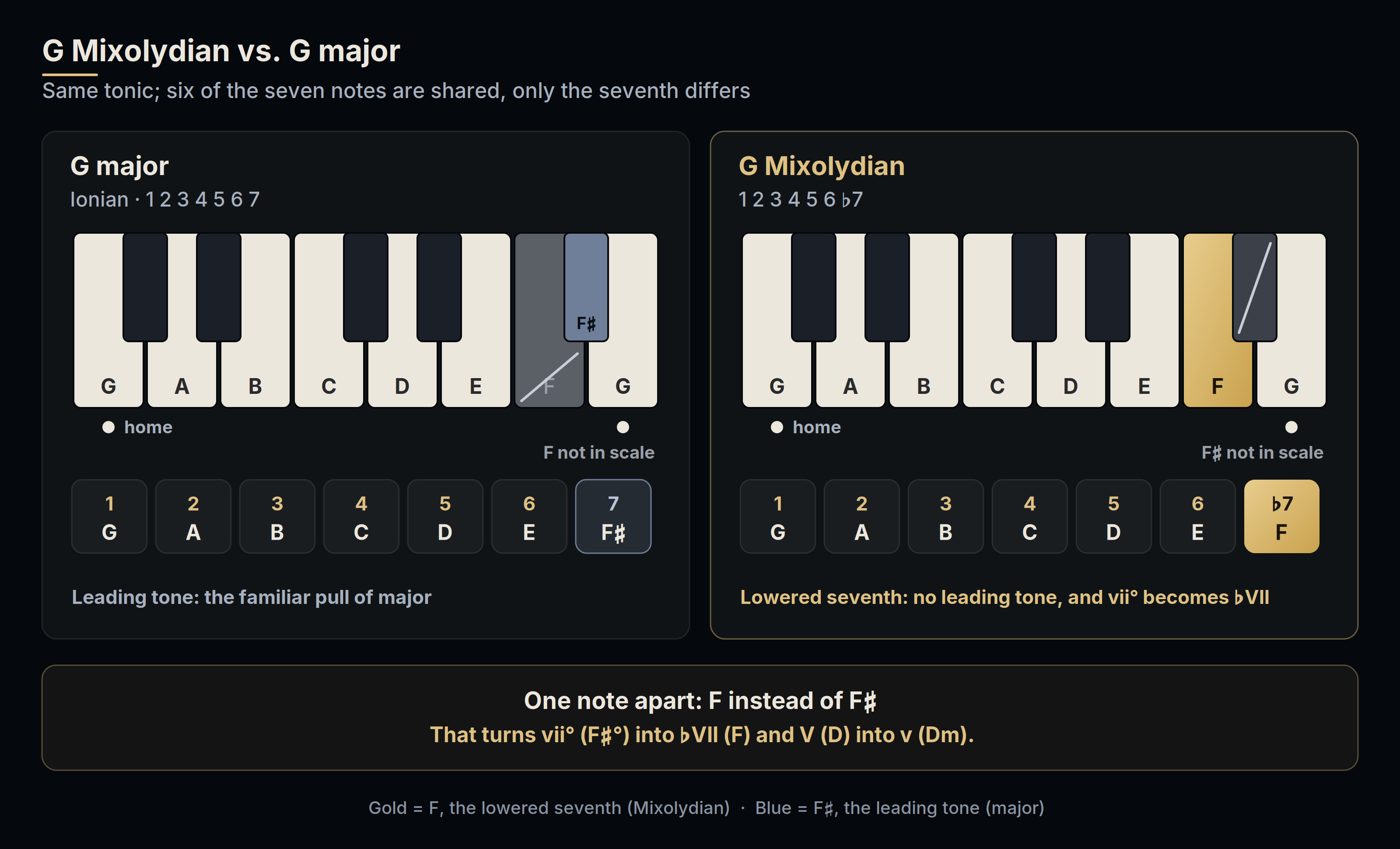
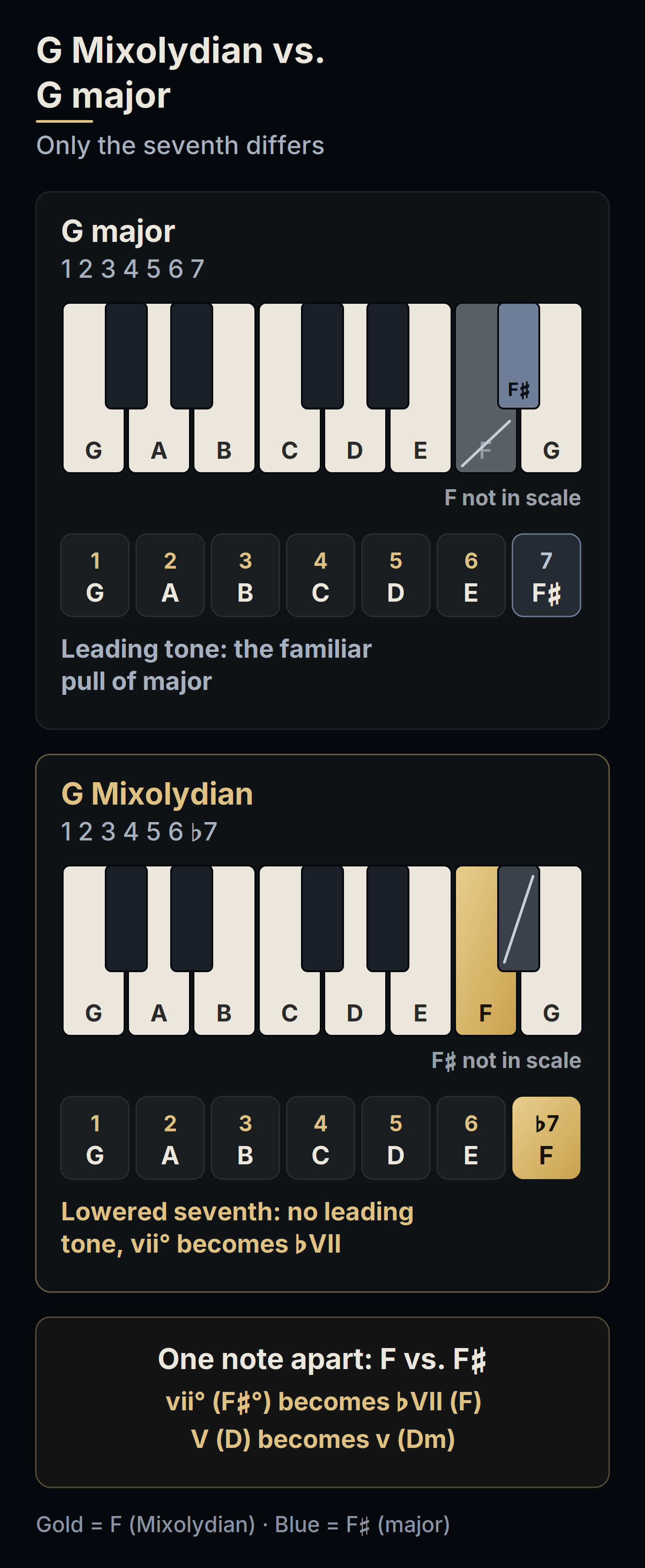
Play the white keys of a piano from G to the next G and you get G Mixolydian: G, A, B, C, D, E, F. These are the same seven notes as C major. With G as the tonal center, F natural is the lowered seventh; G major would use F♯ instead.
As with every mode, the notes alone are not enough. The ear has to hear G as home: G in the bass, phrases that begin and end on G, harmony built around a G major chord. The mode lives in the relationship between the notes and the tonic.
Because its third is major, Mixolydian belongs to the major family, alongside Ionian (the major scale) and Lydian. On the brightness spectrum of the modes, it sits one step below Ionian: still major, but a shade darker.
Compared to the major scale on the same root, Mixolydian changes exactly one degree, the seventh:
1 – 2 – 3 – 4 – 5 – 6 – ♭7
That lowered seventh is Mixolydian's color note, the one degree that separates it from ordinary major.
As an interval pattern, Mixolydian runs whole step, whole step, half step, whole step, whole step, half step, whole step. The top of the scale is where the difference shows: instead of a half step from the seventh up to the tonic, there's a whole step, so the scale arrives home without the usual pull of a leading tone.
On C, the formula gives C, D, E, F, G, A, B♭. It's C major with B♭ in place of B. G Mixolydian, which needs no sharps or flats, is the main example in the rest of this guide.
There are two ways to find the notes, and both are worth knowing.
Method 1: Start on the fifth degree of a major scale. Every Mixolydian scale shares its notes with the major scale a perfect fourth above its root. G Mixolydian uses the notes of C major, D Mixolydian the notes of G major, C Mixolydian the notes of F major. This is the fastest way to find the notes if you already know your key signatures.
Method 2: Take a major scale and lower the seventh. Any major scale becomes Mixolydian when you lower its seventh degree by a half step. G major has F♯; G Mixolydian has F. C major has B; C Mixolydian has B♭. This is the more useful way to think about Mixolydian while composing, because it names exactly what makes the mode sound the way it does.
Here is every Mixolydian scale, with the major scale it shares its notes with:
In each one, the seventh degree is the note to watch: F in G Mixolydian, B♭ in C Mixolydian, G in A Mixolydian.
Since Mixolydian and major differ by only one note, the best way to understand Mixolydian is to hear that note in context. Hold a G major chord and play G – F – G in the melody, then G – F♯ – G. Both figures step down to the seventh degree and return; in the first it's a whole step below the tonic, in the second a half step. Then try it with chords: G – F – G against G – D – G. F major contains F natural, the lowered seventh; D major contains F♯, the leading tone. A few notes over one chord don't establish a whole mode, but the difference between F and F♯ is the difference between the two colors.
That's why the major ♭VII is a direct way to bring out Mixolydian. In major, the chord on the seventh degree is diminished (vii°). In Mixolydian, the lowered seventh turns it into a major chord a whole step below the tonic, the ♭VII.
The same note changes the chord on the fifth degree. In major, V is a major chord and pulls strongly home. In Mixolydian, the fifth-degree chord is minor (Dm in G), because it contains F instead of F♯. So the most familiar cadence in tonal music, V–I, isn't available inside the mode, and Mixolydian finds other ways home.
Three related scales are worth separating from Mixolydian:
Mixolydian is often described as warm, relaxed, earthy, or bluesy. It keeps the brightness of a major key, but without the leading tone the music doesn't strain toward home in the same way. In Pillars of Composition it's described as "kind of like major, but a little cooler": positive, but not quite so overtly happy.
That lowered seventh has its own pull. In solfège terms it becomes Te instead of Ti, and as Pillars of Composition II explains, a lowered pitch tends to pull downward: Te often settles onto La, the sixth degree, rather than rising to the tonic. It can still resolve up to Do, just less urgently than Ti.
In film, game, and concert music, Mixolydian has picked up associations with folk music, Celtic and Scottish color, rustic heroism, and a certain archaic quality, and in popular music with blues and rock. These are conventions of musical traditions rather than properties of the scale itself. Tempo, orchestration, and rhythm can push Mixolydian in very different directions: over a drone it can sound old and ceremonial; with a backbeat and a dominant-seventh tonic it can sound like rock or funk.
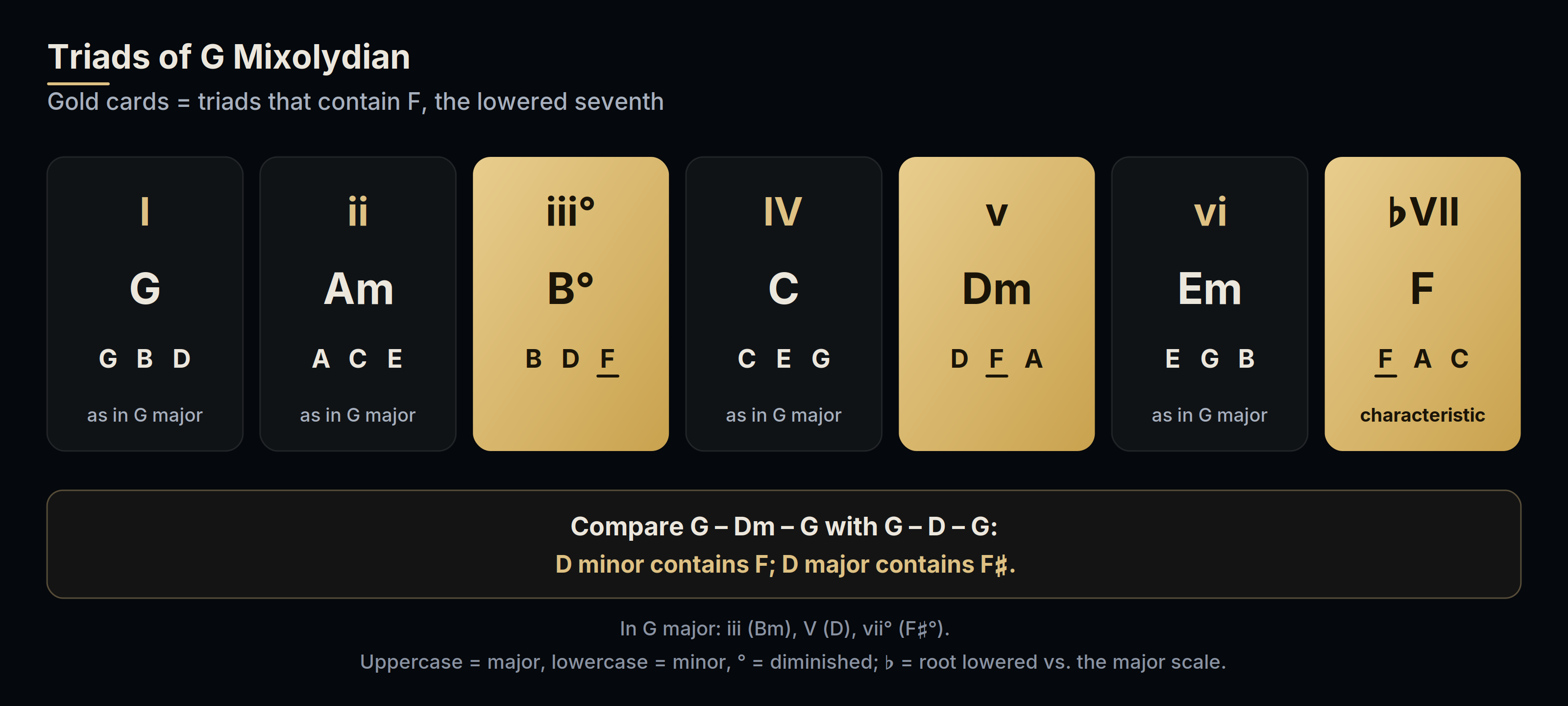
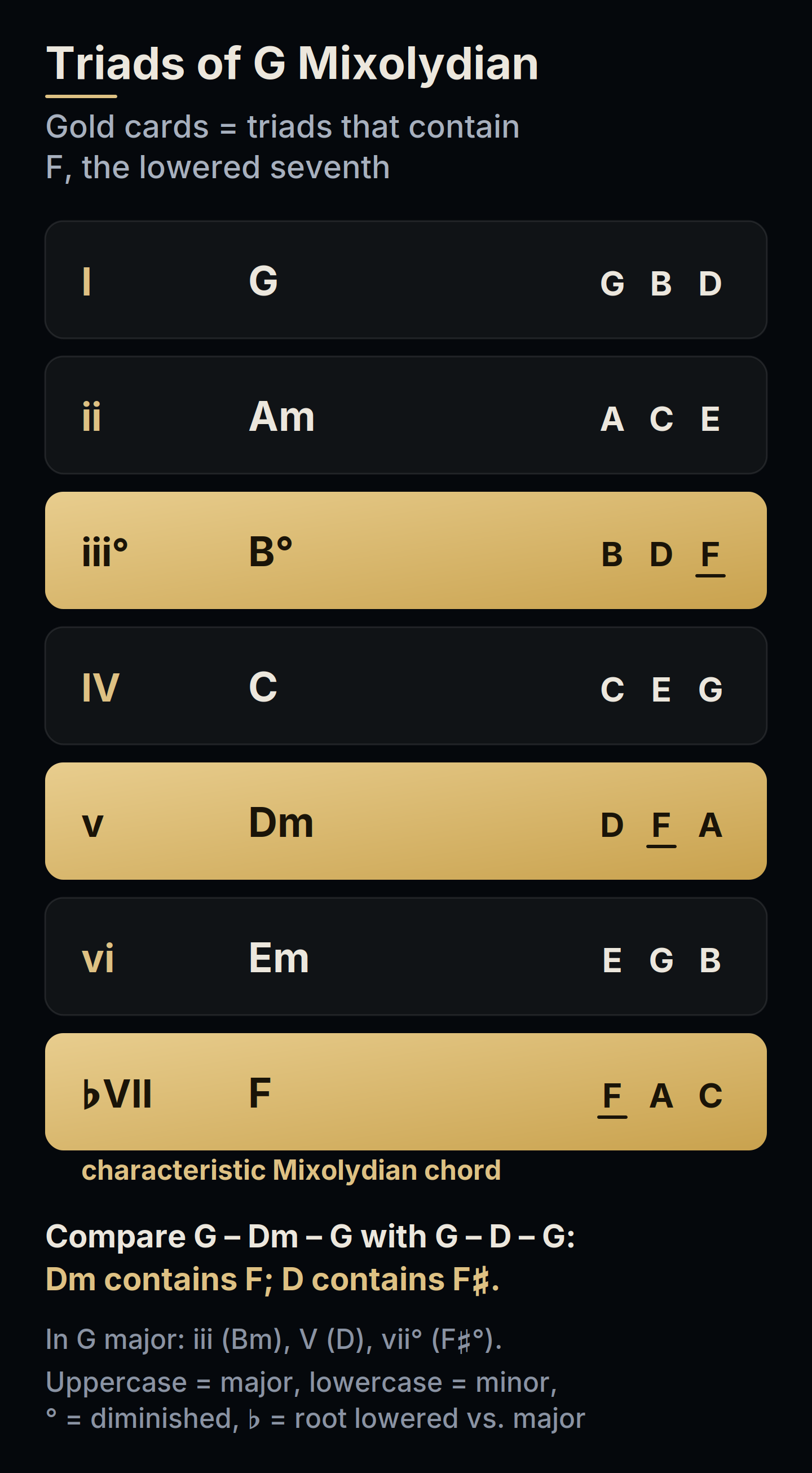
Build a triad on each degree of G Mixolydian and you get:
As seventh chords: G7, Am7, Bm7♭5, Cmaj7, Dm7, Em7, Fmaj7. (Roman numerals follow the usual convention: uppercase for major, lowercase for minor, ° for diminished, and a flat before the numeral means the root is lowered compared to the major scale.)
Four of these triads are identical to G major: I, ii, IV, and vi. The other three contain the lowered seventh, F, and those are the ones that make the mode audible:
The tonic seventh chord is worth a note of its own: in G Mixolydian it's G7, a dominant-seventh chord by structure, used here as the tonic. That's a big part of the mode's bluesy sound, and it's also a risk. G Mixolydian shares its notes with C major, and G7 moving to C is a V7–I in C. A passage that keeps resolving G7 to C will start to sound like it's in C major. Let G7 sit as a home chord, and keep the weight on G.
One more thing to listen for: ♭VII alone doesn't prove Mixolydian. The same F major chord appears in G Dorian and G Aeolian (natural minor) as well. Against an established G major tonic, F major creates a characteristic Mixolydian color. Whether the passage stays in G Mixolydian or borrows that color within G major depends on the surrounding melody and harmony.
The Piano Composer Chapter 3 takes Mixolydian to the keyboard: how to remember it as major with a lowered seventh, which chords carry that color note, and a progression-and-scale exercise in C Mixolydian with the tonic held in the left hand. Explore the course
These four progressions use only notes from G Mixolydian. Give the G major chord a clear sense of arrival so that G remains the tonal center.
A blues comparison: I7–IV7 (G7–C7) shares the dominant-seventh tonic sound, but C7 introduces B♭, outside G Mixolydian. It illustrates the connection with blues rather than a progression drawn entirely from the mode.
Knowing the notes is the easy part. Two things decide whether the music actually sounds Mixolydian.
Establish the tonic. Because G Mixolydian shares its notes with C major, it can easily be heard as C major instead, especially when G7 resolves to C. Put the tonic in the bass, start and end phrases on it, and build your harmony around the I chord. A pedal tone is a direct way to do this, and ♭VII over a held tonic is a characteristic Mixolydian sound. It's not the only way, though.
Let the color note be heard. If neither melody nor harmony uses the seventh degree, the passage may not distinguish Mixolydian from ordinary major. Use the chords that contain it, especially ♭VII and v, and give the lowered seventh some weight in the melody. Pillars of Composition II points to John Williams' theme from Jurassic Park as an example of landing on the lowered seventh on a strong beat, so that it sounds intentional rather than like a wrong note.
It also helps to know what F♯ does. It lies outside G Mixolydian, and bringing it in, through a major V or a leading tone at a cadence, leans the music toward plain major. A single F♯ doesn't necessarily mean a change of mode; it can be a local inflection, and many themes move between major and Mixolydian freely. The more the music leans on the leading tone, though, the more the Mixolydian color gives way to ordinary major.
There's a second, complementary way Mixolydian shows up: as a chord scale. In a major key, Mixolydian is the scale conventionally paired with the V7 chord. Over G7 in C major, G Mixolydian contains exactly the notes of the key. Here G is the chord root, while C remains the tonal center: using G Mixolydian over V7 does not make the passage a piece in G Mixolydian. That's why the mode is sometimes called the dominant scale.
In conventional chord-scale teaching, the fourth degree (C over G7) is treated as an avoid note when sustained, because it lies a half step above the chord's third. The 9th and 13th are the usual available tensions. Dominant chords are also where jazz harmony most often reaches outside the scale, for altered tensions such as ♭9, ♯9, and ♭13, so over a functional V7 Mixolydian is one option among several.
When the third is omitted, a G7sus4 voicing (G, C, D, F) makes the fourth a chord tone instead. The chord can support a G Mixolydian melody, but it does not identify the mode on its own: it leaves out B, the major third, and also fits several minor modes. In 20th Century Orchestral Writing, a modal variation combines a sustained G7sus4 with a melody drawn from G Mixolydian, keeping G as the center.
The dominant-seventh tonic has a second life as a borrowed chord. In The Legend of Otoe: Levels 2 & 3, a I7 borrowed from Mixolydian into a major key is described as a common choice for the blues, with a caution that it can also sound like a secondary dominant, the V of IV. (Our guide to secondary dominants covers that reading.)
You don't need to write a whole piece in Mixolydian to use it. One practical approach is to borrow ♭VII into an otherwise major-key progression, a technique known as modal interchange. In C major, a B♭ chord borrowed from C Mixolydian adds a sudden widening of color, and because B♭ also lies a half step above A, it can lead smoothly into an A minor chord. 20th Century Orchestral Writing uses this move in one of its variations. Elsewhere in the course, a heroic theme in E♭ moves to a D♭ chord over an E♭ pedal: a ♭VII over the tonic bass, which keeps the harmony grounded and, as the course notes, makes a more interesting change than a plain D♭ major chord.
Concert music. Ottorino Respighi named the mode in the title of his Concerto in modo misolidio for piano and orchestra, written in 1925 and built on Gregorian chant melodies.
Film scoring. John Williams' theme from Jurassic Park is in B♭ major, but as a guide to the theme notes, at a few prominent moments Williams uses a chord containing A♭, the lowered seventh, which stands out as something strange and otherworldly. It's a clear example of a single Mixolydian color inside a major-key theme rather than a whole theme in the mode.
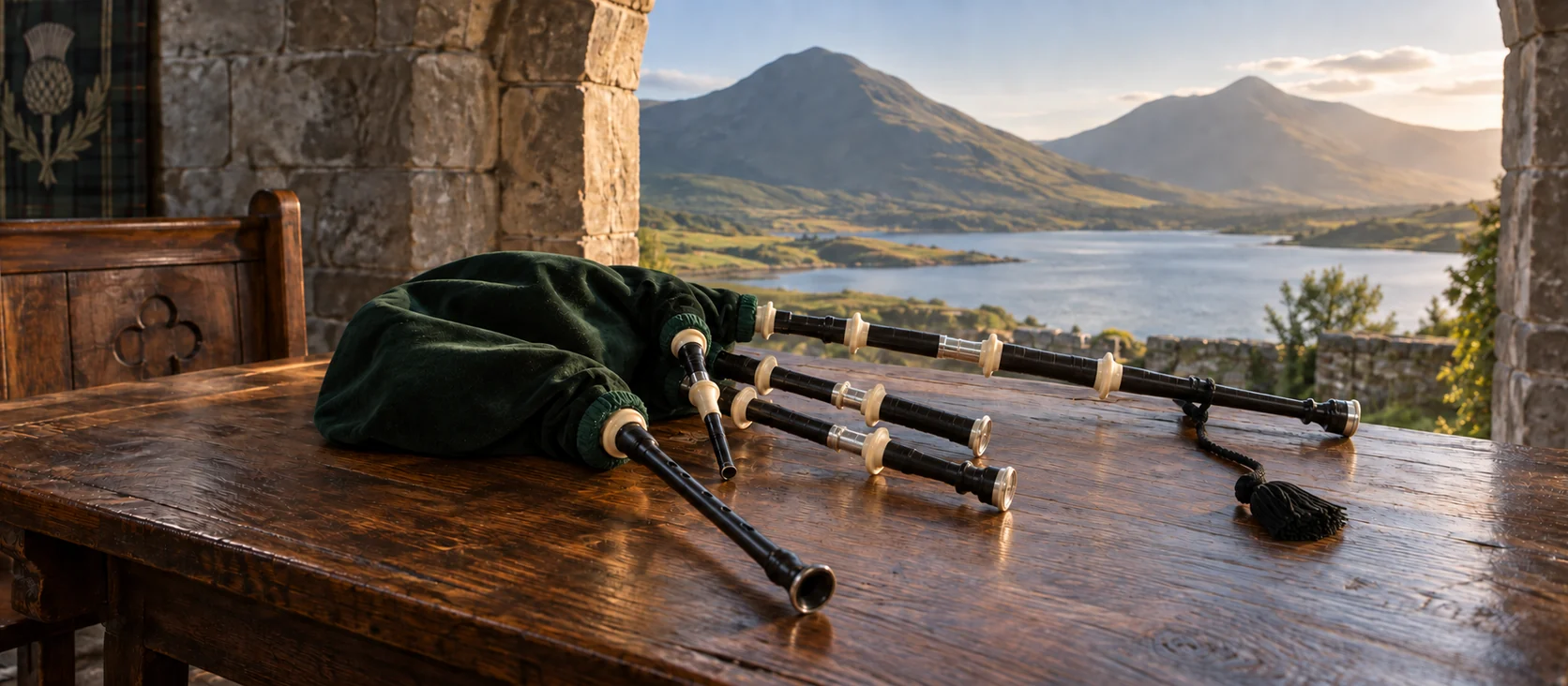
Folk music. The Great Highland bagpipe chanter offers a familiar Mixolydian sound. As Ewan Macpherson explains, its nominal scale can be written G–A–B–C♯–D–E–F♯–G–A: A Mixolydian with an extra low G. Traditional piping notation calls the sharpened notes simply C and F. These are conventional note names; the instrument's actual pitch and tuning differ from concert A and equal temperament. The chanter provides a concrete instrumental connection to the Scottish associations often heard in Mixolydian writing.
Popular music. Rock and pop use Mixolydian progressions constantly. Open Music Theory cites the Kinks' "Tired of Waiting for You" as a song built on the ♭VII–I subtonic shuttle through its intro and first verse.
A useful way to see Mixolydian in action is to look at how a composer arrives at it. In the bonus final project of Pillars of Composition, a main-titles cue for a refined, positive setting, the choice of mode comes down to three candidates: Lydian felt too bright, too happy; plain major felt ordinary; Mixolydian offered a positive sound without being too happy, as long as its bluesy side was handled with care.
The cue is set in F, and the opening already makes the lowered seventh part of the harmony: the chords implied by the first phrase move from F to a C minor chord with E♭ in the bass, the minor v of F Mixolydian, carrying the mode's color note in the lowest voice.
The choice was made by listening for this particular cue, not by rule. Mixolydian is sometimes rejected for the same reason it's chosen here: in another context, a composer might hear the lowered seventh as too bluesy and stay in plain major. That's one of the most practical things to take from any mode: the same color can be exactly right in one scene and wrong in another.
20th Century Orchestral Writing Chapter 1 reworks one simple theme in different modes, then brings in borrowed chords from Mixolydian, Lydian, and the parallel minor to build richer variations, and uses Mixolydian scales to shape orchestral build-ups. Chapter 4 applies those colors to a heroic theme. Explore the course
Once Mixolydian is in your ears, it becomes one of the most useful colors in the major palette. For how it relates to the other six modes, and how to borrow a single ♭VII into other keys, see our guides to modes in music and modal interchange.
Our Music Composition & Orchestration Courses
Our Music Production Courses
Our Music Trailer Courses
See All CoursesWhat is the Mixolydian mode? The Mixolydian mode is the fifth mode of the major scale: a major scale with a lowered seventh degree. G Mixolydian uses the white keys from G to G: G, A, B, C, D, E, F.
What is the Mixolydian scale formula? 1 – 2 – 3 – 4 – 5 – 6 – ♭7. Compared to the major scale, it lowers the seventh by a half step and leaves everything else unchanged.
Is Mixolydian major or minor? Major. Its third is a major third, so its tonic chord is major. The lowered seventh gives it a slightly darker, more relaxed character than the major scale.
What is the difference between Mixolydian and major? One note: the seventh. Major has a leading tone a half step below the tonic, Mixolydian a lowered seventh a whole step below. That changes the chord on the seventh degree from diminished (vii°) to major (♭VII) and the chord on the fifth degree from major (V) to minor (v).
What are the chords in G Mixolydian? G, Am, B°, C, Dm, Em, and F. The F major chord (♭VII) carries the Mixolydian color most directly because it contains the lowered seventh, F, as its root.
Why is Mixolydian called the dominant scale? Its tonic seventh chord is a dominant seventh (G7 in G Mixolydian), and in a major key it's the scale conventionally paired with the V7 chord. Over G7 in C major, G Mixolydian contains exactly the notes of the key. In that setting, C can remain the tonic even though G is the root of the chord scale.
What does the Mixolydian mode sound like? Mixolydian often sounds warm, relaxed, and a little bluesy, because the lowered seventh removes the leading tone. The actual mood depends on tempo, rhythm, and instrumentation. It's often associated with folk, Celtic, and rock music.
What songs use the Mixolydian mode? Frequently cited examples include Respighi's Concerto in modo misolidio, the Kinks' "Tired of Waiting for You," and the lowered-seventh color in John Williams' theme from Jurassic Park. The Great Highland bagpipe's scale is also close to Mixolydian.
Learn with Master The Score
Courses on composition, orchestration, music production, trailer music and sound design, from composers writing for film, games and media. Students also get exclusive discounts on leading sample libraries and plugins.
Discover all courses →


Online education for media composers — orchestral writing, trailer music, mixing and more, taught by working professionals.