

Music Theory and Composition

David McCaulley is a pianist and composer known for his YouTube channel Film Score Analysis, home to more than 150 score reductions of iconic film scores. He studied composition and piano at the University of North Texas and teaches The Piano Composer at Master The Score.
The Phrygian mode is a natural minor scale with a lowered second degree. That one note, a half step above the tonic, gives it a sound that many listeners describe as darker and more tense than ordinary minor, and it pulls back down to the tonic with unusual force. It's a mode composers often reach for when a scene needs menace or mystery, and together with its close relative Phrygian dominant it's also tied to a Spanish color.
This guide covers the Phrygian scale formula, how to build it in every key, how it differs from natural minor, which chords bring out its color, how Phrygian dominant differs, and how the mode is used in classical and game music. It's part of our series on the modes; for the big picture of all seven, start with our guide to modes in music.
The Phrygian mode is the third mode of the major scale. Seen from its own root, it's a natural minor scale with a lowered second degree, and that one lowered note gives it its character.
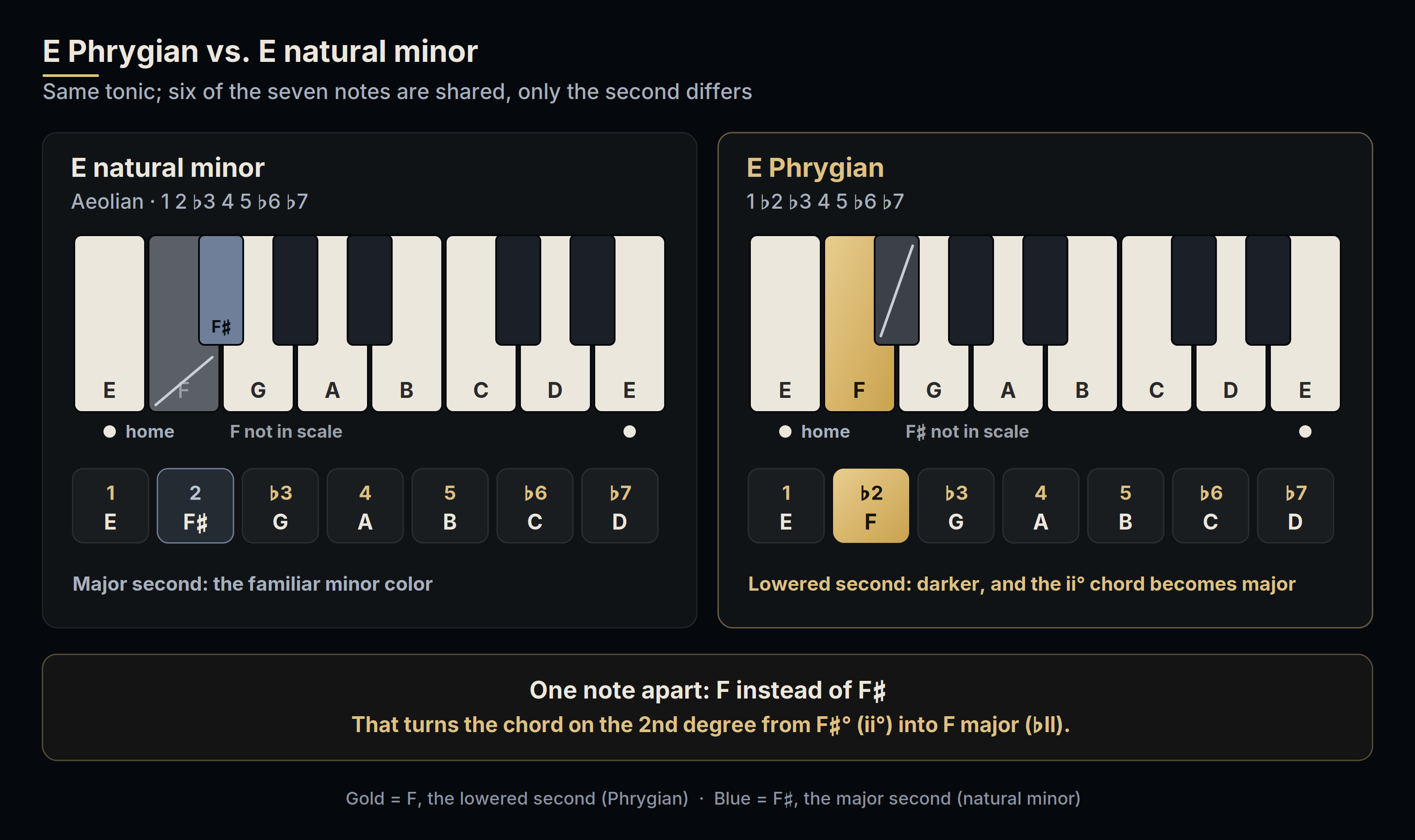
Play the white keys of a piano from E to the next E and you get E Phrygian: E, F, G, A, B, C, D. These are the same seven notes as C major and A minor. With E as the tonal center, F natural is the lowered second; E natural minor would use F♯ instead.
As with every mode, the notes alone are not enough. The ear has to hear E as home: E in the bass, phrases that begin and end on E, harmony built around an E minor chord. The mode lives in the relationship between the notes and the tonic.
Because its third is minor, Phrygian belongs to the minor family, alongside Aeolian (natural minor) and Dorian. On the brightness spectrum of the modes, it sits one step above Locrian, which is why it's often called the darkest of the modes composers use regularly.
Compared to the major scale on the same root, Phrygian lowers four degrees: the second, third, sixth, and seventh.
1 – ♭2 – ♭3 – 4 – 5 – ♭6 – ♭7
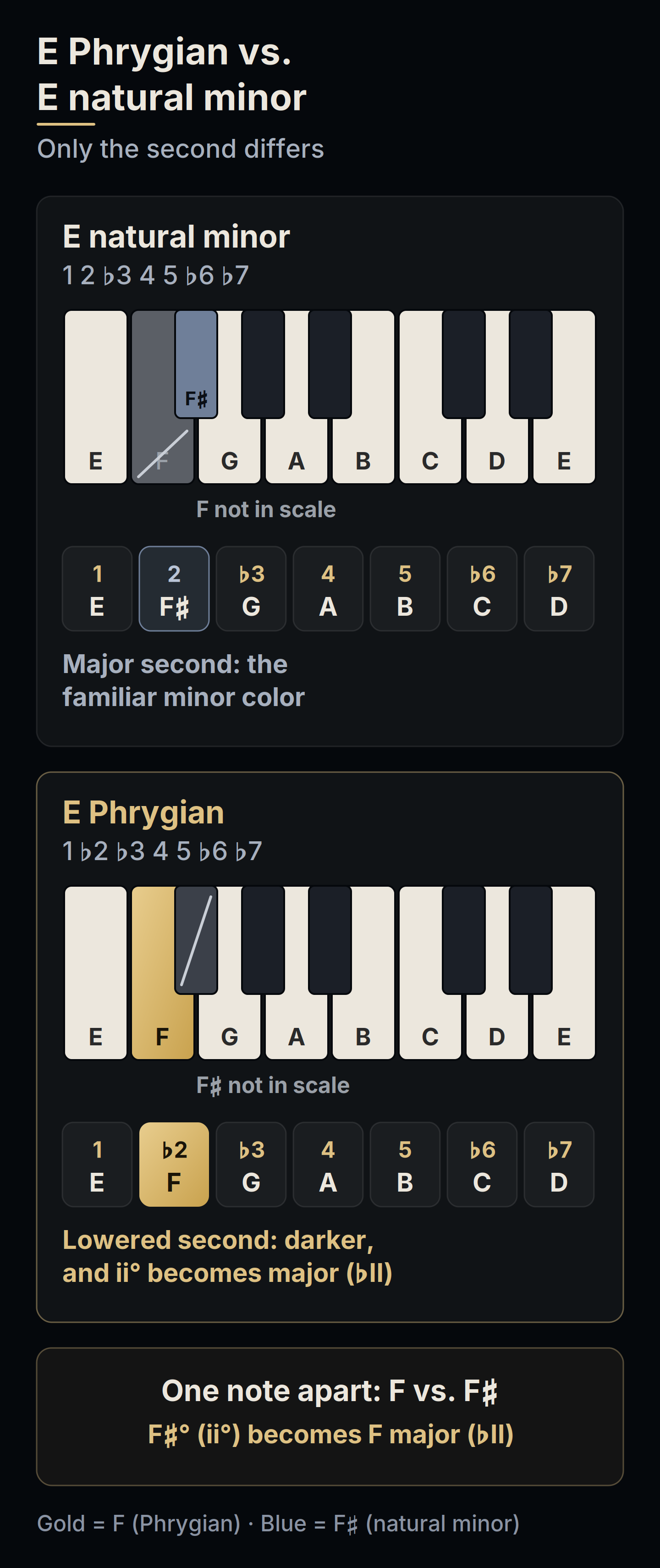
Compared to natural minor, which already has ♭3, ♭6, and ♭7, it changes exactly one degree: the second. That lowered second is Phrygian's color note, the one degree that separates it from ordinary minor.
As an interval pattern, Phrygian runs half step, whole step, whole step, whole step, half step, whole step, whole step. Along with Locrian, it's the only mode of the major scale that begins with a half step, so the very first move away from the tonic is the smallest one possible.
On C, the formula gives C, D♭, E♭, F, G, A♭, B♭. It's C natural minor with D♭ in place of D. E Phrygian, which needs no sharps or flats, is the main example in the rest of this guide.
There are two ways to find the notes, and both are worth knowing.
Method 1: Start on the third degree of a major scale. Every Phrygian scale shares its notes with the major scale a major third below its root. E Phrygian uses the notes of C major, A Phrygian the notes of F major, C Phrygian the notes of A♭ major. This is the fastest way to find the notes if you already know your key signatures.
Method 2: Take a natural minor scale and lower the second. Any natural minor scale becomes Phrygian when you lower its second degree by a half step. E minor has F♯; E Phrygian has F. A minor has B; A Phrygian has B♭. This is the more useful way to think about Phrygian while composing, because it names exactly what makes the mode sound the way it does.
Here is every Phrygian scale, with the major scale it shares its notes with:
In each one, the second degree is the note to watch: F in E Phrygian, B♭ in A Phrygian, D♭ in C Phrygian.
Since Phrygian and natural minor differ by only one note, the best way to understand Phrygian is to hear that note in context. Hold an E minor chord and play E – F – E in the melody, then E – F♯ – E. Both figures touch the second degree and return; in the first it's a half step away, in the second a whole step. Then try it with chords: Em – Dm – Em against Em – D – Em. D minor contains F natural, D major contains F♯. A few notes over one chord don't establish a whole mode, but the difference between F and F♯ is the difference between the two colors.
The most direct Phrygian move has no counterpart in natural minor at all: Em – F – Em. In E minor, the chord on the second degree is diminished (F♯°). In Phrygian, the lowered second turns it into a major chord a half step above the tonic, the ♭II. That chord, and its slide back down into the tonic, is the sound most people mean when they call something "Phrygian."
Three related scales are worth separating from Phrygian:
Like natural minor, Phrygian has no leading tone (D natural in E, not D♯), so it has no major V chord. In fact its chord on the fifth degree is diminished. Phrygian's characteristic way home is not V–i but ♭II–i: the lowered second falling a half step onto the tonic.
Phrygian is often described as dark, tense, brooding, or sinister. It keeps the gravity of a minor key, and the lowered second adds a pressure right next to the tonic, as if the melody were leaning on home from above. In solfège terms, the second degree becomes Ra instead of Re, and as Pillars of Composition II puts it, a lowered pitch tends to pull down: Ra wants to fall to Do. Depending on context, that pull can sound somber, threatening, or exotic.
In film, game, and concert music, Phrygian has picked up strong associations with danger, crime, dark fantasy, and ritual. A single ♭II chord or a melodic half step from ♭2 down to the tonic is often enough to call up that color in an otherwise minor-key cue. A guitar-driven ♭II–I gesture can suggest flamenco, using the major tonic discussed in the Phrygian dominant section below.
These are conventions of musical traditions rather than properties of the scale itself. Tempo, orchestration, and rhythm can push Phrygian in very different directions: played slowly and softly it can sound ancient or mournful; played fast with hard accents it can sound aggressive. It's a natural choice when plain minor doesn't feel dark enough.
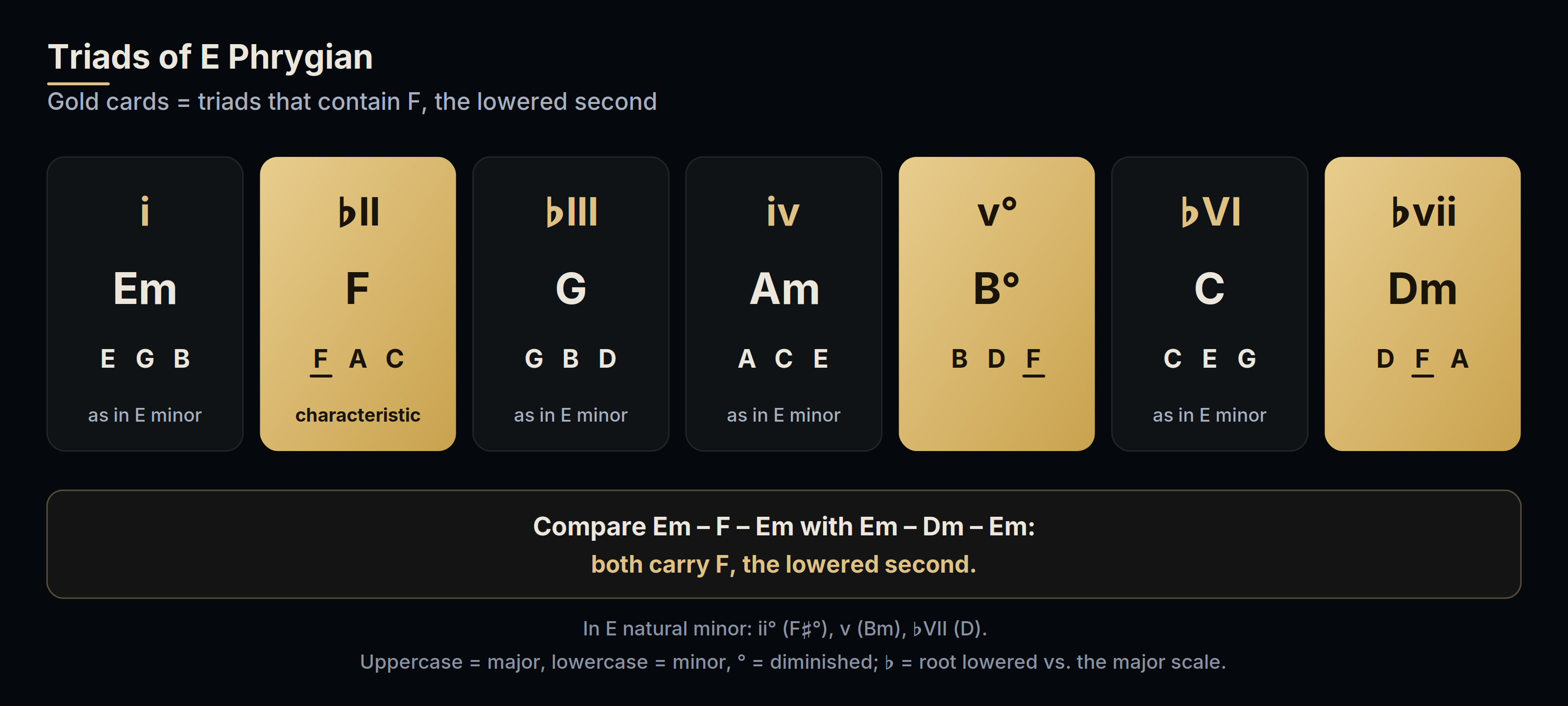
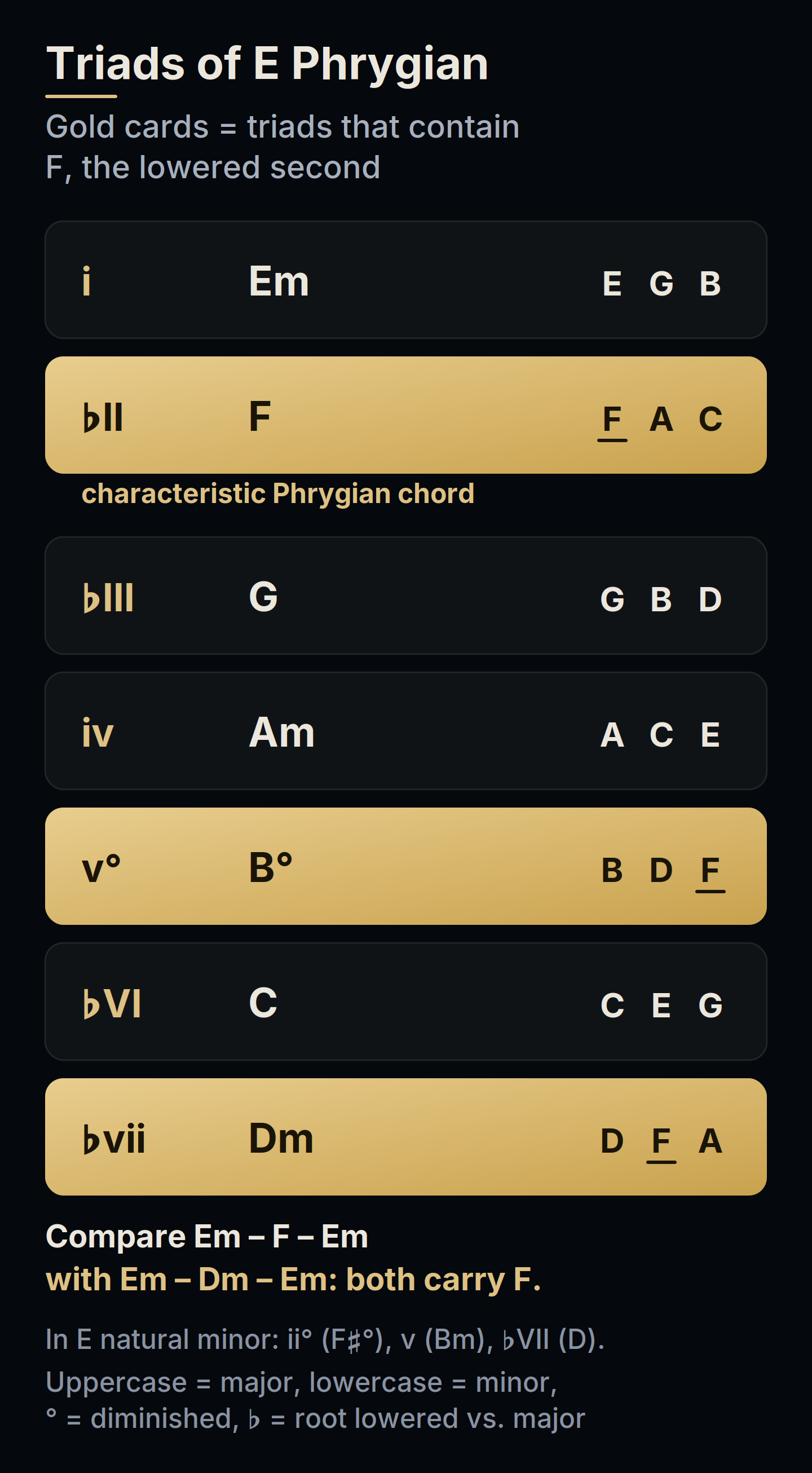
Build a triad on each degree of E Phrygian and you get:
As seventh chords: Em7, Fmaj7, G7, Am7, Bm7♭5, Cmaj7, Dm7. (Roman numerals follow the usual convention: uppercase for major, lowercase for minor, ° for diminished, and a flat before the numeral means the root is lowered compared to the major scale.)
Four of these triads are identical to E natural minor: i, ♭III, iv, and ♭VI. The other three contain the lowered second, F, and those are the ones that make the mode audible:
One thing to listen for with the ♭III: in Phrygian, its seventh chord is G7, a dominant seventh, and G7 moving to C is a V7–I in C major. Since E Phrygian shares its notes with C major, a passage that keeps landing on C, or on A minor, can start to sound like it's in one of those keys instead. Use ♭III and ♭VI freely, but keep the weight on E.
The Piano Composer Chapter 3 takes Phrygian to the keyboard: how to remember it as minor with a lowered second, why that ♭2 needs emphasis so the mode doesn't just sound like minor, which chords carry it, and a progression-and-scale exercise in C Phrygian with voice leading written out. Explore the course
A few progressions that show the mode clearly, all in E Phrygian. Hold E in the bass under the i chord to keep the tonal center clear.
In the first two examples, compare the Phrygian chord with its natural-minor counterpart (F with F♯°, Dm with D) to hear F change to F♯.
Knowing the notes is the easy part. Two things decide whether the music actually sounds Phrygian.
Establish the tonic. Because E Phrygian shares its notes with C major and A minor, it can easily be heard as one of those instead. If your bass and your phrases keep landing on C or A, the listener hears C major or A minor. Put the tonic in the bass, start and end phrases on it, and build your harmony around the i chord. A pedal tone is the bluntest way to do this, and in Phrygian it's especially effective, because the lowered second rubbing against a held tonic is exactly the tension the mode is known for. It's not the only way, though.
Let the color note be heard. If neither melody nor harmony uses the second degree, the passage may not distinguish Phrygian from natural minor. Aim melodic lines at the ♭2, let it fall to the tonic at phrase endings, and use the chords that contain it, especially the ♭II. The ♭2 often resolves down by a half step, but it doesn't have to: sustained over the tonic, it can simply hang there as a dissonance.
It also helps to know what the notes outside the mode do. F♯ leans the music toward natural minor. Adding D♯ alongside F♯ allows a major V chord, B, or a V7 chord, B7, and introduces the pull of a conventional minor-key cadence, which can overpower the Phrygian color. A single F♯ or D♯ doesn't necessarily mean a change of mode; it can be a local inflection, and many pieces move between Phrygian and minor freely. The more the music leans on those notes, though, the more the Phrygian color gives way to ordinary minor.
There's a second, complementary way Phrygian shows up: as a chord scale. In a major key, Phrygian is the scale conventionally paired with the iii chord. Over Em7 in C major, E Phrygian contains exactly the notes of the key.
In conventional chord-scale teaching, F and C are often treated as avoid notes when sustained over a functional Em7 chord: they lie a half step above E and B. A, the 11th, is the usual available extension. This describes one approach to voicing a iii7 chord, not a rule against emphasizing ♭2 in modal music. Still, it's worth noticing, as Pillars of Composition II points out, that the note giving Phrygian its identity is the one that rubs most over a iii chord.
When you want that rub as a deliberate sound, an E7sus4(♭9) voicing (E, A, B, D, F) makes the lowered ninth an intentional part of the harmony. The F–E tension remains; spacing and context determine its effect. Because the voicing omits the third, it can fit both E Phrygian and E Phrygian dominant.
The ♭II chord has its own chord scale, too. Over Fmaj7 in E Phrygian, the notes of the mode give F Lydian, so the ♭II can be extended as an Fmaj7♯11, with B, the tonic's fifth, as the ♯11. The Legend of Otoe describes the ♭IImaj7 this way, as a chord extended "in a Lydian way." (See our guide to the Lydian mode for that sound in detail.)
You don't need to write a whole piece in Phrygian to use it. One practical approach is to borrow the ♭II into an otherwise minor or major progression, a technique known as modal interchange.
In a minor key, the borrowed ♭II has a long history as the Neapolitan sixth: a first-inversion ♭II used as a predominant, often leading to V. In E minor, a typical example is F/A – B – Em. Pillars of Composition II also uses it as a pivot chord for modulation.
In a major key, the ♭II is more surprising. In The Legend of Otoe: Levels 2 & 3, a bright adventure theme in A major places a borrowed B♭maj7, the ♭IImaj7 from A Phrygian, at the melodic climax, so the most foreign chord arrives at the highest point of the tune. The B section then opens in A Phrygian (B♭maj7 to Am7), and because the climax chord has already introduced B♭, the new color sounds fresh but not unrelated. Piano Composer's modal-interchange exercise uses the same borrowing in a simple cadence: I – ♭II – V – I in C major.
One close relative is worth knowing by name. The Phrygian dominant scale keeps Phrygian's lowered second but raises the third:
1 – ♭2 – 3 – 4 – 5 – ♭6 – ♭7
In E, that's E, F, G♯, A, B, C, D. Technically it's not a mode of the major scale but the fifth mode of harmonic minor: E Phrygian dominant uses the notes of A harmonic minor. Its tonic chord is major, and its tonic seventh chord is a dominant seventh, E7, with the ♭2 and ♭6 available as ♭9 and ♭13. Over E7 resolving to A minor, E Phrygian dominant supplies the notes of A harmonic minor, including G♯, the leading tone of A.
The half step from the tonic to ♭2 and the augmented second from ♭2 to 3 give the scale its distinctive tension: E–F–G♯ in E Phrygian dominant. It's widely used in flamenco, where it's sometimes called the Spanish Phrygian or Spanish Gypsy scale, and in Jewish music, where it's known as Freygish or Ahava Rabbah. In film and game scoring it often stands in for the desert, the ancient world, or anything that should feel far away.
In 20th Century Orchestral Writing, a set of modal variations on one melody shows the difference in practice: the Phrygian version sounds dark and depressing, and changing a single note, G to G♯, turns it into Phrygian dominant, with a major tonic chord and a more exotic character.
Two familiar cadential gestures use a descending half step in the bass, but their harmonic functions differ.
The Andalusian cadence, Am – G – F – E, is a descending progression associated with flamenco. Heard from A, it's a minor-key progression ending on V. Heard from E, it's iv – ♭III – ♭II – I, which is why it's described as built upon the Phrygian mode, with F–E as the ♭2–1 step in the bass. The G major chord contains G natural, while the E major chord contains G♯. The progression therefore combines minor and major thirds above E; it is not drawn entirely from one fixed Phrygian dominant scale, and flamenco harmony in general isn't limited to a single scale.
A Phrygian half cadence is iv6 – V in a minor key: Am/C – B in E minor, for example. Its bass falls from C to B, or ♭6 to 5 relative to E. The name refers to the resemblance to the descending semitone of a Phrygian cadence; the progression ends on the dominant, not on a Phrygian tonic. It's a characteristic gesture of Baroque music, often closing a slow movement on an open chord.
Classical music. The slow movement of Brahms' Symphony No. 4 opens with two horns stating a theme in E Phrygian: the notes of C major, centered on E, heard at first without accompaniment. The Los Angeles Philharmonic's program notes link the movement's archaic quality to this use of the Phrygian mode. Ralph Vaughan Williams' Fantasia on a Theme by Thomas Tallis is built on a Phrygian tune, one of nine that Tallis wrote for Archbishop Parker's Psalter of 1567, set to Psalm 2.
Game music. Richard Anatone identifies "Omen," "Catastrophe," "Battle Theme," and "Phantom Train" from Nobuo Uematsu's Final Fantasy VI score as predominantly Phrygian. His analysis also distinguishes these from tracks that use expressive Neapolitan harmony without being classified as predominantly Phrygian. The opening cue, "Omen," is a clear place to start listening.
Flamenco and Spanish color. The Andalusian cadence and the Phrygian dominant sound described above are central to much flamenco music, and they're the main source of the Spanish associations Phrygian carries in film and concert music.
A useful way to see Phrygian in action is to take a familiar minor theme and change its mode. In Pillars of Composition, an existing water theme in A minor is recast in A Phrygian. The lowered second changes its familiar minor color into something darker and more unsettled, while the theme remains recognizable.
The example also shows that changing a mode affects how melody and harmony work together: a note that feels expressive in one phrase can feel awkward in another. The course develops those choices at the keyboard, judging them by ear rather than treating the scale as an automatic substitution rule. It also points out that you could just as easily start in Phrygian from the beginning; rewriting a known theme simply makes it easier to hear what the mode changes.
Pillars of Composition Module III introduces all seven modes, the chords each one produces, and how they set mood, then rewrites the course's element themes in new modes, including the water theme's move from A minor to A Phrygian. The module project is a piece for three instruments in a mode other than Ionian. Explore the course
To hear the relative, raise the third in step 1 as well. That's Phrygian dominant, and comparing the two side by side is a quick way to learn both.
Once Phrygian is in your ears, it becomes one of the most useful colors in the minor palette. For how it relates to the other six modes, and how to borrow a single ♭II into other keys, see our guides to modes in music and modal interchange.
Our Music Composition & Orchestration Courses
Our Music Production Courses
Our Music Trailer Courses
See All CoursesWhat is the Phrygian mode? The Phrygian mode is the third mode of the major scale: a natural minor scale with a lowered second degree. E Phrygian uses the white keys from E to E: E, F, G, A, B, C, D.
What is the Phrygian scale formula? 1 – ♭2 – ♭3 – 4 – 5 – ♭6 – ♭7. Compared to natural minor, it lowers the second by a half step and leaves everything else unchanged.
Is Phrygian major or minor? Minor. Its third is a minor third, so its tonic chord is minor. The lowered second gives it a darker character than natural minor, and among the commonly used modes it's usually considered the darkest.
What is the difference between Phrygian and natural minor? One note: the second. Natural minor has a major second above the tonic, Phrygian a minor second. That changes the chord on the second degree from diminished (ii°) to major (♭II), the characteristic Phrygian sound.
What are the chords in E Phrygian? Em, F, G, Am, B°, C, and Dm. The F major chord (♭II) carries the Phrygian color most directly because it contains the lowered second, F, as its root.
What does the Phrygian mode sound like? Phrygian often sounds dark, tense, and a little exotic because of the half step between the tonic and the second degree. The actual mood depends on tempo, rhythm, and instrumentation. In film and game music, it's often associated with danger and dark fantasy, and, together with Phrygian dominant, with a Spanish color.
What songs use the Phrygian mode? Frequently cited examples include the opening horn theme of the second movement of Brahms' Symphony No. 4, the Tallis tune behind Vaughan Williams' Fantasia on a Theme by Thomas Tallis, and cues from Nobuo Uematsu's Final Fantasy VI such as "Omen." Much flamenco music uses the related Phrygian dominant sound and the Andalusian cadence.
What is the difference between Phrygian and Phrygian dominant? The Phrygian dominant scale lowers the second like Phrygian but raises the third: 1 – ♭2 – 3 – 4 – 5 – ♭6 – ♭7. That turns the tonic chord from minor to major, and the scale is the fifth mode of harmonic minor rather than a mode of the major scale.
Learn with Master The Score
Courses on composition, orchestration, music production, trailer music and sound design, from composers writing for film, games and media. Students also get exclusive discounts on leading sample libraries and plugins.
Discover all courses →


Online education for media composers — orchestral writing, trailer music, mixing and more, taught by working professionals.