

Music Theory and Composition

Ryan Leach is an Award Winning Composer for film and tv. His music has been heard on Every major Network. His clients includes Disney, Mtv and Netflix.
Counterpoint is the art of writing two or more melodic lines that sound good together while each still sounds like its own line. The word comes from the Latin punctus contra punctum, "point against point," or note against note. When a bass line moves against a melody, or a horn answers the strings at the end of a phrase, you're hearing counterpoint.
It has a reputation for being dry and rule-bound, and the traditional exercises can feel far removed from writing a battle cue or a town theme. But the core ideas are simple, and they solve problems composers run into constantly: a clumsy bass line, an arrangement that sounds static, or a melody that needs support without getting buried.
This guide covers what counterpoint is, the principles behind it, the five "species" traditionally used to teach it, and how film, game, and media composers use it today.
In simple terms, counterpoint is several melodies sounding at the same time, written so that each makes sense on its own and all of them make sense together.
That creates a built-in tension. The lines have to belong together. In the tonal examples covered here, that means they share a key, agree on the implied harmony, and arrive at stable sounds at important moments. But they also have to stay independent, each with its own shape, rhythm, and direction. Too much agreement and the lines melt into one thick line. Too much independence and they sound like two pieces playing by accident.
The traditional rules are largely ways of managing two balances: unity against independence, and consonance against dissonance.
Harmony and counterpoint describe the same music from two directions. Harmony is the vertical view: which chord is sounding right now? Counterpoint is the horizontal view: where is each line going, and how do the lines move against each other?
In practice they depend on each other. Good counterpoint implies chords, and a good progression has voices that move well. What changes is where you focus. When you think contrapuntally, you pay attention to how the bass line and melody move against each other, not only to the name of the chord on beat three.
Most film and game music is mainly homophonic, melody plus accompaniment. Counterpoint shows up in the bass line, the inner voices, and the gaps of the melody.
Counterpoint starts with two questions. What interval do the two lines make at any moment? And how do they move from one interval to the next?
Traditional counterpoint sorts intervals into three groups:
Two points often surprise beginners. First, in two-voice counterpoint, the perfect fourth above the bass counts as a dissonance. Second, thirds and sixths do most of the work. Perfect intervals are so stable that the voices blend, while thirds and sixths keep the lines distinct and still sound consonant.
These categories are conventions of the style. In real music, how tense an interval sounds also depends on register, instrumentation, and context.
Whenever two lines move to their next notes, they move in one of four ways:
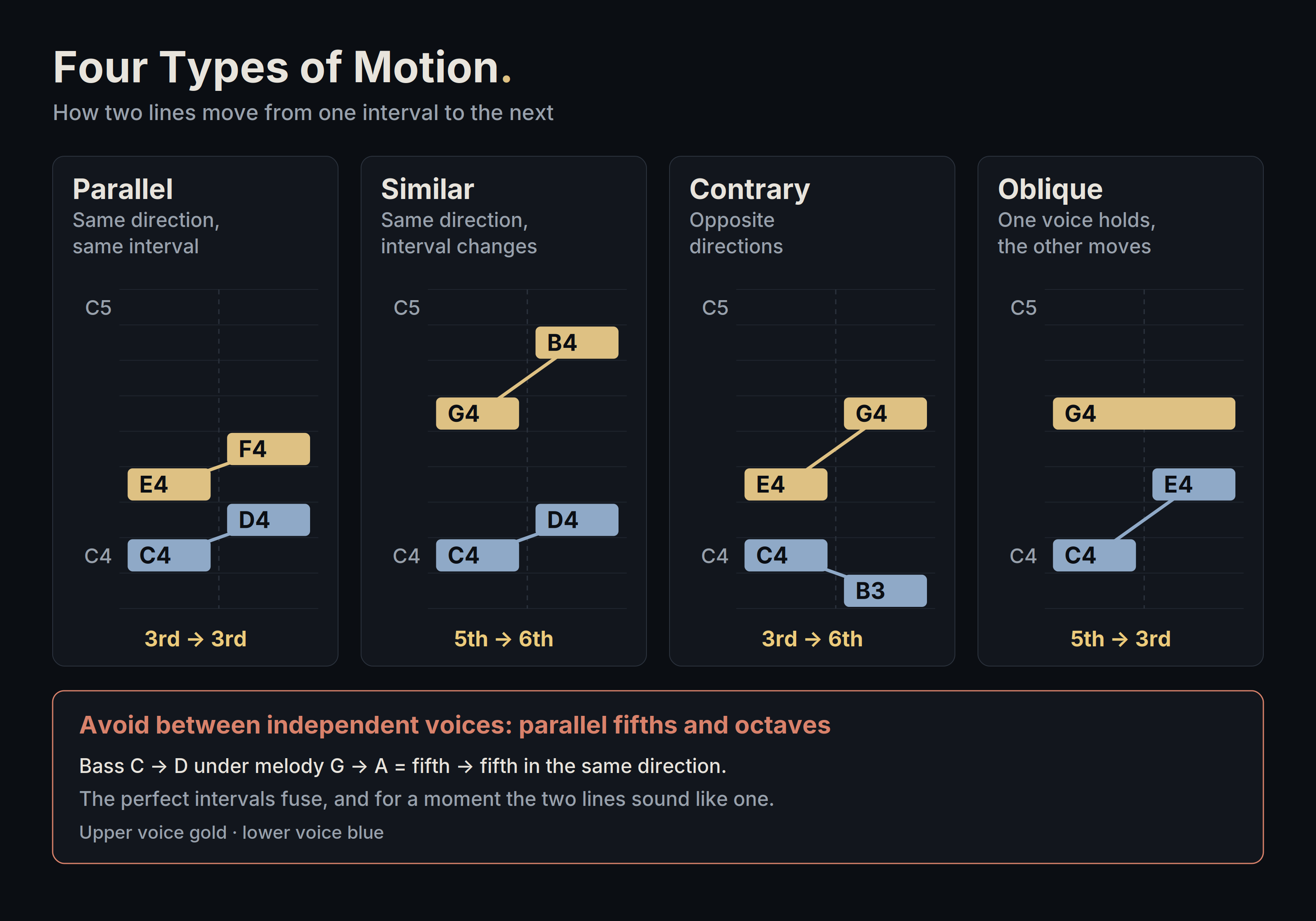
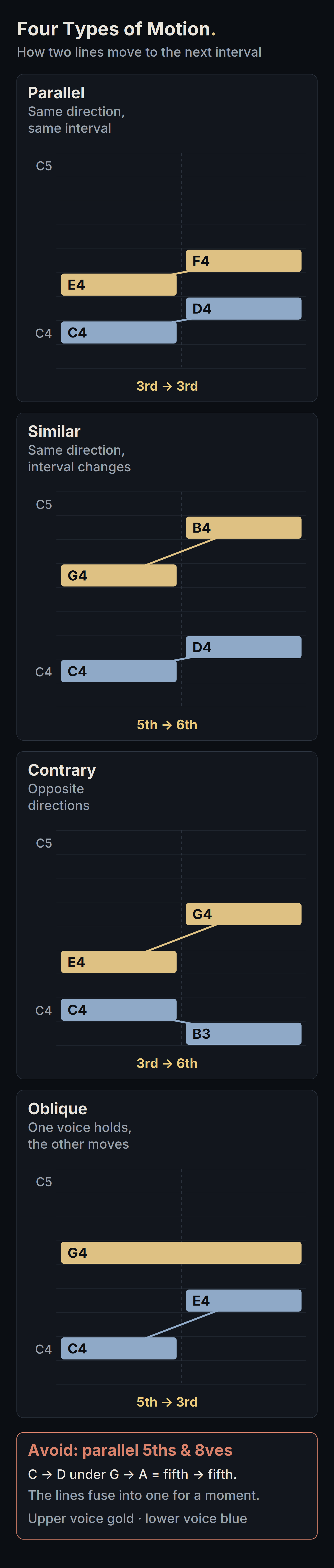
The goal is balance. Two voices that move mostly in parallel stop sounding independent. A good counterpoint mixes all four types, with contrary motion often carrying the structurally important moments.
This is one of the best-known rules in music theory, and it follows from the idea of independence. When two voices move in parallel fifths or octaves, the perfect intervals fuse so strongly that the lines briefly sound like one. For example, a bass moving from C to D under a melody moving from G to A makes a fifth followed by another fifth in the same direction.
In Pillars of Composition, Ryan compares it to listening in stereo when the sound collapses to mono for a single beat. You may not know what happened, but something feels off.
A related guideline concerns direct (or hidden) fifths and octaves, where both voices move in the same direction into a perfect interval. Traditional counterpoint restricts these too, especially when the upper voice leaps. Approaching fifths and octaves by contrary or oblique motion keeps the voices distinct.
The rule applies to lines that are supposed to be independent. Some textures use parallel motion on purpose:
Between those two poles is a gray zone. Many working composers are strict about the outer voices (melody and bass) and decide case by case about inner voices that mainly fill in chords. That decision depends on the style, the voicing, and how exposed the voices are, so it's not a blanket rule.
For centuries, counterpoint has been taught in stages called species. The system was set down by the Viennese composer and theorist Johann Joseph Fux in Gradus ad Parnassum (1725), a textbook written as a dialogue between a teacher and a student. Haydn, Mozart, and Beethoven all studied or taught from it, and its method is still widely used today.
Every exercise starts from a given melody in whole notes, the cantus firmus ("fixed song"). You write a new line above or below it. Each species changes the rhythmic relationship between your line and the cantus, and with it, which dissonances are allowed.
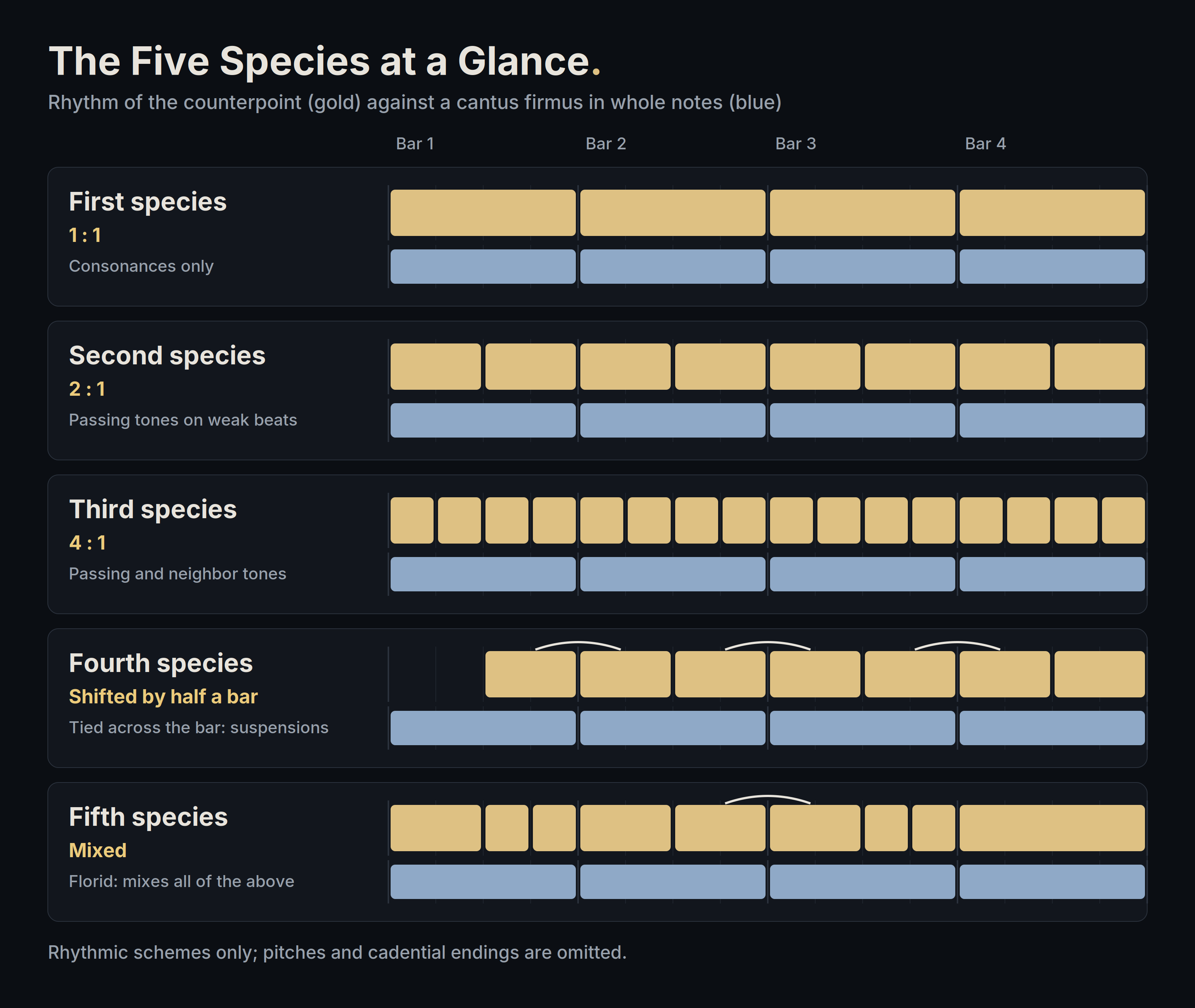
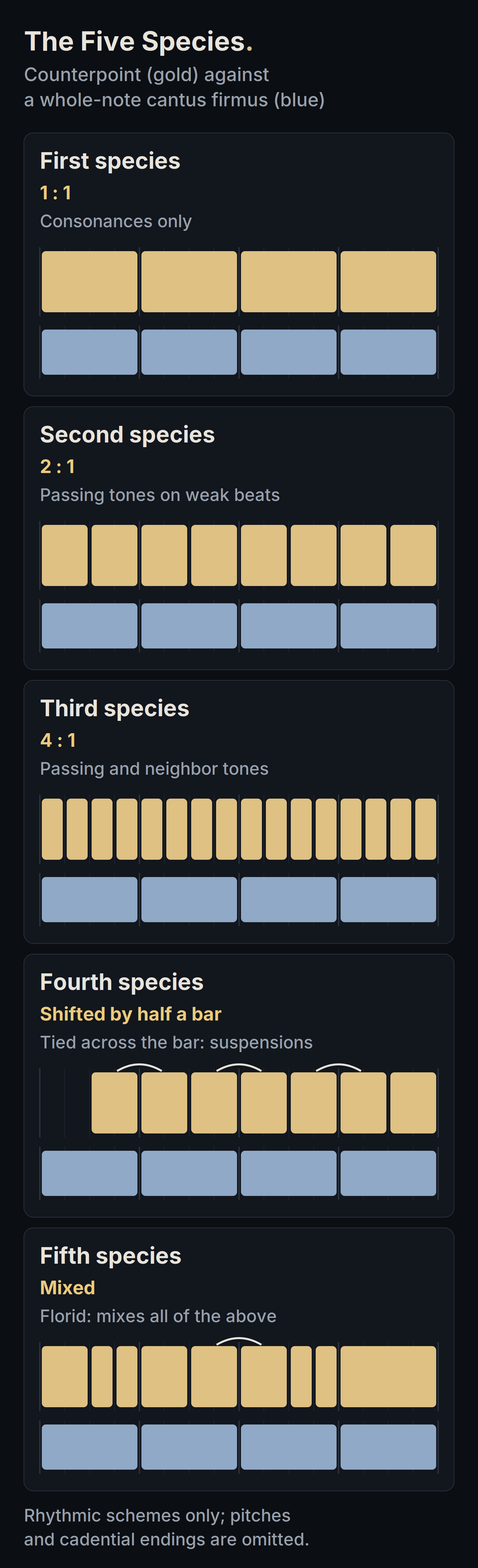
One note in your line for every note of the cantus, and every interval consonant. The exercise is about choosing between thirds, sixths, fifths, and octaves and controlling the motion between them.
In the strict two-voice model, the exercise begins on a perfect consonance (a unison or octave, or a fifth when the counterpoint is above the cantus) and ends on a unison or octave. Some modern teachers are freer. In Pillars of Composition, for example, Ryan accepts any note of the tonic chord at the start and end, including the third. First species sounds plain, but it builds the skeleton the later species decorate: the shape of the line, its high point, and a clear path to the ending.
Two notes against each cantus note. This is where dissonance enters, on the weak beat and mainly as a passing tone. When the line moves by a third, the note in between can fill the gap, as in E–F–G. The strong beats stay consonant, and the weak beats connect them.
Four notes (or three in triple meter) against each cantus note. Dissonances appear on weak beats as passing tones and neighbor tones (E–F–E or E–D–E). The line can also leap between consonant notes. These consonant skips outline the implied chord, using chord tones rather than dissonances.
The downbeats still carry the structure, so parallel fifths and octaves from downbeat to downbeat still count. In Pillars, Ryan also brings in freer figures such as escape tones, which step away and leap back in the other direction. That's his practical application in the course, not part of the strict species rules.
Your line moves in half notes against the whole-note cantus, shifted by half a bar and tied across the bar line. This produces the suspension, which unfolds in three stages:
For example, hold a C above an A in the bass (a consonant third). The bass moves down to G, and the C becomes a dissonant fourth above it. The C then steps down to B, a third above G. That's a 4–3 suspension.
In strict counterpoint, suspensions resolve down by step. A suspended note that resolves upward is usually called a retardation, and it's a long-established device, not a modern loosening of the rules. Fourth species also relates closely to syncopation, since both place emphasis against the beat.
The final species combines the note values and techniques of the earlier ones. It's called florid ("flowery") counterpoint. The principles still apply, and the added freedom goes into rhythmic variety, a clear climax, and a satisfying ending.
One practical way to approach it, and the approach Ryan uses in Pillars, is to start from a note-against-note skeleton and decorate it. The first-species version gets the structure right, and each later layer adds motion without breaking it.
Learn counterpoint the practical way. In Pillars of Composition, counterpoint runs through all four modules, from consonance, dissonance, and motion to all five species. Each stage connects to real writing: bass lines that work against your melody, counterlines as accompaniment, and suspensions that add tension. You then apply it in full projects, including an 8-bar piece, four piano themes, and a video game loop. Explore the course
Most film and game music isn't strict species counterpoint. As the instructor of 20th Century Orchestral Writing puts it, counterpoint in this style is usually a simplified version of the Baroque kind: filling gaps in the melody, adding answer phrases, and writing harmonies. Contrapuntal thinking still shows up in many places.
The most practical use of counterpoint is also the least visible: the relationship between melody and bass. They're the two outer voices, and the ear follows them most easily.
This is where chord inversions become useful. A C major chord doesn't need C in the bass. With E or G in the bass, you can move the bass in contrary motion to the melody, avoid parallel octaves between the outer voices, or hold a pedal note under changing harmony. Our piano chords guide covers inversions in detail.
A simple check is to play only the melody and the bass line. If those two work together, the rest of the arrangement has a solid frame.
A very common contrapuntal device in media music is the countermelody placed in the gaps of the main melody. Melodies breathe: they hold a long note at the end of a phrase, or they pause. A short answering line in that space keeps the music moving without competing with the melody.
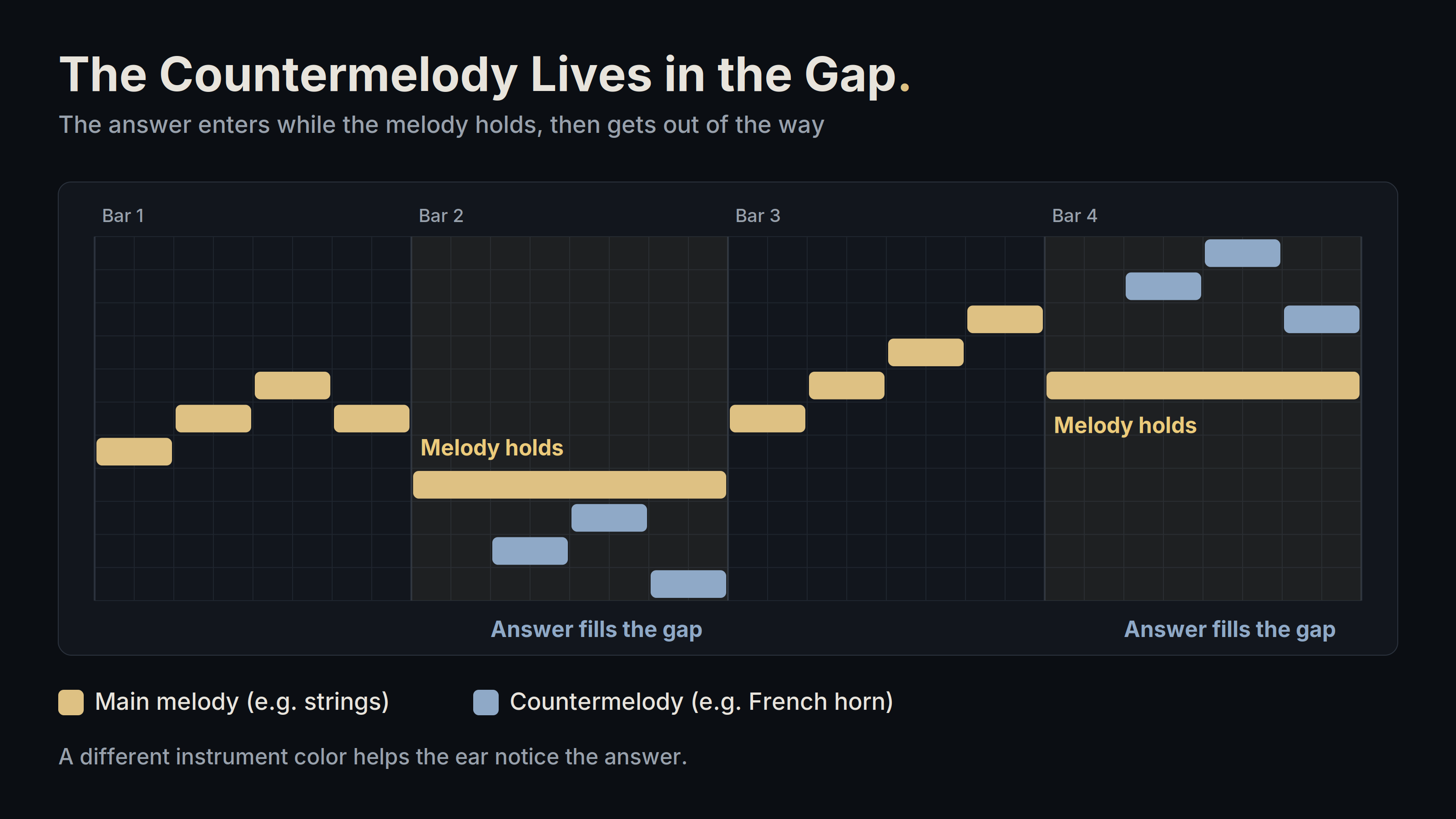
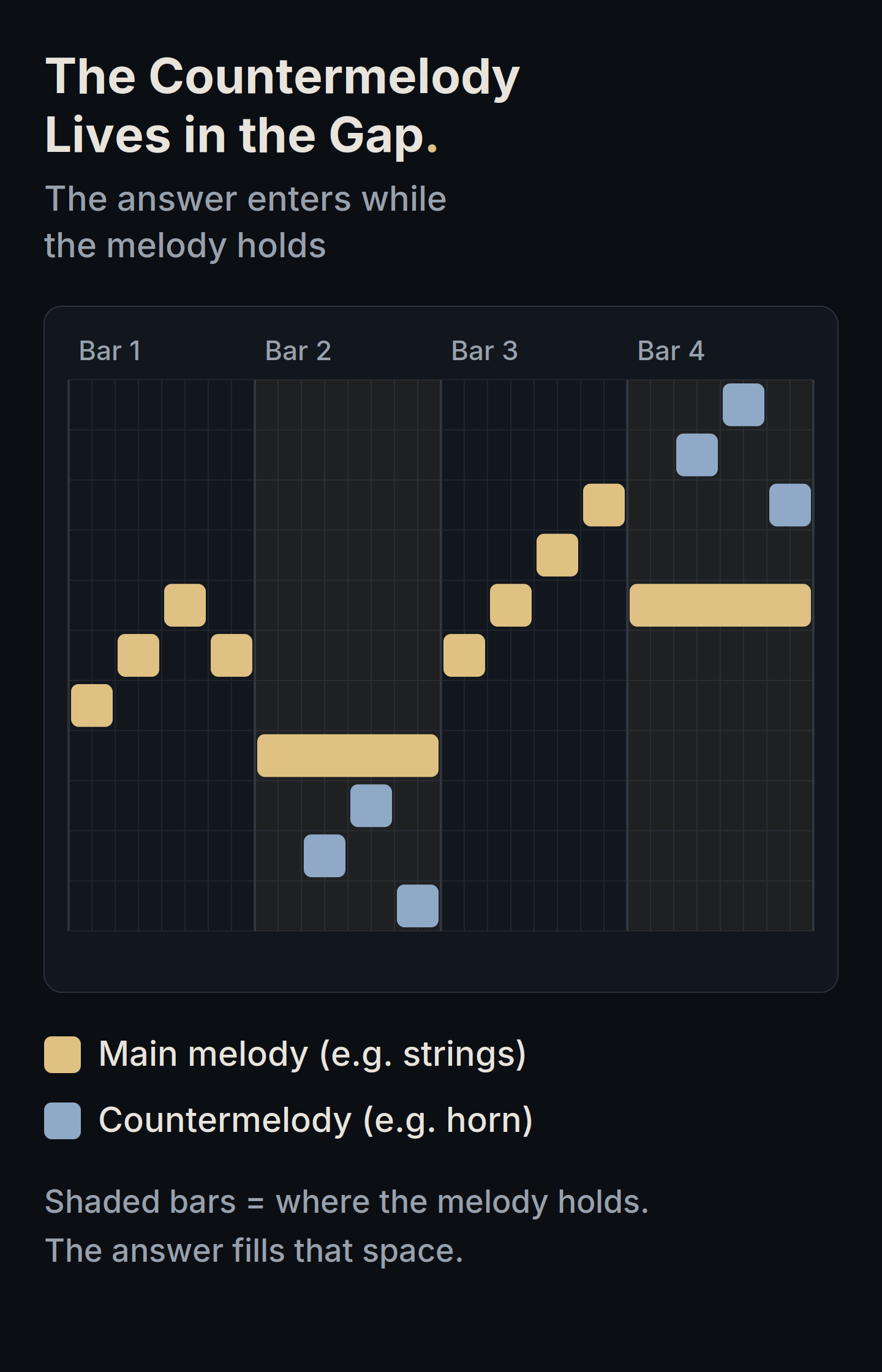
It works because it speaks while the melody sustains a note or pauses, and because it adds a new layer each time a theme returns. Giving the answer to a different color than the melody, such as a French horn answering the strings, helps the ear notice it.
Compare two accompaniments under the same melody. One uses block chords with sustained pads. The other gives the lower parts their own lines, moving through chord tones and connecting them with passing notes. The first can sound static, while the second has inner motion.
In Pillars, Ryan shows how far this goes: a melody, a bass line, and one counterline moving through chord tones in the middle can be enough for a full orchestral texture. A counterline used as accompaniment doesn't have to be a strong melody on its own. It supports the melody by filling harmonic space and staying out of the melody's register and rhythm.
A second voice that follows the melody mostly in thirds and sixths isn't counterpoint in the strict sense, because the lines aren't independent. It's a close relative, though, and one of the most common ways to make a melody warmer and fuller. Stack several such lines and you get a dense, lush sound.
The boldest option is a new melody played against the main theme. Two melodies compete for attention, so this tends to work better once the audience already knows the main theme, in a later statement or a climax, than in the opening bars.
In imitation, one voice states an idea and another voice picks it up a moment later. It's the principle behind the canon (a round like "Row, Row, Row Your Boat," or Pachelbel's Canon) and the fugue, which J.S. Bach explored in works like The Well-Tempered Clavier and The Art of Fugue.
Film scores use fugal writing too. John Williams' score for Jaws (1975) includes a driving "action fugue" for the shark hunt on the Orca, and it returns as the crew builds the shark cage. Intrada's 50th-anniversary edition lists that cue as "Work Montage (The Shark Cage Fugue)". In the cue breakdown of 20th Century Orchestral Writing, the instructor builds a fugue-like passage by passing a single melodic cell between voices and displacing it across octaves.
A sustained drone or pedal note under moving parts is a large-scale example of oblique motion: one element holds while the others move. A drone isn't a second independent melody, but the contrast between stillness and motion is contrapuntal thinking, and it's common in intros, outros, and breakdowns of hybrid and horror tracks.
Hear counterpoint in a real orchestral cue. 20th Century Orchestral Writing has a dedicated counterpoint lesson that compares four options side by side: contrapuntal string accompaniment, answer phrases in the gaps of the melody, harmonizing lines, and a second melody on top. The course then breaks down a complex cue bar by bar, including its counterlines and a fugue-like section, from piano sketch to full orchestration. Explore the course
A short modal tune or the opening phrase of a sentence-form theme makes a good practice melody.
Our Music Composition & Orchestration Courses
Our Music Production Courses
Our Music Trailer Courses
See All CoursesWhat is counterpoint in simple terms? Counterpoint is writing two or more melodies that sound at the same time, where each line keeps its own identity and the lines sound good together. A melody with a well-shaped bass line is already a simple form of counterpoint.
What's the difference between counterpoint and harmony? Harmony looks at music vertically: which notes sound together at a given moment. Counterpoint looks at it horizontally: how each line moves over time and against the others. In real music they depend on each other.
What is a countermelody? A countermelody (or counterline) is a secondary melody played against a main melody. In film and game music, it often sits in the pauses or held notes of the main theme so it adds interest without competing.
Why are parallel fifths avoided in counterpoint? When two independent voices move in parallel fifths or octaves, the perfect intervals blend so strongly that the voices briefly sound like one line. Parallel fifths used deliberately as a texture, rather than between independent lines, are a different technique.
What are the five species of counterpoint? First species is note against note. Second species is two notes against one. Third species is four (or three) notes against one. Fourth species uses syncopation and suspensions. Fifth species, florid counterpoint, combines them. The system was codified by Johann Joseph Fux in Gradus ad Parnassum (1725).
What is a cantus firmus? The cantus firmus ("fixed song") is the given melody, usually in whole notes, that you write a counterpoint against in species exercises.
Do film composers still use counterpoint? Yes, though rarely in strict textbook form. It shows up in bass lines written against the melody, countermelodies in the gaps of a theme, contrapuntal accompaniment, suspensions, and fugal passages such as the action fugue in John Williams' Jaws.
Do I need to learn counterpoint to compose? You can compose without formal counterpoint training, but the basics help with bass lines, voicings, accompaniment parts, and arrangements, because they train you to hear every part as a line.
Learn with Master The Score
Courses on composition, orchestration, music production, trailer music and sound design, from composers writing for film, games and media. Students also get exclusive discounts on leading sample libraries and plugins.
Discover all courses →

Online education for media composers — orchestral writing, trailer music, mixing and more, taught by working professionals.


